
Leave no baton. Leave only wisdom.
The Weight We Carry are just Data and no Wisdom.
The interview began the way they always do.
“Tell me about yourself.”
For the next thirty minutes I became an archivist of my own life. I restored twenty five years of history—education, first job, promotions, projects, failures, successes, technologies once revolutionary and now obsolete. It felt less like introducing myself and more like recovering a backup from cold storage.
Then the conversation shifted. We spoke about AI, memory, knowledge, the future. And somewhere in that exchange I recognized a pattern that has defined every technological leap of the last century.
The calculator reduced arithmetic.
The computer reduced computation.
The internet reduced information scarcity.
AI reduces cognitive effort.
Each tool has closed a gap in human capacity. None has replaced the capacity that longs to create. None has replaced judgment, values, or purpose. AI is not competing with natural intelligence. It should be freeing it. Let the machine handle the mundane so that humans can do the meaningful.
As an engineer, I couldn’t help thinking about software. Systems rarely fail because they are busy. They fail because they carry too much. Log files grow without limit. Caches become polluted. Pointers keep referencing objects that no longer exist. Garbage collection falls behind. Memory leaks appear. Eventually the system slows under the weight of its own past.
What if humans suffer from the same bug?
Old arguments. Old failures. Old identities. Old fears. Old comparisons. Old victories. A lifetime of emotional log files. Storage became cheap. Clouds became infinite. Now we save everything—photos we will never revisit, documents we will never open, messages we will never search. The digital world taught us how to store. It forgot to teach us what deserves to be stored.
Data is not knowledge.
Knowledge is not wisdom.
Wisdom is compressed experience.
Perhaps life needs an archive strategy: three years of active history, one year of active planning. Everything else becomes an archive. Not denied. Not deleted. Simply moved out of working memory.
The interviewer smiled and asked the next inevitable question.
“Where do you see yourself in five years?”
I almost laughed. For the previous hour we had been discussing uncertainty, the speed of technological change, the limits of prediction. And now I was expected to forecast the most complex system of all: myself.
I answered differently.
“I don’t know my title five years from now. But I know my direction. I know the principles I will not compromise. I know the problems I want to solve. Direction matters more than prediction.”
Society still frames life as a race. Run faster. Earn more. Own more. Become more. Compare more. But compare with whom? There will always be someone ahead and someone behind. Comparison has no finish line.
An older view suggests something quieter. There is no competition. Every life has its own path, its own unfinished work, its own particular weight. The real question is not “Who is ahead?” It is “Who am I?” When that question is answered with any clarity, comparison loses its grip. Envy loses its fuel. Success stops being a matter of outperforming others and becomes a matter of becoming fully oneself.
I have begun to think of karma less as cosmic scorekeeping and more as a relay. Each life receives a baton—not of medals, but of unresolved attachments, unlearned lessons, unfulfilled duties. We carry it. We run. We pass it on. Unless one lifetime finally understands that the goal was never to outrun the other runners. The goal was to finish with empty hands. No baton left to pass. No unfinished business. No return ticket.
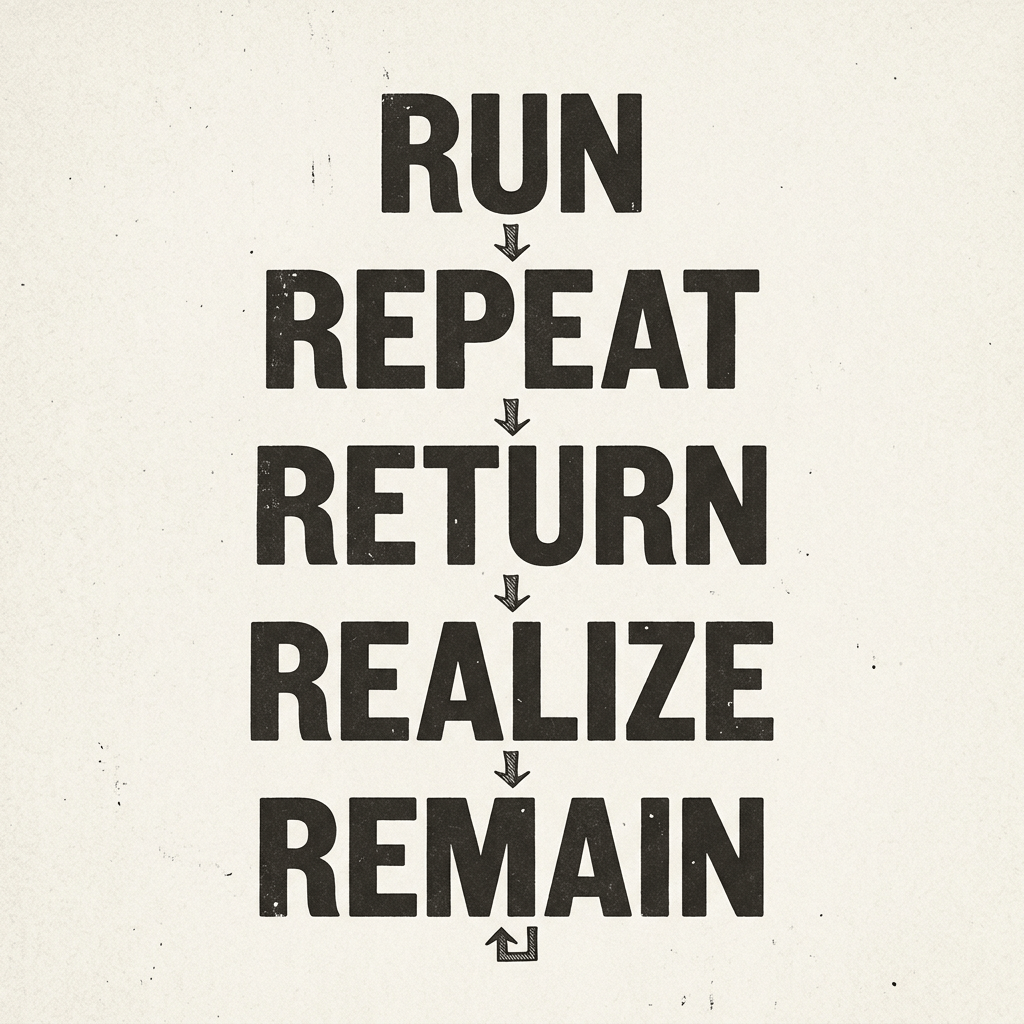
Run. Repeat. Return.
Until there is nothing left to return for.
We archive too much. We plan too far. We compare too often. We accumulate without limit. Death asks only one question of us: What truly deserves your limited time? Suddenly titles grow smaller. Possessions grow lighter. Arguments grow quieter. Purpose grows clearer. Death is not life’s enemy. It is life’s most effective prioritizer. It reminds us that our scarcest resource has never been intelligence. It is time.
That is why AI does not frighten me. It can process more data than any human, retrieve more information, generate more content. Yet it cannot answer the oldest human question: Who am I? Only natural intelligence can ask it. Only the slower, older intelligence of reflection can illuminate it.
The future is not AI versus humans. The future is AI freeing natural intelligence from the mundane so that humans can pursue the meaningful. The world does not need more information. It needs more wisdom. It does not need more storage. It needs better distillation. It does not need more competition. It needs more realization.
Perhaps that is the quiet purpose of a life: not to accumulate memories, but to distill them into wisdom; not to outrun others, but to understand oneself; not to win the race, but to complete the lap so thoroughly that there is no baton left to carry.
Run.
Repeat.
Return.
Realize.
And finally—remain.
 Arambhin
Leave a comment