
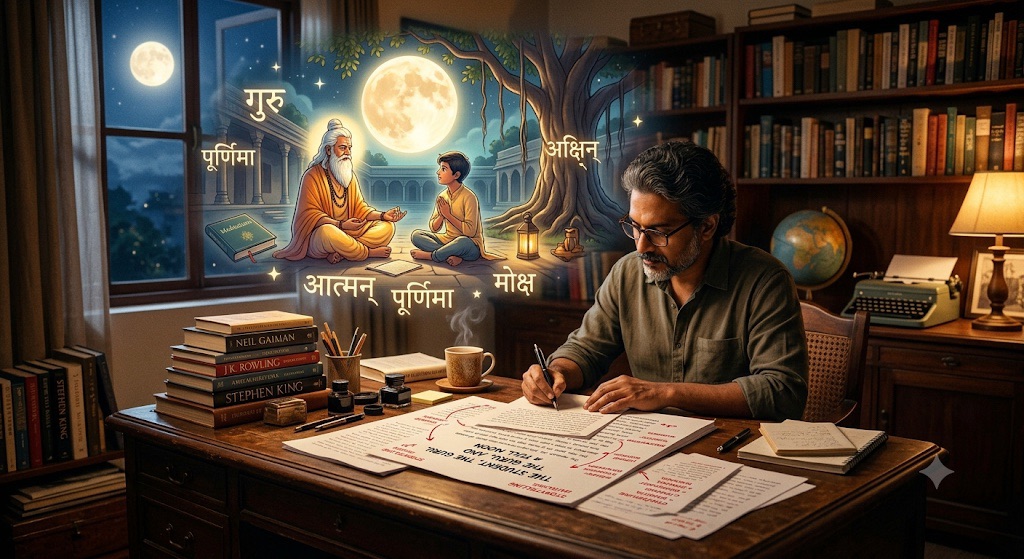
The silver light of the Guru Purnima moon spilled across the courtyard, painting the ancient stones in shades of ivory and ash. The Student sat cross-legged beneath the sprawling canopy of a banyan tree, a worn copy of Marcus Aurelius’s Meditations resting on his lap.
He looked up at the old man sitting opposite him. The Guru’s stillness rivaled that of the tree, his eyes reflecting the vast, unbroken night.
“Every civilization has asked the same enduring questions,” the Student said, his voice a soft murmur against the quiet hum of the crickets. “Who am I? Why am I here? What should I do with the little time I have?”
The Guru smiled gently. “The answers differ in language, culture, and symbolism. Yet every genuine tradition seeks to illuminate the human condition. What has your Roman emperor taught you tonight?”
The Student looked down at the text. “He leaves behind a remarkable reminder: Matter: How tiny your share of it. Time: How brief and fleeting your allotment of it. Fate: How small a role you play in it.”
The Student closed the book, tracing its cover. “Three simple observations. We own almost nothing of this vast universe. Our time here is but a blink in cosmic history. The world revolved for billions of years before we arrived and will continue long after we leave.”
“A heavy thought for a young mind,” the Guru noted. “Does it bring you despair?”
“No,” the Student replied, eyes brightening. “His message is neither pessimism nor resignation. It is liberation from ego. It tells me to stop believing the universe revolves around me. To perform my duty with integrity. To accept what cannot be changed, and live virtuously.”
The Guru nodded slowly, acknowledging the truth in the words. “For nearly two thousand years, those words have inspired men to find peace amidst uncertainty. It is a noble path. Yet, thousands of years before Aurelius penned his reflections, the sages of Sanatana Dharma had already ventured one question deeper.”
The Student leaned forward, the moonlight catching the curiosity in his eyes. “They did not stop at asking how to live within fate?”
“No,” the Guru said softly. “They asked: Who is it that experiences fate?”
The silence that followed felt heavier, charged with the weight of the inquiry.
“That single inquiry changes the entire conversation,” the Guru continued. “The Upanishads, the Bhagavad Gita, the Yoga Vasistha… they all point toward an extraordinary insight. Matter belongs to the changing world. Time belongs to creation. Karma belongs to the individual who believes, ‘I am the doer.’ But the true Self, the Ātman, is untouched by all three.”
The Guru picked up a dried leaf that had fallen onto the stone, holding it up to the moonlight. “If the Self was never born, who truly dies? If awareness itself is eternal, what exactly is reborn?”
The Student watched the leaf. “The wheel,” he whispered.
“Yes. The wheel turns. Actions create karma. Karma generates desires. Desires lead to further action. Action produces more karma. Birth follows birth. Death follows death. Not as a punishment, but as a consequence.” The Guru let the leaf fall. “The goal of life was never merely to accumulate comfort, status, or even virtue. It was to understand reality so completely that the cycle itself comes to rest. This is Moksha.”
“Freedom,” the Student said.
“Not an escape from a difficult life, nor a rejection of the world,” the Guru corrected gently. “But freedom from mistaken identity. An end to compulsory rebirth because the illusion of separateness has dissolved.”
The Student looked back at his book. “Then… was Aurelius wrong?”
“Seen this way, Stoicism and Vedanta are not opponents. They are fellow travelers walking different stretches of the same mountain. Stoicism teaches us how to remain calm while sailing through life’s storms. Vedanta asks whether we have mistaken the ocean for our home.”
The poetry of the thought hung in the air.
“Stoicism teaches acceptance of fate; Vedanta invites transcendence of fate,” the Guru said, his voice dropping to a resonant whisper. “Stoicism refines the character. Vedanta reveals the Self. One perfects the actor. The other reveals the witness watching the entire play.”
The Student looked at the old man, suddenly understanding the profound weight of the night they were celebrating. Information could be found in the book on his lap. Skills could be learned from experience. But this—the removal of the veil—required something else.
Gu means darkness. Ru means the remover.
A Guru does not give you something new; a Guru helps you discover what was always present.
The Student bowed his head, placing his hands together. “Marcus Aurelius reminded us that our share of matter is small, our time is brief, and our role in fate is limited,” the Student said quietly.
“And the Gurus of Sanatana Dharma,” the old man replied with a gentle smile, “ask one question further: Who is the one measuring matter, counting time, and experiencing fate?”
Perhaps the journey of philosophy ended there, the Student thought as he closed his eyes against the silver light. And the journey of wisdom began.
गुरुर्ब्रह्मा गुरुर्विष्णुः गुरुर्देवो महेश्वरः ।
गुरुः साक्षात् परं ब्रह्म तस्मै श्रीगुरवे नमः ॥
With reverence and gratitude, my humble pranams to all Gurus, whose wisdom continues to guide humanity from ignorance to knowledge, from darkness to light, and from the transient to the eternal. Happy Guru Purnima.
 Arambhin
Leave a comment