
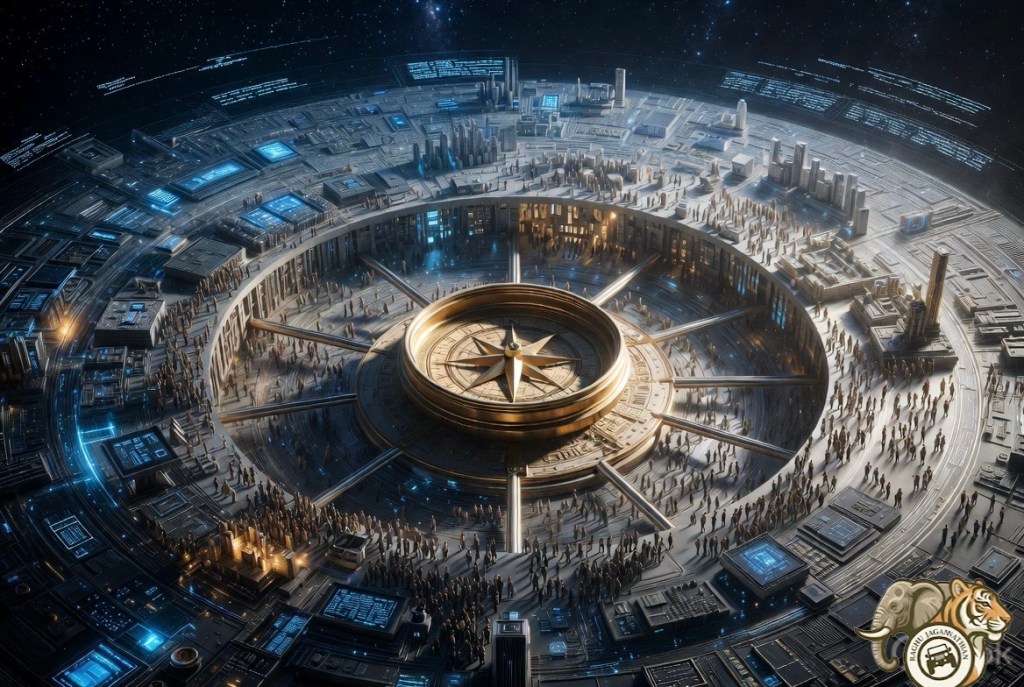
We live in an age that worships change. Every year brings a faster processor, a smarter algorithm, a shorter attention span, and yet another hollow promise that technology will finally cure the human condition.
Yet if history has taught us anything, it is this: the world revolves. Human nature repeats. Dharma endures.
The Mahabharata is not merely an ancient epic. It is humanity’s operating manual. Its battlefield is not confined to the dust of Kurukshetra. It is waged in every family, every institution, every society, and every human mind. The tragedy did not begin with the greed of Duryodhana. It began earlier, in the shadows of compromise—when wisdom retreated into silence, when rigid vows were held higher than living justice, when blind loyalty replaced sharp discernment, and attachment overpowered duty.
Bhishma was noble. Drona was learned. Vidura was wise. Dhritarashtra loved his family. Their strengths were real. And those same strengths were turned against them. Bhishma’s inviolable vow and martial invincibility became the chains that prevented him from stopping the catastrophe. Drona’s mastery and sense of obligation bound him to a throne that no longer deserved his service. Dhritarashtra’s paternal love, left unexamined, hardened into blindness. Knowledge without timely action cannot protect dharma. Strength without the freedom to re-orient that strength becomes a liability.
The greatest threat to any civilisation is not merely the presence of wrongdoers. It is the paralysing silence of those who know better—and the quiet capture of their virtues.
That silence echoes louder today. We raise a generation in a world overflowing with information yet starving for wisdom. They inherit sophisticated technology and fragile institutions. They receive education but little guidance on the architecture of character. We ask them to compete, consume, compare, and conform. Rarely are they taught how to discern.
Modern society often mistakes age for wisdom. Time alone does not produce insight; it merely produces older memories. True wisdom requires humility and the courage to question one’s own assumptions—including the assumptions that once made us strong.
The Mahabharata repeatedly reminds us that dharma is dynamic. Nothing in life is permanent. Kingdoms change. Relationships change. Power changes. Goals change. Even the noblest vows must be broken when they begin protecting adharma instead of dharma. Krishna never asks Arjuna to worship blind tradition. He asks him to uphold righteousness. His methods evolve with the circumstances, but his compass never changes.
Perhaps that is the deepest lesson of the Gita: do not become attached to yesterday’s methods. Become devoted to timeless principles. And among those principles, one stands quietly at the centre.
Endurance is dharma.
Not the endurance of the stubborn, who cling to a position long after it has ceased to serve truth. Not the endurance of the exhausted, who simply refuse to fall. But the endurance that remains answerable to discernment—the capacity to stay the course when the course is right, and the equal capacity to change course when the course has become wrong. Strength that cannot be redirected is no longer strength. It is captivity.
This distinction has never been more urgent. Science expands our understanding of the physical universe. It tells us how stars are born, how atoms behave, how neurons fire. But science cannot answer every human question. It tells us what is. It cannot, by itself, tell us what ought to be. It can split the atom, but it cannot decide whether that atom should power a city or level it. It can build artificial intelligence, but it cannot determine what kind of intelligence truly serves the human spirit.
That is where philosophy and dharma begin. Science seeks evidence; dharma seeks righteousness. Science explains mechanisms; dharma examines meaning. The two are not enemies—they simply answer different questions.
Technology, too, has its boundaries. Every machine depends upon external energy. Unplug the servers and our digital civilisation falls silent. Human beings also require energy, but life is more than metabolism. Between energy and action lies something no machine possesses: sankalpa—the capacity to choose purpose.
Electricity powers a computer. Sankalpa directs a civilisation.
Knowledge has never survived on the back of technology alone. Palm leaves decayed. Grand libraries burned. Empires collapsed into dust. Yet the Vedas, the Upanishads, the Gita, and countless traditions survived because one conscious mind awakened another. Technology stores information. The human mind transforms information into knowledge. The human heart transforms knowledge into wisdom. And wisdom, if it is to last, must be able to endure.
Life itself follows the same pattern. We often imagine birth as a blank slate. The Dharmic vision suggests something deeper: life is not a hundred-metre sprint. It is a relay race. Each generation receives a baton. Some inherit prosperity; others inherit conflict. Some inherit wisdom; others inherit unresolved mistakes. We do not choose where we begin on the track. We only choose how faithfully we carry what has been entrusted to us—and whether we leave the baton in better condition than we received it.
Comparison, therefore, becomes meaningless. The ego compares positions. Dharma compares responsibilities.
Modern civilisation craves certainty. It wants every human question reduced to a neat equation. But human life refuses such simplicity. Mathematics seeks equality. Science seeks consistency. Dharma seeks balance.
The Mahabharata does not offer equations. It presents dilemmas. It teaches that every decision carries consequences, and that every virtue can mutate into a vice when detached from its context. That is why Krishna teaches discernment, not formulas.
The world will continue to revolve. Technology will continue to evolve. Scientific theories will be rewritten, political systems will rise and fall, and economic models will come and go. Yet one thing remains astonishingly constant: truth, justice, compassion, integrity, responsibility—and the quiet endurance required to uphold them when they are inconvenient.
Their expression may evolve. Their essence does not.
The wheel turns endlessly. Its hub remains still. That still centre is dharma.
Every civilisation survives only as long as it remembers the difference between changing methods and permanent principles. Do not cling to the past. Do not blindly worship the new. Do not mistake mere movement for progress. And do not allow your strengths to be turned into the very instruments of your defeat.
Stand firmly in dharma. Endure what must be endured. Release what must be released. Then let everything else evolve.
Civilisations do not decline because they change. They decline when they lose the timeless principles that should guide that change—and when the virtues that once sustained them become the chains that bind them.
 Arambhin
Leave a comment