
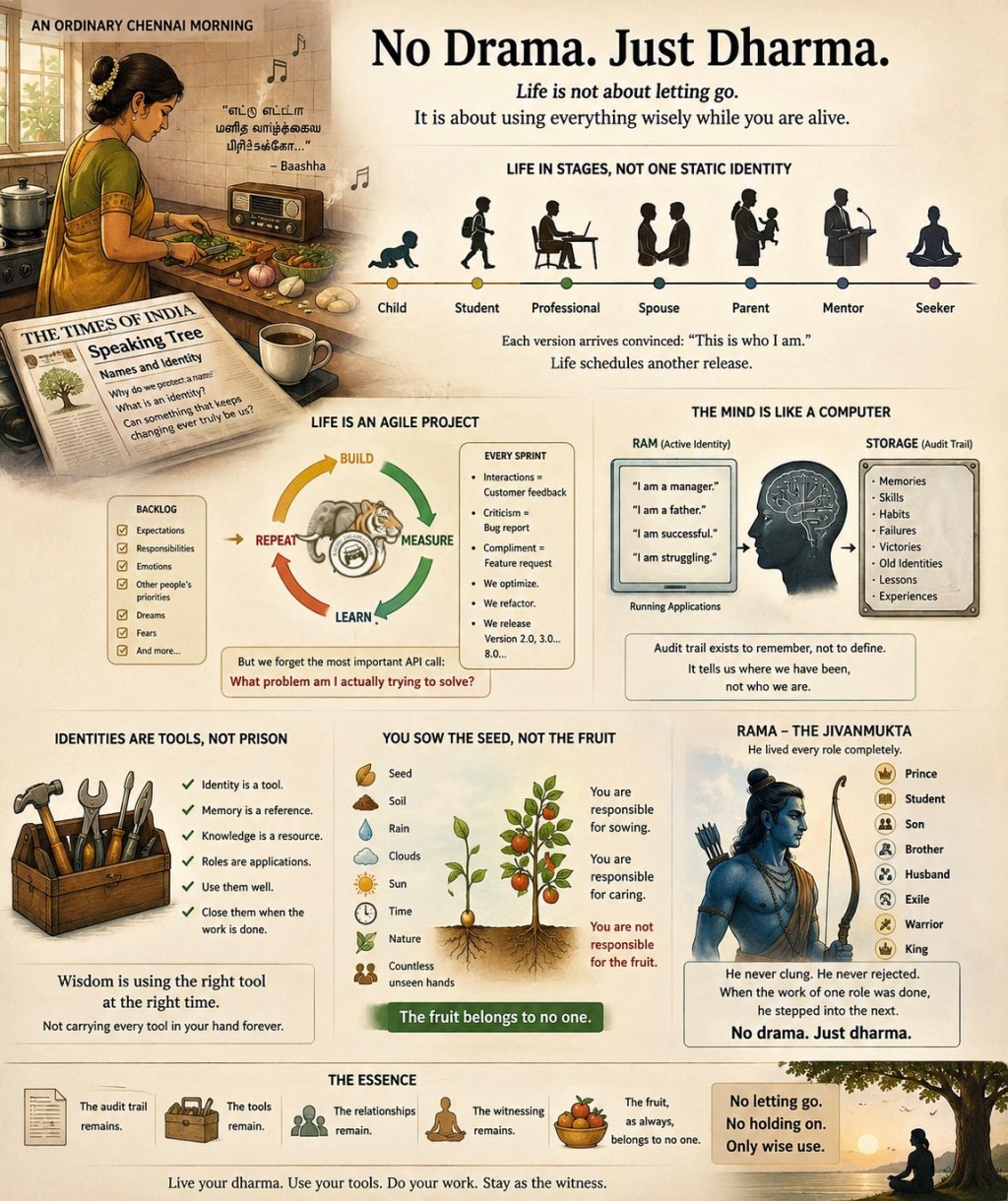
It was one of those ordinary Chennai mornings that never announce themselves as memorable.
My wife had already been in the kitchen for nearly an hour. There was no cooking yet, just the quiet rhythm of preparation. Beans were trimmed with patient precision. Drumsticks cut into neat lengths. Curry leaves separated from their stems, leaving a faint, peppery green scent in the humid air. Onions peeled, tomatoes chopped. The sink slowly filled with vegetable peels that had faithfully served their purpose, while the pressure cooker waited silently on the stove for its turn.
From the FM radio drifted an old Rajinikanth song from Baashha.
“எட்டு எட்டா மனித வாழ்க்கையை பிரிச்சுக்கோ…”
The familiar rhythm floated through the house, an upbeat soundtrack to the knife’s steady, percussive conversation with the cutting board. I sat nearby with the morning edition of The Times of India. As was my habit, I turned first to the Speaking Tree column before braving the headlines.
The article explored the idea of names and identity. Why do we spend so much of life protecting a name? What exactly is an identity? Can something that keeps changing ever truly be us?
Outside my newspaper, breakfast was being prepared. Inside my head, another recipe was beginning to take shape. The kitchen and the newspaper were asking the exact same question, only in different languages.
Soon, the vegetables would lose their individual forms to become a single, nourishing meal. The onion would never argue that it deserved more credit than the tomato. The curry leaves would quietly disappear into the background after lending their fragrance. Every ingredient would play its role without demanding ownership of the finished dish.
And Rajini’s voice kept repeating, “எட்டு எட்டா மனித வாழ்க்கையை பிரிச்சுக்கோ…”
Divide life into stages. That line anchored itself in my mind. Perhaps every stage of life is simply another version of ourselves. Each version arrives wholly convinced: “This is who I am.”
Then life schedules another release. We call it growth. The world calls it success. Psychology calls it identity formation. Software engineers call it iteration. And Vedanta smiles quietly from the corner, asking, “Who is watching all these versions come and go?”
As the hiss of the pressure cooker finally broke the morning quiet, another thought arrived. Perhaps we are all just busy building an MVP—a Minimum Viable Person. Every sprint changes the output. Every interaction becomes customer feedback. Every criticism is logged as a bug report, and every compliment as a feature request. Our backlog keeps growing. We optimize. We refactor. We release Version 2.0, then 3.0, then 8.0.
But somewhere along the way, we forget to make the most important API call: What problem am I actually trying to solve?
Perhaps that is why our long to-do lists feel so unbearably heavy. The mind cannot distinguish between what is urgent, what is important, what is emotional, what belongs to someone else, and what truly deserves our attention. Everything appears equally loud. Without urgency, years disappear like days. With panic, days stretch out like years. Neither leads to clarity. Only purpose does.
I folded the newspaper, letting the metaphors blend. The mind is so much like a computer. The identities running today occupy the RAM. “I am a manager.” “I am a father.” “I am successful.” “I am struggling.” Meanwhile, the hard disk quietly preserves everything else. Memories. Skills. Habits. Failures. Victories. Old identities.
They exist not as chains, but as an audit trail. An enterprise system never deletes its audit logs; they exist to remember, not to define. The audit trail tells us where we have been, but it does not dictate who we are.
Then perhaps liberation is not about deleting the past. Nor is it clinging to it. It is certainly not about manufacturing a brand-new identity called “the liberated person.” It is simply knowing that identities are tools. Memories are references. Knowledge is a resource. Roles are applications.
Use them well. Close them when the work is done.
There is no need to “let go.” Nothing valuable needs to be thrown away. The surgeon keeps every instrument. The musician remembers every note. The engineer preserves every design document. Wisdom lies in using the right tool at the right time—not in carrying every tool in your hand forever.
People often say proudly, “I sowed the seed.”
Perhaps they did. But the fruit belongs to no one. The seed needed soil. The soil needed rain. The rain needed clouds. The clouds needed the sun. Time, chance, nature, and countless unseen hands all played their part. You are responsible for sowing. You are responsible for caring. You are not responsible for the fruit.
The kitchen had finished its work. The vegetables had surrendered their individual identities, and breakfast was ready. Nothing had been lost. Everything had found its purpose.
Perhaps that is what liberation really is. Not letting go. Not holding on. Simply using everything wisely while you are alive.
In Hinduism , even the gods themselves wear many identities. Vishnu becomes Rama, Krishna, Narasimha, Vamana. Shiva appears as Nataraja, Dakshinamurthy, Bhairava, the quiet yogi under the banyan. Each form is real enough for the purpose it serves—protection, teaching, destruction of ego, grace. Yet none of them claims to be the final truth. The forms arise, do their work, and dissolve back into the formless. The deities do not cling to their names. They do not defend their identities. They simply play the role required by the moment.
One example we all know is Rama—called the Jivanmukta.
He lived every role completely: prince, exile, warrior, king, husband, brother. He never clung to any of them, nor did he renounce them in bitterness. When the work of each stage was done, he simply closed the application and moved to the next without drama.
No drama. Just dharma.
The audit trail remained. The tools remained. The witnessing remained.
The fruit of action has never been fully yours.
Praise will come and go.
Failure will come and go.
Even the identity built from success will eventually dissolve.
What remains is the quality of your action in this moment.
The world asks,
“Who are you?”
Wisdom asks,
“What are you doing right now?”
One seeks an identity.
The other seeks alignment.
When action is free from attachment, there is no burden of becoming someone.
And the fruit, as always, belonged to no one.
 Arambhin
Leave a comment