
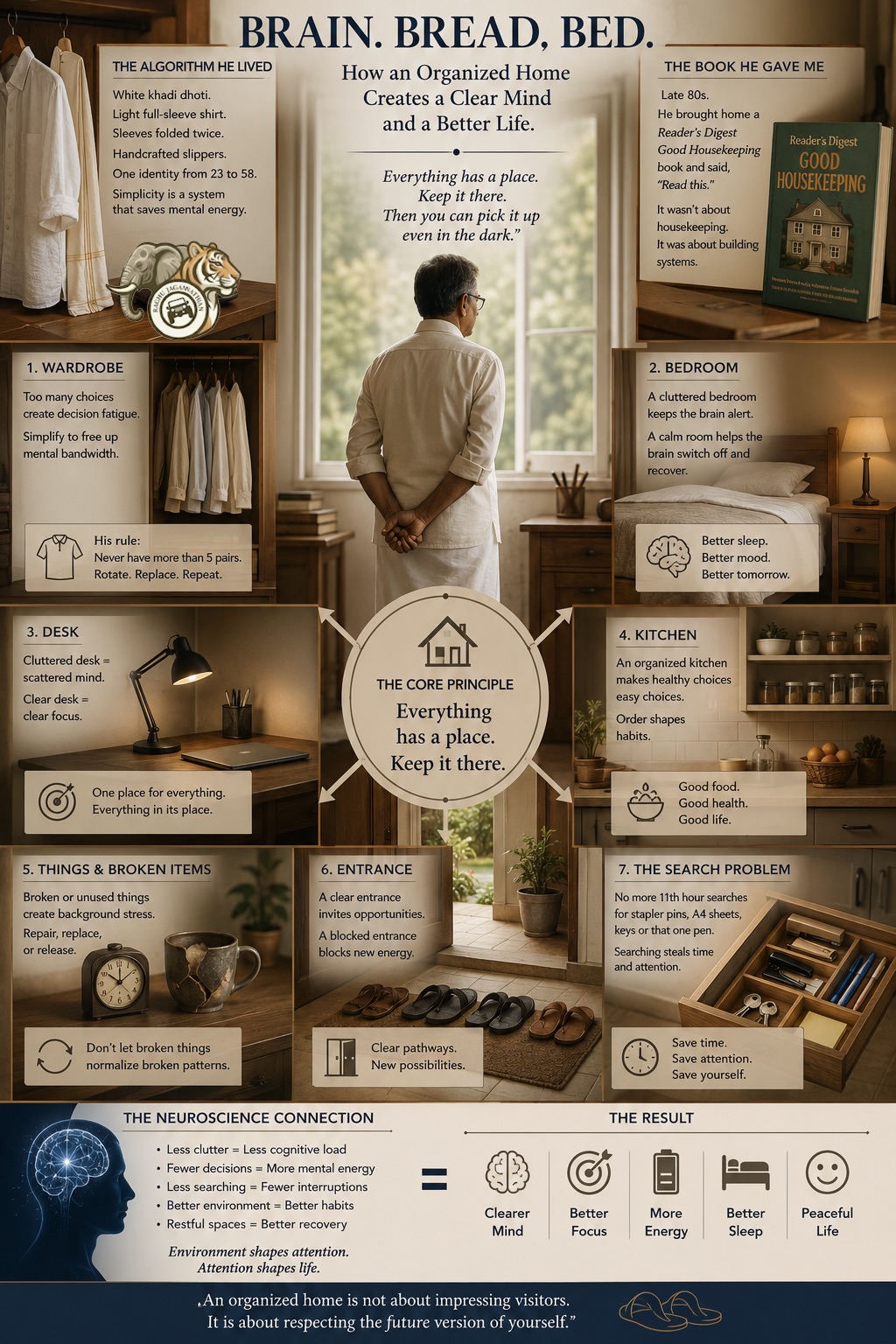
A few days ago I came across a study on how our physical surroundings shape the weather of our minds. It was not framed in mysticism, only in the plain language of neuroscience. An overflowing wardrobe induces decision fatigue before the day has begun. A cluttered desk fragments attention. A bedroom that still carries the residue of work refuses to let the brain settle into rest. Even a neglected kitchen quietly steers our eating. Every broken object and unfinished pile becomes a small, unfinished task that the eye keeps registering and the mind keeps processing.
The more I read about cognitive load, the less I thought about neuroscience. I thought about my father.
He became a school teacher at twenty-three. On the day he entered the profession he seemed to install a permanent personal operating system. His uniform never changed: a crisp white khadi dhoti, a light full-sleeved shirt with the cuffs folded neatly twice at the forearm, and handcrafted leather slippers moulded to his feet. That remained his singular identity until he retired at fifty-eight. No trousers. No T-shirts. No shoes. No conversation about fashion. Whenever I came home proudly carrying four or five new shirts, he would offer a gentle, knowing smile and say, “Never keep more than five pairs. Rotate them. Replace them when they wear out.”
At the time I took it for the frugality of a middle-class provider. Now I hear the quiet genius of a man who had already decided to eliminate unnecessary decisions.
Clothes were only a fraction of his philosophy. His real lesson was about order. “Everything has a place,” he would say, without the edge of a dictator but with the weight of a law. “Keep it there.”
That single sentence governed the geography of our house. The stapler lived in the left-hand drawer. The pins had their own tin. A4 sheets rested on the second shelf. The heavy iron scissors hung from a specific hook. The keys sat in their bowl. Nothing wandered. Nothing was left for a later, more energetic version of ourselves to deal with.
Because of that quiet discipline there were no frantic morning searches, no eleventh-hour scramble for a pin the night before a school project, no one shouting across the hallway for the A4 sheets. The house moved in an easy rhythm. Even decades later I can walk into that house, reach into the dark, and my hand closes exactly around what I am looking for.
One memory from the late 1980s stays clear. My father brought home a Reader’s Digest Good Housekeeping book and slid it across the table to me.
“Read this,” he said.
As a schoolboy surrounded by textbooks and comics, the request felt absurd. Why would I want to read about housekeeping? It took years for the real lesson to register. He was not teaching me how to sweep or dust. He was teaching me systems.
A system is simply a bridge built so that tomorrow is easier than today. An organised kitchen removes friction from cooking. An organised desk lets work begin at the strike of the hour. An organised bedroom tells an exhausted mind that the day is finished.
We now have clinical names for what he understood by instinct: working memory, attention residue, context switching. Each interruption forces the brain to pause, search, and rebuild its previous train of thought. One interruption is a nuisance. Hundreds, compounded daily by our own environments, quietly bankrupt attention.
That is why an ordered home feels peaceful. Not because the furniture is arranged with an interior designer’s flair, but because the brain is no longer bombarded by dozens of unresolved visual signals.
Looking back, my father was not trying to run a sterile museum. He was engineering a low-friction life—a place where time was not bled away in searching, where mornings were not hijacked by panic, and where finite attention could stay with the people we loved rather than the objects we had misplaced.
Today we spend fortunes optimising our machines. We reduce latency, eliminate redundant processes, automate the repetitive. Then we return home to environments that interrupt us every few minutes. Perhaps the most sophisticated productivity system is not a digital app. It begins with a physical habit: put things back where they belong. Protect tomorrow’s attention with today’s discipline.
We spend our youth building the Brain. We spend our adulthood earning the Bread. The quieter wisdom of later life is learning to cultivate the Bed—not merely the mattress where we sleep, but the environment that allows the mind to rest, recover, and think clearly.
Sometimes the most useful lessons are not found in management books or peer-reviewed journals. Sometimes they arrive in a white khadi dhoti, a pair of worn leather slippers, five neatly rotated shirts, and a quiet voice that simply says:
“Everything has a place. Keep it there.”
 Arambhin
Leave a comment