
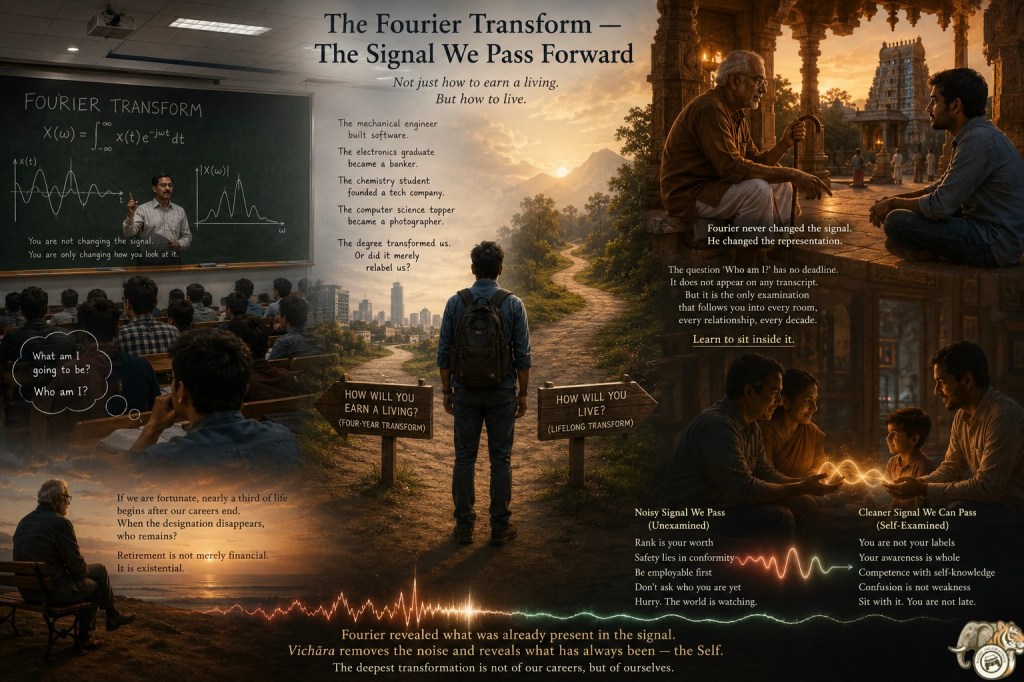
The lecture hall smelled faintly of chalk dust and warm overhead projectors.
It was my second year of engineering. One of those Chennai afternoons where the ceiling fans lost their battle against the heat. The professor entered with a stack of notes that looked older than most of us and wrote two words on the blackboard.
FOURIER TRANSFORM
“One of the most beautiful ideas in mathematics,” he declared.
One ear listened to him. The other wandered inside my own mind.
While two hundred students copied integrals and Greek symbols with disciplined precision, a quieter question echoed within me:
What am I going to be?
And beneath it: Who am I?
The professor continued. “You are not changing the signal. You are only changing how you look at it.”
Time domain. Frequency domain. Complex waves broken into simpler sine and cosine components. Everything complicated, he showed us, could be expressed more clearly.
I wrote the equations, then closed my notebook. A new thought had arrived.
If mathematics has a Fourier Transform, does education have a Four-Year Transform? And what exactly is being transformed?.
Years passed. The equations stayed with me; life moved on.
The friends who sat beside me scattered into unexpected paths. The mechanical engineer built software. The electronics graduate became a banker. The chemistry student founded a tech company. The computer science topper became a photographer.
Many never worked in the field they studied for four years. The degree had transformed us — or had it merely relabeled us?
Society now called us engineers, professionals, actionable adults. We answered emails, attended meetings, and said “let’s circle back” without irony. Yet underneath the performance, the question “Who am I?” had not disappeared. It had simply gone underground, waiting.
That question waited for decades until one quiet evening in a temple.
An elderly professor I respected had retired years earlier. I visited expecting talk of technology and AI. Instead, he stood watching the evening ārati. Without turning, he asked, “Do you still remember Fourier?”
I laughed. “Only enough to know I forgot most of it.”
He smiled. “Then you remember the important part.” With his walking stick, he drew a small circle on the granite floor.
“Fourier never changed the signal. He changed the representation.”
He turned to me. “Modern education does something similar. It changes how society sees you. You enter as a student; you leave as an engineer, doctor, or employee. The person may not have changed as much as the label.”
The temple bells faded into the evening sky.
“Modern education, shaped by the Industrial Revolution, excels at one question: How will you earn a living?”
“But another question was quietly postponed: How will you live?”
He gestured toward the children playing in the courtyard. “The ancient gurukulas taught vichāra before vocation, attention before ambition. They were interested in the mind that would one day hold the job.”
Then came the line that stayed with me:
“The confusion your generation carries is not a failure of education. It is the first honest moment of it. The question ‘Who am I?’ has no deadline. It does not appear on any transcript. But it is the only examination that follows you into every room, every relationship, every decade.”
“Do not rush to answer it. Learn to sit inside it. That patient, uncomfortable sitting is the beginning of real education.”
I walked home in silence. Something shifted—not a resolution, but a reframing.
We believe we are giving the next generation a noble signal: Study hard, build a career, the world will open for you. The intention is genuine. We want them to suffer less than we did.
But what do they actually receive?
They absorb a subtler message through our anxiety, our comparisons, our silences: Your worth is your rank. Your safety lies in conformity. The question ‘Who am I?’ is a luxury — first become employable.
No parent says it aloud. Yet the distortion passes forward because the transmitter — us — carries unexamined noise: our own fears of scarcity, memories of humiliation, and equation of external success with inner peace.
If we keep transmitting the same signal, each generation will wake up at forty-five with a career, a mortgage, and a hollow space where a self should have been — then pass the same noise onward.
A cleaner signal would sound like this:
You are not your marks, your degree, or your job title. These are garments, not skin.
You are the awareness that notices all of it — the success, the failure, the longing. That awareness is already whole. Your worth is not up for negotiation.
Yes, learn to navigate the world. Competence matters. But competence without self-knowledge is a vehicle without a driver.
We will help you earn a living. We will also help you learn to live. When confusion comes — as it will — know it is not weakness. It is the beginning of deeper inquiry. Sit with it. You are not late.
We cannot transmit this cleaner signal until we clean our own first.
We cannot tell them their worth is not their rank if we still measure ourselves by designation, bank balance, or LinkedIn profile. We cannot grant permission to sit with confusion if we have spent decades running from our own.
The work begins with us — the transmitters.
Only a self-examined generation can raise a self-examined one.
Perhaps that is the missing subject. Not another certification, but a lifelong practice of vichāra. Education that produces not just employees for sixty years, but human beings for the whole of life.
The signal we are giving our children right now is:
“Become something. Quickly. The world is watching.”
The signal we can learn to give — if we do the inner work, quiet our noise, and remember what the gurukulas knew — is:
“Become yourself. Slowly. The world will wait. And if it doesn’t, that is its own loss.”
The first produces engineers who don’t know why they are engineering.
The second produces human beings who may choose engineering, poetry, solitude, or service — but choose it consciously, from a self they have actually met.
Only then does the deepest transformation begin. Not of our careers, but of ourselves.
Years after that temple conversation, I find myself still sitting with the question. The Four-Year Transform gave me tools and a label. The lifelong one continues to strip them away, revealing something quieter, steadier, and already whole. This writing, this inquiry, is part of that unfolding. The signal I hope to pass forward is a little cleaner than the one I received.
 Arambhin
Leave a comment