
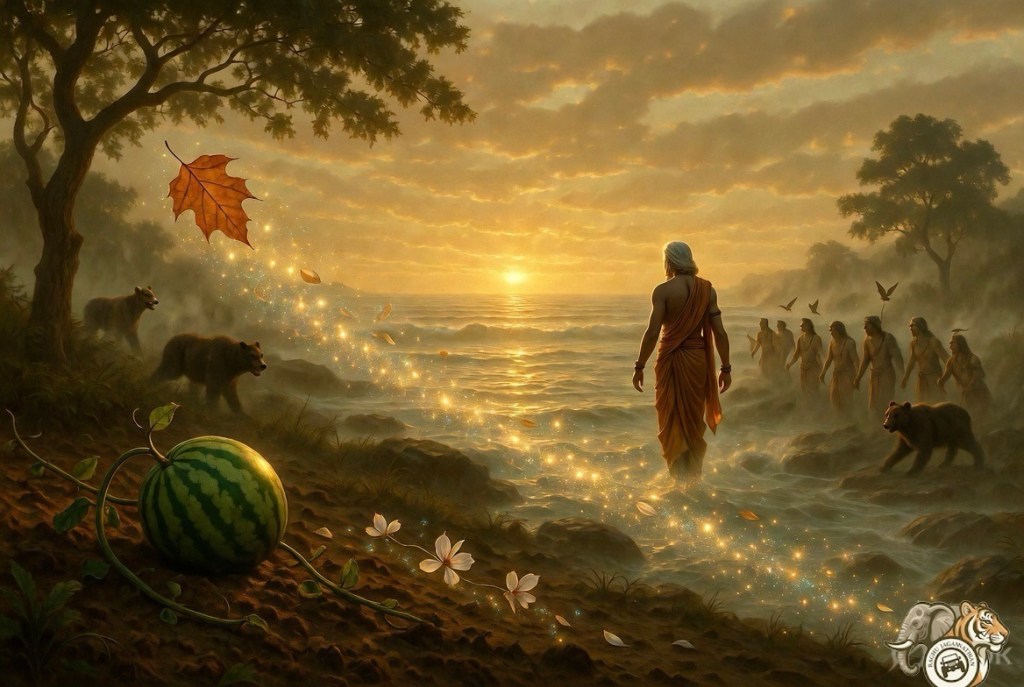
We spend decades mastering the mechanics of how to live. Parents teach us how to walk. Schools teach us how to think. Society instructs us on how to earn, and books reveal how to succeed. Yet in all our striving, almost no one teaches us how to leave.
Nature remains our most patient and silent teacher.
From childhood, we are told to leave every place clean after we use it. We assume it is merely a lesson in tidiness, a rule for polite society. But one afternoon, my father’s voice echoed in my memory with newfound weight: “Leave the place as clean as it was when you entered.”
As a boy, I thought he was talking about a room. Today I understand he may have been speaking of life itself. Perhaps the instruction was never about sweeping floors. Perhaps it was about departing this world without littering it with ego, greed, lingering anger, or unfinished attachments. We have perfected the science of healthy living, yet remain novices in the wisdom of healthy leaving.
Nature, unlike us, never clings. It leaves with astonishing grace.
A ripe watermelon rests on the earth. Once it has received everything the vine can offer, it quietly separates. The vine does not mourn; the fruit does not resist. Their bond was never meant to be permanent—its purpose was fulfillment. A dry leaf does not negotiate with autumn. When its work is complete, the gentlest breeze is enough to release it. The tree does not push; the leaf does not cling. The river flows into the ocean without fear. The flower sheds its petals without mourning.
Everything in nature knows exactly when to leave. Only human beings resist.
We are perhaps the only creatures blessed with enough intelligence to question life, yet cursed with enough ignorance to resist its fulfillment. We cling to possessions, fleeting identities, shifting relationships. We clutch a body that was never truly ours to keep. Nature leaves without identity. We leave only when the universe compels us.
This wisdom finds its highest expression in our oldest epics. The Ramayana is remembered as the blueprint for ideal living—Rama as the perfect son, brother, husband, friend, and king. But His final teaching may be the most profound: the art of leaving.
When His earthly mission was complete, Rama walked calmly toward the banks of the sacred Sarayu River. There was no fear, no regret, no resistance in His steps. The citizens of Ayodhya followed. The vānaras followed. Bears, birds, and even the trees and plants, it is said, leaned toward their beloved Lord. Witnessing this outpouring of devotion, Rama did not turn to the heavens seeking liberation for Himself alone. Instead, He prayed for them: “They came because of their love for Me. They shared My joys and sorrows. They sacrificed for Me. Bless each according to the fruits of their karma.”
This is divine gratitude at its zenith. Rama did not abandon the world—He ensured that those who walked with Him were uplifted. The final chapter of the Ramayana is not about death. It is about completion.
Our modern age has largely lost this reverence for completion. We crown the GOAT—the Greatest Of All Time—unaware that the very phrase confesses limitation. Time itself is the cage. The ancient rishis sought something far greater. They sought no immortality within history; they sought freedom from history. Death ends one lifetime. Moksha ends the cycle.
Ancient Indian traditions speak of prāṇa, the vital life force. Life unfolds according to dharma and karma. Yogic traditions measure a life not merely in years but in breaths. Prāṇāyāma was never only an exercise for better breathing; it was training in conscious living. Every inhalation acknowledged life. Every exhalation prepared for the final one.
The Kanchi Paramacharya illustrated this truth through nature itself. A ripe fruit falls when both fruit and vine have fulfilled their mutual purpose. Neither clings. Neither resists. Completion is enough. Nature never mistakes attachment for love. Only humans do.
My father’s simple instruction has become my quiet manifesto: Leave the place as clean as it was when you entered.
Perhaps that is the highest expression of dharma. Leave your home cleaner. Leave your workplace kinder. Leave your relationships lighter. Leave your community stronger. Leave the earth gentler than you found it.
And when the time comes, leave your body as effortlessly as the ripe fruit leaves the vine and the autumn leaf leaves the tree—without fear, without resistance, without unfinished attachment.
The greatest tragedy is not death. It is forgetting that life has a purpose beyond mere survival. We are born, we learn, we serve, we love, we fulfill our dharma. Then, like the leaf, the fruit, and the river, we leave. Not because life has defeated us, but because our life has been completed.
The world celebrates those who leave behind wealth. History celebrates those who leave behind empires. The sages celebrate those who leave behind themselves.
The art of leaving is not the death of life; it is the highest expression of a life well lived. The body returns to the five elements, the name returns to memory, and deeds return as karma. The awakened, having completed their purpose, leave nothing behind except the fragrance of dharma—just as a flower leaves its sweet scent in the air long after its petals have fallen.
Leave the place as clean as you found it—and perhaps even sweeter
 Arambhin
Leave a comment