
Reclaiming Prāṇa in a World Ruled by Pana
Every child arrives with the same inheritance. Not money. Not status. Not a surname. Just one quiet, unstoppable breath.
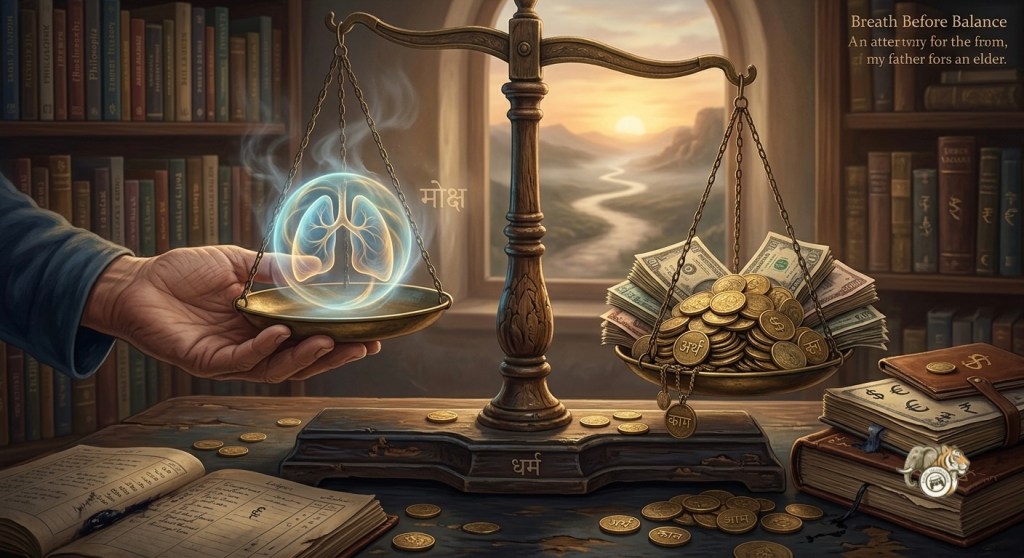
That first gulp of Prāṇa Vāyu — life force — comes free. No invoice. No negotiation. Yet almost immediately, another force steps in: Pana. Money. From that moment on, the world teaches us to measure our worth not in breaths, but in bank balances.
We breathe for free, but everything else has a price.
The New Religion
Ancient cultures asked, “How do I protect my Prāṇa?”
Modern life asks, “How do I protect my income?”
Both questions matter. One is biological. The other is social. The danger begins when necessity hardens into identity — when wealth becomes self-worth and lifestyle quietly replaces life itself.
Mokṣa in Shifts
We all chase liberation, though we rarely call it that. Some seek it at the bottom of a glass, others in endless scrolling, travel, fame, or power. For a few hours the mind falls quiet. The burden lifts.
Then Monday returns. The craving restarts.
Perhaps pleasure is simply mokṣa working in shifts — temporary freedom, borrowed silence, rented peace. Money can buy a holiday, but it cannot end restlessness. Power can silence critics, but not the inner voice. Fame can fill a stadium, yet leave the soul empty.
The Four Pursuits, Reversed
The sages gave us an order: Dharma. Artha. Kāma. Mokṣa.
Direction. Stability. Beauty. Freedom.
Today we have flipped the sequence. We chase Artha as the final destination. We consume Kāma as if desire had no horizon. We speak of Mokṣa only when exhaustion sets in. And Dharma — the quiet foundation — slips out of the conversation entirely.
Without Dharma, Artha becomes greed. Kāma becomes addiction. Even the search for Mokṣa turns into another product on the shelf.
Raghu and Rahu
Many fear Rahu, the shadow planet of insatiable hunger. Yet Rahu is not evil — it is hunger without direction. Give it a map and it becomes purpose. Leave it unmapped and it becomes obsession.
Every Raghu carries a little Rahu within: ambition, curiosity, the endless search. The difference between confusion and clarity is never the absence of desire. It is the presence of direction.
A Simple Practice: The Prāṇa Audit
Once a week, sit quietly for five minutes and ask:
• Where did my Prāṇa flow freely today?
• Where did I trade it cheaply for Pana?
Write the answers without judgment. Patterns appear quickly.
The Cost of the Search
What if I spend my wealth looking for meaning, only to find truth after the resources are gone?
The Gita offers no glorification of blind renunciation or blind accumulation. The real challenge is to seek deeply while ensuring those who depend on us do not pay the price of our inner journey. Knowledge without compassion remains incomplete. True wisdom reduces suffering — it does not merely redistribute it.
Growing Older Is Automatic; Maturing Is Not
I watched my father remain a wellspring of strength until his final months. Even then he offered guidance, listened deeply, and left every room a little lighter. He taught me that time does not automatically ripen into wisdom. Some people simply grow older. Others grow inward.
We spend decades learning how to earn. Far too few learning how to become useful.
The Balance Sheet That Matters
One day your salary will stop. Your title will vanish. Your possessions will pass to others. What remains?
Not your Pana Value, but your Prāṇa Value — the clarity you cultivated, the compassion you practiced, the quiet presence that made others feel more alive simply because you existed.
Three Anchors to Begin
1. Conscious Breath Anchor — Before opening your phone or laptop each morning, take ten deliberate breaths. Feel the Prāṇa. Set the tone.
2. Rahu Direction Prompt — When ambition or restlessness rises, ask: “Is this hunger serving Dharma, or merely feeding itself?” Write one sentence. Repeat.
3. Evening Prāṇa Review — At day’s end, note one moment you chose presence over pressure. Celebrate it.
Wealth Beyond Time
Money can outlive you. Time cannot. You can leave a fortune, but you cannot leave an unfinished life.
The real tragedy is not dying with wealth. It is reaching the final chapter with a swollen bank account and an unexamined heart. The richest retirement is not the largest balance. It is becoming the kind of person whose presence still enriches others long after you are gone.
Money buys survival. Prāṇa makes survival meaningful.
The purpose of life was never to choose between them. It was to remember their proper order:
Earn enough Artha to support life.
Enjoy Kāma without becoming enslaved by it.
Stand firmly in Dharma.
And one day you may discover that Mokṣa was never waiting at the end of the journey. It was quietly available in every conscious breath.
 Arambhin
Leave a comment