
From a shoelace on the balcony and tiger cubs in Ranthambore to LLM engineering and organizational learning loops: why nature’s oldest pattern is suddenly everywhere in tech — and why the ancient sages spent millennia asking what remains when the wheel finally stops turning.
“You are never given a wish without also being given the power to make it come true.”
— Richard Bach
A forty-five-day-old kitten taught me something that decades of books, software, philosophy, and technology had been quietly pointing toward all along.
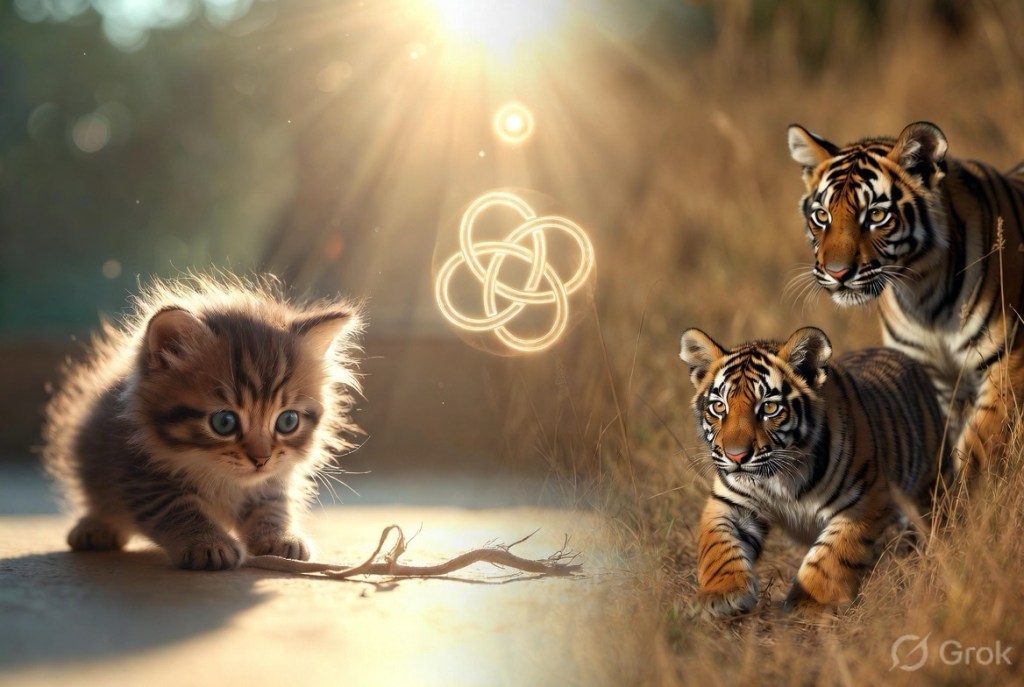
This kitten had never watched a video. It had never attended a class, met a mentor, or read a manual. Yet as it tracked a stray shoelace across the floor, it possessed an ancient, flawless knowledge. It knew how to stalk with its belly low to the ground. It knew how to pounce, how to observe the twitching end of the string, how to retreat into the shadows, experiment with a new angle, and try again.
A few months earlier, under the sweltering sun of Ranthambore, I had watched tiger cubs play under the watchful, amber-eyed gaze of their mothers. They stalked their siblings through the dry, golden grass. They practiced clumsy ambushes, wrestled in the dust, failed, retried, and learned.
The kitten on the balcony and the tiger in the jungle were separated by scale, not by design. One hunted cotton threads; the other hunted sambar deer. But the source code executing beneath their fur was identical: Observe. Act. Learn. Repeat.
The more I reflected on this rhythm, the more I saw its architecture everywhere. Evolution runs on it. Civilizations rise and fall by it. Organizations compound upon it. Artificial Intelligence is entirely governed by it. Life itself appears to be an engine running on loops. Once you see the basic parts, you begin to recognize them in every shadow and every algorithm. Perhaps life is nothing more than inheritance and abstraction, endlessly turning the wheel.
DNA is inherited memory. Language is inherited memory. Culture, technology, art — all inherited memory. Every generation receives compressed wisdom from the previous one, only to build another layer of abstraction on top of it. Nothing starts from zero. Everything is inheritance wrapped in abstraction.
This realization made me smile when I recently encountered the flood of discussion around “LLM Loop Engineering” in the tech sphere. Suddenly my feeds were full of experts fiercely debating the architecture of digital minds: Observe. Reason. Act. Evaluate. Reflect. Repeat. The latest buzzword had arrived. Around the same time, Satya Nadella spoke about building organizational learning loops where human capital and token capital compound together. The argument was elegantly simple: companies that architect these loops first will develop advantages that competitors cannot easily replicate.
The modern world has many names for it: Learning Loops, Feedback Loops, Human-in-the-Loop, Agentic Loops, AI Loop Engineering.
Nature simply calls it life.
The loop isn’t new; nature has been running this code for billions of years. The kitten knows it. The tiger knows it. The forest knows it. The Vedas knew it, the Upanishads knew it, and the Buddha knew it. We merely keep renaming the wheel. A species survives because it learns. A child grows, a company thrives, an AI improves — all because they learn.
As Bach wrote, the wish and the capability arrive together. The kitten is given the urge to climb, but nature has already supplied the hooked claws. The tiger cub is given the urge to hunt, but nature has already supplied the instinctual stealth. A human is given curiosity, but life has already supplied the capacity to observe. The wish itself is the foremost evidence of latent capability.
The Radical Divergence
Yet the deeper I explored Vedanta, the more I realized something entirely unexpected. The ancient rishis were not fascinated by the loop.
They were fascinated by the possibility of freedom from it.
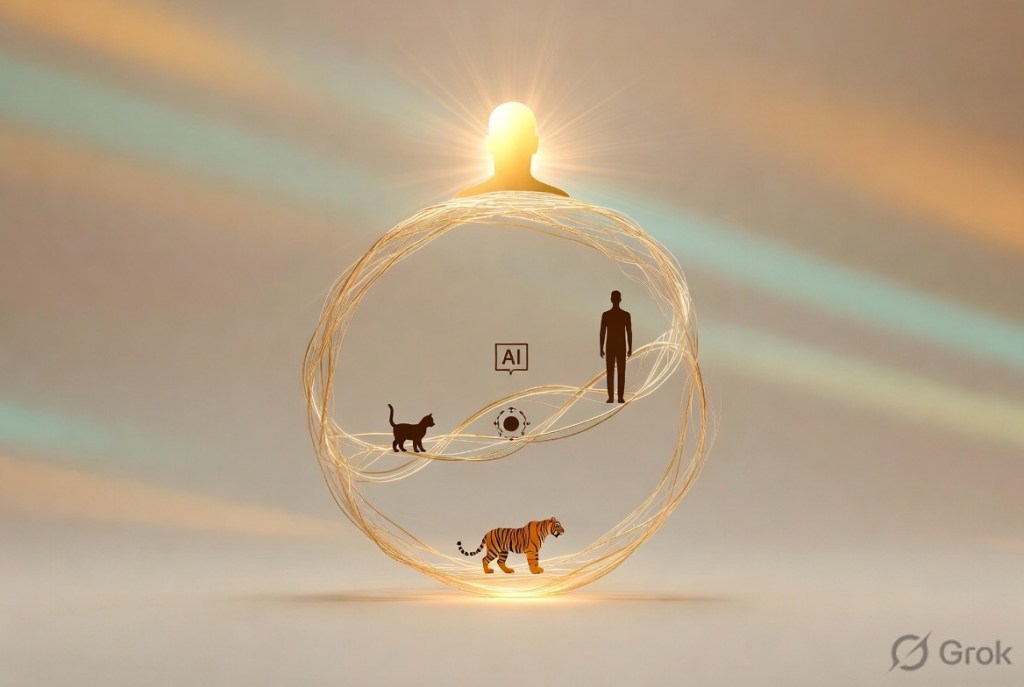
Learning is a loop. Habit, desire, pleasure, fear — all loops. Birth is a loop, and death is a loop. Planets move in them, and thoughts arise in them. Even human identity appears to be nothing more than a loop of carefully curated memories repeatedly narrating a story called “me.”
Observing this, the sages asked a question that changed the direction of human inquiry: Who is observing the loop?
The scientist studies the wheel.
The engineer optimizes it.
The entrepreneur monetizes it.
The AI researcher scales it.
The sage asks who is riding it — and then, more devastatingly: What remains when the wheel stops turning?
Vedanta does not reject the loop. It sees the loop as Māyā’s elegant user interface — useful, beautiful, even necessary for the great play of becoming. But it refuses to mistake the interface for the underlying Runtime. The kitten learns how to be a cat. The tiger cub learns how to be a tiger. Humans learn how to become doctors, engineers, parents, and philosophers.
The sages invite us to discover what we are before becoming anything at all.
The Irony of the AI Age
Today’s technology industry is pouring hundreds of billions of dollars into building the perfect learning loop. We ask: How do we make the loop smarter?
Meanwhile, the ancient sages spent thousands of years investigating whether freedom lies beyond all loops entirely. They asked: How do we stop mistaking ourselves for the loop?
This is where Vedanta diverges wildly from biology, psychology, management theory, or artificial intelligence. It poses a singular, devastating inquiry: If every experience comes and goes, if every thought comes and goes, if every identity comes and goes… what is it that remains?
Watching a kitten on a balcony and watching tiger cubs in Ranthambore became chapters of the same profound lesson. The kitten showed me inheritance. The tiger showed me practice. Technology showed me abstraction. AI showed me repetition. Richard Bach showed me possibility, and Satya Nadella showed me how organizations compound.
But the Vedas showed me the limits of those loops. Vedanta showed me the observer.
Suddenly, the grand pattern became visible: Life inherits. Life abstracts. Life loops. Most of humanity is busy improving the loop. But the monks, mystics, and sages across the world spent their lives exploring something far more radical — the possibility of stepping beyond it.
Perhaps the greatest irony of the AI age is this: just as humanity is definitively proving that intelligence emerges from loops, the ancient sages are still whispering across the millennia…
You are not the loop.
You are the one aware of it.
And right now, as you read these words, that same awareness is quietly watching a forty-five-day-old kitten stalk a shoelace across a sunlit balcony — and recognizing itself in the watching.
 Arambhin
Leave a comment