
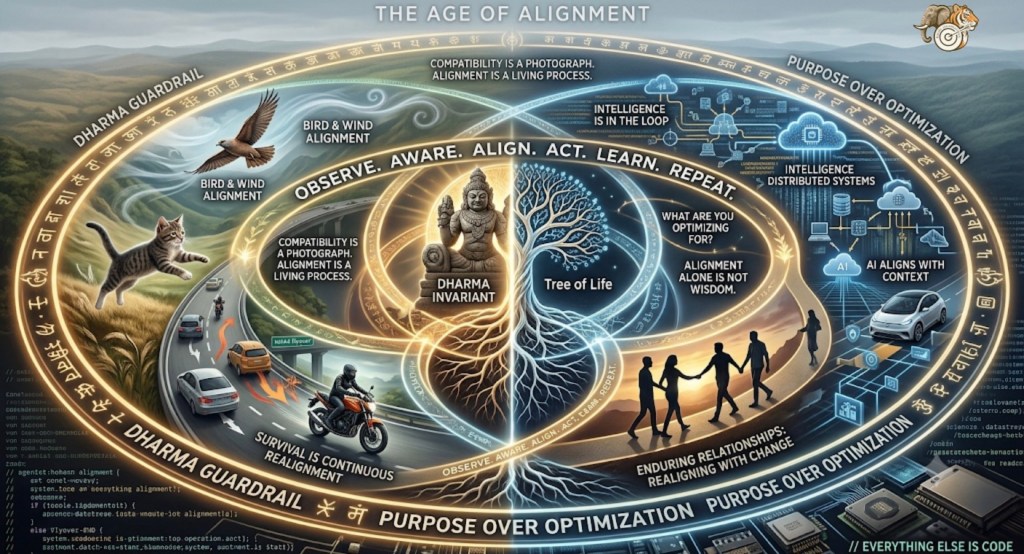
Why Life, AI, Relationships, and Civilizations Are All Feedback Loops
yad jāgrato dūram udaiti daivaṃ tadu suptasya tathaivaiti |
dūraṅgamaṃ jyotiṣāṃ jyotir ekaṃ tan me manaḥ śiva-saṅkalpam astu ||That mind which, even in the waking state, travels far into the divine, and in sleep does the same; that far-ranging one, the single light among lights—may my mind be established in auspicious resolve.
Last few centuries, we misinterpreted intelligence meant knowing the right answers. Schools rewarded memory, businesses rewarded efficiency, and computers rewarded deterministic logic. We assumed that with the right inputs, we could reliably produce the right outputs. That assumption built the industrial age, but it also limited it.
Nature had already solved a far more difficult problem: not producing the right answer once, but continuously finding the right answer in a changing world. A bird never memorizes the wind; it aligns with it. A kitten doesn’t solve differential equations before leaping; it continuously adjusts to movement that our eyes barely perceive.
I felt this on the NH44 flyover last week—lane changes, sudden braking, the scooter ahead swerving unpredictably. The rider who survives isn’t the one who memorized the route perfectly, but the one who continuously realigns. Every second is a thousand tiny corrections. Even walking is controlled falling. Balance, it turns out, is simply continuous realignment. Life does not survive because it is strong. Life survives because it continuously aligns.
Nature has always been running what we might call Loop Engineering. Observe. Become aware. Align. Act. Learn. Repeat.
Every organism is a feedback system. Evolution, learning, breathing, the beating of a heart, the defense of an immune system—all are feedback loops. Life itself is an architecture of continuously aligned loops.
Relationships are no different. People often ask why marriages once lasted fifty years while many modern relationships struggle after only a few. The answer is not that previous generations magically found perfect partners. No two human beings remain the same. Health changes, careers pivot, children reshape priorities, and dreams evolve. Loss and success alter the fabric of who we are. Time changes everyone. Enduring relationships survive not because two people remain identical, but because they continually realign with each other’s changing lives. Compatibility is a static photograph. Alignment is a living process.
Engineering eventually discovered this same truth. Early computers expected fixed inputs and produced fixed outputs. They were extraordinarily precise, yet remarkably fragile. As software grew more complex, engineers stopped trying to predict every possible situation and instead built systems that could adapt. Today, distributed systems reroute around failures, cloud platforms scale automatically, and autonomous vehicles continuously correct their path. The intelligence is no longer in the instruction. The intelligence is in the loop.
This pattern isn’t invented by modern theory; it is simply how reality operates. Military strategists formally recognize it as the OODA loop: Observe. Orient. Decide. Act. Every living system follows this rhythm naturally. Winning was never about making one perfect decision, but about learning and adapting faster than reality changes.
Artificial Intelligence represents this same transition. Earlier software executed rigid instructions; modern AI aligns itself with context. It observes, retrieves knowledge, reasons, acts, reflects, learns, updates its memory, and realigns. AI did not become revolutionary because it achieved better computation. It became revolutionary because it mastered continuous alignment.
The age of simply doing—of functioning in constant, predictable motion—has ceased. We are entering a new era of unlearning. An era of unsupervised intelligence—not in the narrow algorithmic sense, but as a sovereign way of navigating existence—where constant realignment is the only way out of the maze.
Yet, this reveals something deeply uncomfortable: alignment alone is not wisdom.
A guided missile continuously aligns itself to its target. A phishing scam continuously aligns to human psychology. A recommendation algorithm continuously aligns to your attention. Consider social media: its recommendation loop is extraordinarily intelligent, turning every swipe, pause, and click into feedback. The system observes, learns, predicts, optimizes, and realigns. The loop works exactly as designed. But if the objective is maximizing engagement, outrage often outperforms understanding. Addiction outperforms attention. Polarization outperforms truth. The engineering is brilliant, but the destination is questionable. The loop is aligned, but the purpose is not.
This is where modern thinking often stops. We celebrate optimization, but Nature asks a different question: What are you optimizing for?
This is where Dharma enters the conversation.
Dharma is often misunderstood as mere religion or strict morality. It is neither in the narrow sense. Dharma is the principle that determines whether the destination itself is worthy. It is the guardrail that keeps optimization from becoming self-destruction. One company can optimize profit by exhausting employees, manipulating customers, and eroding trust. Another can optimize profit by creating value, serving customers well, developing its people, and thinking in decades rather than quarters. Both are aligned. Both are intelligent. But only one is operating within dharmic guardrails.
In software engineering, we protect invariants. In aviation, we respect safety envelopes. In distributed systems, we preserve consistency. In life and civilization, Dharma is that invariant—the silent constraint that keeps every feedback loop from optimizing itself into oblivion.
Without guardrails, optimization becomes exploitation. Without Dharma, intelligence becomes capability devoid of wisdom. Without purpose, feedback loops become engines accelerating us toward the wrong destination. You may be traveling at the correct speed, in the correct lane, with perfect control—yet be traveling on the entirely wrong road.
Technology cannot answer that. AI cannot answer that. Optimization cannot answer that. Only purpose can.
The future will not be decided by who builds the largest models, who owns the most data, or who writes the fastest code. The future will belong to those who design the right loops. Loops that continuously observe reality. Loops that learn, adapt, and remain aware. Loops that remain bounded by Dharma.
Perhaps this is the architecture of every enduring intelligence:
Reality: The foundation.
Awareness: Seeing clearly.
Alignment: Adapting continuously.
Learning: Improving through feedback.
Intelligence: Choosing wisely.
Action: Changing the world.
All of it enclosed within one timeless invariant: Dharma.
Technologies will change. Programming languages will disappear. AI models will evolve. Businesses will rise and fall. Relationships will grow or fade, and civilizations will reinvent themselves. Implementations will always vary.
But Dharma remains the guardrail for every alignment.
Everything else is code.
 Arambhin
Leave a comment