
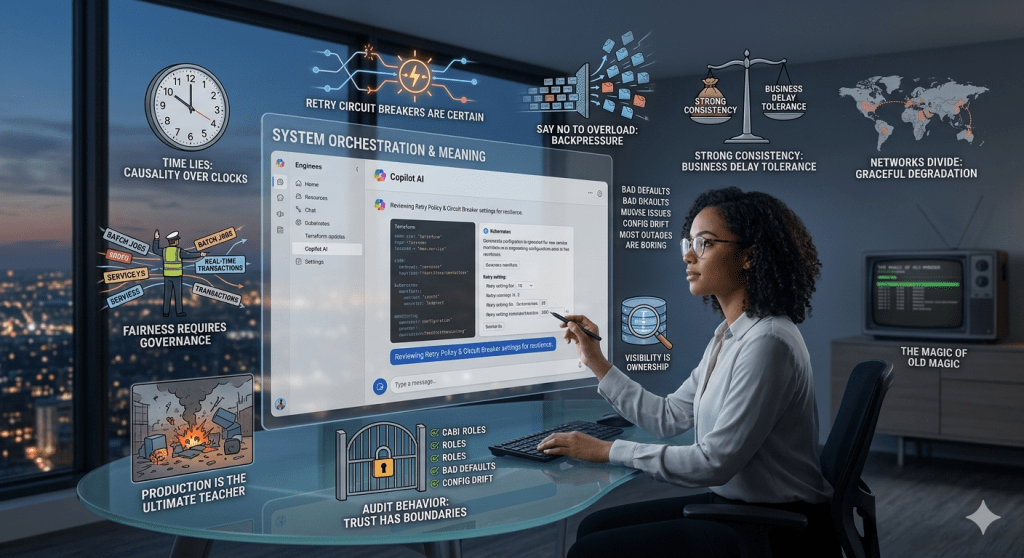
The Quiet Laws of Distributed Systems and the Age of AI
I still remember the days when moving batch performance monitoring to a television screen using cron jobs and JavaScript felt like magic.
We fought GoldenGate replication delays in ledger management, optimized end-of-day processing across time zones, and squeezed every ounce of performance out of SAP HANA’s in-memory architecture. The technology was impressive, but the real ingredients of success were simpler:
Risk appetite.
Trust in the team.
Confidence to challenge conventional wisdom.
And the willingness to own the consequences.
Back then, solving problems meant coordinating databases, schedulers, middleware, dashboards, and countless moving parts. Success demanded specialists, synchronization, and late-night troubleshooting. Today, much of that orchestration begins with a conversation.
One smart AI tool.
The bottleneck has shifted. Computing is abundant. Coordination is cheaper. Code is increasingly commoditized. What remains scarce is imagination, judgment, and the courage to act. AI is compressing the distance between ideas and outcomes. Yet, anyone who has survived enough production incidents knows a secret: AI did not eliminate complexity. It merely moved it higher up the stack.
Beneath all the abstractions lie ten quiet laws that govern every distributed system. They are rarely taught with the urgency they deserve, yet they explain the scars engineers carry.
The First Law: Time Lies
I learned this one in a windowless room at three in the morning. We had two servers—one in London, one in Singapore. A trade was booked in Singapore at 23:45 local time. The London server, still basking in the afternoon sun, stamped the data with its own clock. The trade slipped into tomorrow’s ledger. The reconciliation failed. The auditors called.
We spent hours tracing the error, only to discover that both servers were right—and both were wrong. They had faithfully recorded their own truths. The problem was our premise: we had asked “What time is it?” instead of “What happened first?”
Clocks disagree. Messages arrive late. Yesterday’s event may arrive after today’s. Timestamps are opinions. Causality is truth. The wise engineer trusts sequence over clocks.
The Second Law: Retries Are Certain
Networks fail. Humans click twice. Timeouts happen. Operations must be safe to repeat. Running a process twice should never create two realities.
I once saw a payment system charge a customer fourteen times because the acknowledgment packet was lost. The customer was patient. The lawyer was not. Idempotency is not a feature. It is a survival instinct.
The Third Law: Everything Fills Up
Queues fill. Threads fill. CPUs fill. Even calendars fill. Without backpressure, overload spreads like floodwater. Sometimes the healthiest response is to say no; it is better to reject work than drown under it.
I have watched a single stuck thread cascade into a thousand waiting connections, each holding a database handle, consuming memory until the entire service collapsed into silence. The fix was not more capacity. The fix was a circuit breaker and the courage to return a 503 error.
The Fourth Law: Consistency Is a Business Decision
Not every problem deserves absolute certainty. Bank balances require strong consistency; recommendations can wait. Architecture is not merely a technical choice—it is economics expressed in code.
The right question is not “Can stale data exist?” but “How much delay can the business tolerate?” I once sat across from a CFO who answered that question in seconds. She knew exactly what a delay would cost. The engineers had argued for days. She settled it with a number.
The Fifth Law: Networks Divide
Regions become isolated. Dependencies disappear. Failures rarely arrive dramatically; they arrive strangely.
Distributed systems seldom die completely. They stumble. They whisper. They fail in unexpected ways. Graceful degradation matters more than optimism.
I remember a dependency on a DNS service we did not know we had. When it failed, half our services continued normally. The other half paused, politely, and waited. No alerts fired. No errors logged. Just a slow, suffocating stillness. We found it by accident, hours later. The system had not crashed. It had simply stopped breathing.
The Sixth Law: Fairness Requires Governance
One noisy tenant can ruin everyone else’s day. Traffic needs traffic cops. Priorities need boundaries. Emergency services should outrank batch jobs. Fairness is not kindness. Fairness is architecture.
I once saw a batch job—a well-meaning report generation—consume every available thread on a shared middleware cluster. Real-time transactions queued up behind it, their latency climbing like a fever. The batch job was doing exactly what it was told. It was the system that had failed to say “enough.”
The Seventh Law: Visibility Is Ownership
Production is a dark forest. Metrics reveal that something is wrong. Logs reveal what happened. Traces reveal where. Without observability, ownership becomes an illusion. Debugging starts long before the outage.
The best on-call engineer I ever knew spent her quiet hours building dashboards. She said, “I don’t want to understand this system at 3 a.m. I want to understand it now, so that at 3 a.m. all I have to do is look.” She was right. The outage you cannot see is the outage you cannot own.
The Eighth Law: Production Is the Ultimate Teacher
Some lessons refuse to appear in lower environments. Reality always finds the edge cases imagination misses. The bug you cannot reproduce is the bug that owns you. Humility begins where simulation ends.
We spent two weeks trying to reproduce a race condition in staging. We injected latency, manipulated clocks, rewrote the concurrent code. Nothing. It only appeared in production, under real traffic, on a Tuesday afternoon, when two unrelated deployments happened to collide in a way no test harness could predict. We fixed it by acknowledging we could not reproduce it—only guard against it.
The Ninth Law: Trust Has Boundaries
Assume compromise. Protect every service. Rotate secrets. Audit behavior. Grant the minimum necessary privileges. Security is not a feature to add later. It is architecture expressing distrust intelligently.
I have seen a production database dropped by a script that had more permissions than it needed. The developer was competent. The script was tested. The permissions were a leftover from a migration completed months earlier. Trust had been extended and never revoked. The blast radius was exactly what we had allowed it to be.
The Tenth Law: Most Outages Are Boring
Rarely does disaster emerge from exotic algorithms. More often, the culprits are ordinary: bad defaults, configuration drift, version mismatches, resource contention, human mistakes.
Reliability does not arise from perfection. It arises from recovery. Feature flags. Canaries. Rollbacks. Progressive delivery. The strongest systems are not those that never fail. They are the ones that heal.
The Meta-Law
Distributed systems are ultimately an exercise in humility.
Single-machine thinking says: “Everything should work.” Distributed-system thinking says: “Everything will fail.” Design so that failure remains ordinary.
In many ways, distributed systems resemble civilizations. Time is uncertain. Communication is imperfect. Resources are finite. Trust is selective. Recovery matters more than perfection.
Perhaps that is why these engineering lessons feel strangely philosophical. Life itself is distributed. People misunderstand each other. Memories arrive out of order. Resources are limited. Trust must be earned. Failures are inevitable. Resilience matters more than control.
Yesterday, we managed machines. Today, we manage intent. Yesterday, execution was expensive. Today, indecision is. Yesterday, success required dozens of tools. Today, one intelligent assistant can amplify a small team beyond what once seemed possible.
But the fundamentals remain unchanged. Risk appetite. Sound judgment. Trust in people. And the humility to accept that complexity never disappears. It merely changes shape.
From assembly language to Java. From cron jobs to the cloud. From dashboards to copilots. From managing machines to managing meaning. The tools evolve. The game remains the same.
Last week, I watched a young engineer prompt an AI assistant to deploy a service. She typed a few lines of plain English. The machine generated the Terraform, the Kubernetes manifests, the monitoring configuration, the runbook. In thirty minutes, she accomplished what once took a team of four a full sprint.
I felt a pang of something—nostalgia, perhaps, or the vertigo of obsolescence. But then I noticed what she did next.
She paused. She read the generated runbook carefully. She changed a retry policy that the AI had set too aggressively. She added a circuit breaker. She asked a senior engineer to review the security group rules.
She was not managing machines. She was managing meaning.
The laws had not changed. They had merely found a new steward.
Turning ideas into action. Designing systems that heal. And passing on, person to person, the quiet laws that make healing possible.
The screen flickers. A new dashboard lights up. The work continues.
 Arambhin
Leave a comment