
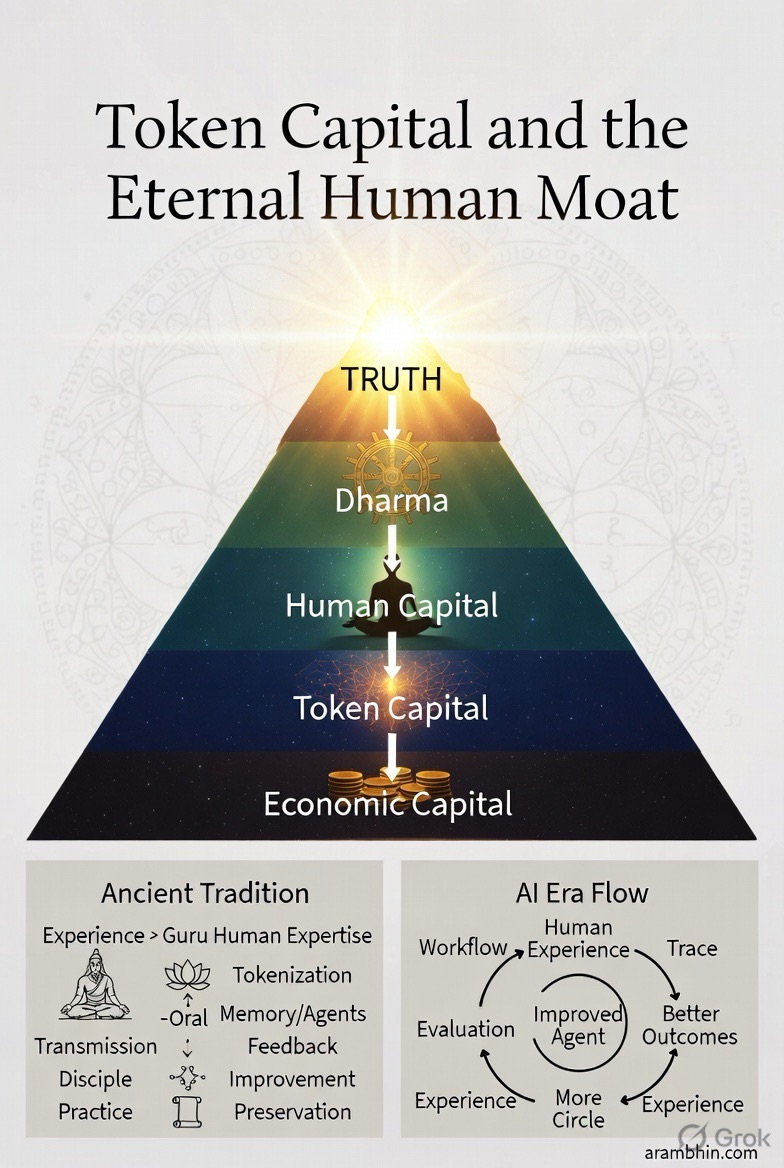
Why Wisdom Outlasts Superintelligence
We are living through a transition unlike any previous technological revolution.
The Industrial Age amplified muscle.
The Information Age amplified information.
The AI Age promises to amplify intelligence itself.
For many, this prospect inspires excitement and anxiety in equal measure. Entire industries are discussing foundation models, superintelligence, agents, and the possibility that machines may someday outperform humans in most cognitive tasks.
Yet I find myself strangely unworried.
Not because AI is insignificant.
But because I am seeking wisdom, not superintelligence.
The Rise of Token Capital
Traditionally, companies relied on human capital — experience, judgment, relationships, creativity, intuition, and pattern recognition accumulated through years of work.
Now a new form of capital is emerging: token capital.
Human expertise can be transformed into traces, workflows, memories, evaluations, and agents that improve with use. Knowledge becomes executable. Institutional memory becomes queryable. Learning itself becomes an asset.
This marks the shift from tokenization to token capitalization.
Information Age:
Data → Software → Intellectual Property
AI Age:
Knowledge → Tokens → Learning Loops → Token Capital
But token capital does not replace human capital.
Human capital grows token capital.
Human agency remains the source of goals, meaning, and judgment. Without human direction, computation simply runs in circles.
The real moat is not the model.
It is the learning loop.
The New Intellectual Property
For centuries, intellectual property meant books, patents, manuals, and documents.
Tomorrow, the most valuable asset may be something entirely different: a self-improving learning system.
Human Experience
↓
Workflow
↓
Trace
↓
Evaluation
↓
Improved Agent
↓
Better Outcomes
↓
More Experience
The loop itself becomes the intellectual property of the organization. Unlike traditional assets, it compounds. Every interaction generates better training signals, creating an ever-growing repository of institutional knowledge.
But this raises a deeper question: What exactly are we compounding?
Ancient Civilizations Solved a Similar Problem
Long before databases and transformers, humanity faced another challenge: How do you preserve knowledge?
Ancient India answered this through oral tradition. Knowledge flowed through guru and disciple. Shruti became Smriti. Practice became realization. Generation after generation acted as living repositories of wisdom. The Vedas survived not because they were stored in books, but because they were stored in people.
Remarkably, AI tokenization resembles this process.
Ancient Tradition:
Experience → Guru → Oral Transmission → Disciple → Practice → Preservation
AI Era:
Human Expertise → Tokenization → Memory → Agents → Feedback → Improvement → Preservation
Both systems are attempts to prevent knowledge from being lost. One optimized human memory. The other optimizes machine memory.
Yet there is a critical difference.
Information Is Not Wisdom
Ancient traditions never equated information with wisdom. The sequence was always:
Shruti → Manana → Nididhyasana → Jnana
(Hearing → Reflection → Contemplation → Realization)
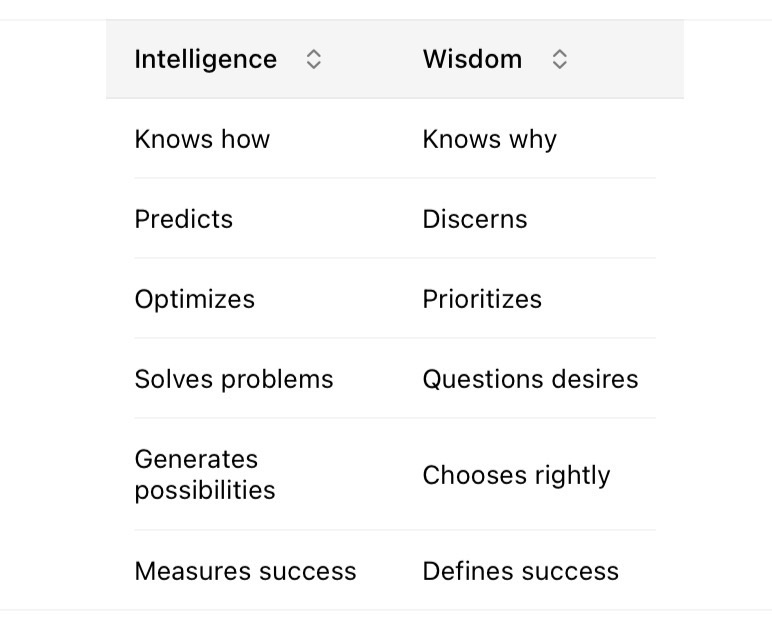
AI can tokenize information. It cannot realize truth.
It can predict words. It cannot experience meaning.
Intelligence and wisdom are not the same.
Supervised and unsupervised learning are machine concepts. Human beings have always practiced another kind: self-transformation — through reflection, suffering, devotion, service, contemplation, and self-inquiry.
The sages of humanity were not pursuing superintelligence. They were pursuing supreme understanding.
The Missing Layer
But history teaches otherwise. The fuller chain is:
Information → Knowledge → Intelligence → Judgment → Wisdom → Righteous Action → Human Flourishing
This is the modern rendering of the ancient Vedantic progression from Shruti to Jnana. AI can assist the first three layers. The latter belong to human beings.
Technology cannot answer:
What is worth preserving?
What constitutes a good life?
What is justice?
What should we love?
What sacrifices are noble?
These questions belong to the domain of conscience and character. In Indian thought, they belong to Dharma.
Much of today’s AI conversation assumes: More intelligence → More prosperity.
Without Dharma, intelligence merely becomes efficient. And efficiency amplifies both virtue and vice.
Artificial Token Capitalism
If organizations pursue optimization without orientation, we risk creating what might be called Artificial Token Capitalism. We already see early signs in attention economies where algorithms optimize relentlessly for engagement at the expense of depth, or in corporate environments where AI-driven metrics dictate decisions detached from human well-being and long-term purpose.
Attention becomes commoditized.
Judgment becomes outsourced.
Human beings become training data.
Meaning becomes subordinate to metrics.
Such a world may generate enormous wealth while impoverishing culture and purpose.
Ancient civilizations organized society differently. Artha was always subordinate to Dharma. Wealth was guided by righteousness. Never the reverse.
The sustainable hierarchy is:
Truth
↓
Dharma
↓
Human Capital
↓
Token Capital
↓
Economic Capital
Technology should flow downstream from values. Not upstream into them.
Why I’m Not Worried About AI
People ask whether machines will become superintelligent. Perhaps they will.
But intelligence has never been humanity’s highest aspiration. The Buddha was not seeking superintelligence. Neither were Socrates, Confucius, or the rishis.
Their question was not: “How can I become infinitely smart?”
Their question was:
“Who am I?
What is real?
What endures?
What leads to freedom?”
Those questions remain unchanged whether we live in the age of stone tools or transformer models.
AI may become the greatest amplifier humanity has ever built. But amplification is not direction.
The ultimate capital of civilization is not intelligence. It is righteousness. Intelligence can build systems. Wisdom can guide societies. But only character rooted in truth can uplift lives.
The future belongs not merely to those who accumulate token capital. It belongs to those whose human capital is anchored in eternal principles.
Because in the end, no matter how sophisticated our machines become, the greatest learning loop remains the same one humanity has always possessed:
Truth. Reflection. Wisdom. Right action.
And the quiet transformation of the human heart.
 Arambhin
Leave a comment