The cabin of Flight 802 smelled of stale coffee, recycled air, and the quiet, collective anxiety of two hundred souls suspended thirty thousand feet above the dark geography of India.
Dr. Arvind Sharma rubbed his temples. The glare from his tablet was a harsh, blue rectangle against the dimming cabin lights. Beside him sat Acharya Somadeva, a man who seemed entirely unaffected by the claustrophobia of economy class. The Vedic scholar wore simple saffron linen that smelled faintly of camphor and sun-dried wood, looking like an ancient monument temporarily occupying 14B.
As the seatbelt sign clicked off, Arvind offered a polite, exhausted nod. “Heading to the tech summit in Bangalore?”
The elderly man turned, his eyes holding the startling clarity of mountain water. “I am heading home, young man. But I suspect our destinations are not so different.”
Arvind smiled, a touch of modern condescension softening his tone. “I study the newest intelligence—generative neural networks and cognitive architecture.”
“And I study the oldest,” the Acharya replied softly.
“Then we are colleagues.”
“Perhaps there is only one intelligence, Doctor,” the Acharya said, gesturing toward the pitch-black window. “We simply approach it from different directions. You build towers to reach the stars; we dig wells to find the water that reflects them.”
For hours, the roar of the jet engines became a baseline drone to a fierce, quiet symphony of ideas. They spoke of memory loops, the mystery of consciousness, and the terrifying speed of machine learning. When the cabin was fully plunged into the artificial twilight of the night flight, Arvind felt a sudden, burning need to make this old man see. He unlocked his tablet and began to sketch a complex, interlocking diagram of nodes and vectors.
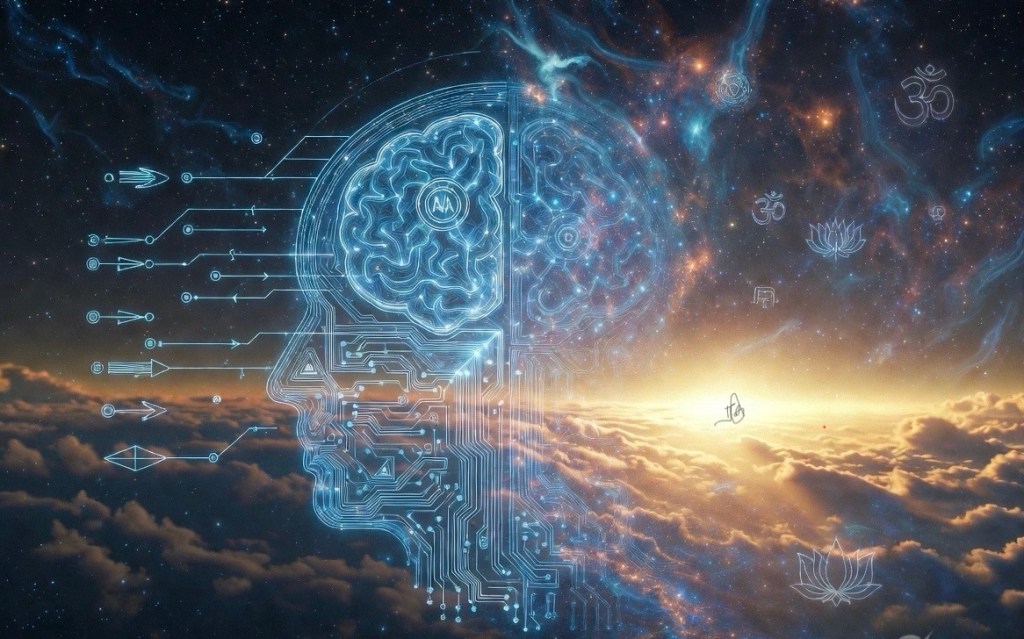
“Look at this,” Arvind whispered, his finger tracking the neon lines. “Let me explain AI using the very architecture of the human body. The Large Language Model is the brain—it processes, structures, and reasons. Retrieval-Augmented Generation, or RAG, is the breath; it constantly refreshes the machine’s understanding from external, living data streams so it doesn’t hallucinate. The Agent represents the hands—the channels of action. And the Model Context Protocol is the nervous system, seamlessly connecting the entire operation.”
The Acharya looked at the glowing screen. He didn’t look bewildered; he looked deeply, profoundly sorrowful. He closed his eyes, tilted his head back against the cheap headrest, and began to chant in a voice so low it was almost swallowed by the engine’s hum:
“Om Purnamadah Purnamidam…”
The ancient Sanskrit syllables vibrated through the armrest. Arvind felt a strange, inexplicable shiver ripple down his spine.
“Beautiful,” the Acharya said, opening his eyes. “But your architecture is a mirror of a mirror, Doctor. Our ancestors left us the original map. Buddhi is the intellect that reasons. Prāṇa is the vital breath that refreshes. The Pancha Koshas are the layers of the self that act in the world. The Nāḍīs are the subtle nervous system connecting the whole. But your diagram lacks a core. Who lights the screen? In our map, above all, Ātman illuminates.”
He turned his gaze back to the window. Outside, the first faint, bruised violet of dawn was bleeding into the edge of the sky, illuminating a vast, undulating sea of gray clouds below.
“The irony, Doctor, is that your generation stores its collective soul in ‘clouds’ made of silicon and burning coal. Long before digital networks, humanity searched another cloud—the Akasha, the eternal storage. All knowledge, every poem never written, every star yet born, resides there. Sages do not upload; they listen. Wisdom is retrieved not by a clever prompt, but by absolute silence.”
Arvind stared at his tablet. The neon diagram suddenly looked incredibly small, fragile, and desperately noisy.
“The mind is older than empires,” the Acharya continued, his voice dropping to a whisper that felt heavier than the cabin pressure. “It knows how to breathe, heal, and dream without a single watt of electricity. Our task is not to replicate the machine of the mind, but to remember the ghost within it.”
Outside, the sun finally cracked the horizon, spilling blinding, molten gold across the tops of the clouds. Inside, the two men sat in a sudden, heavy stillness. The tablet screen timed out and went black, reflecting both their faces against the dawn. They sat side by side, no longer trying to conquer the mystery, but finally content to sit in its shadow.

The Eternal Storage
 Arambhin
Leave a comment