
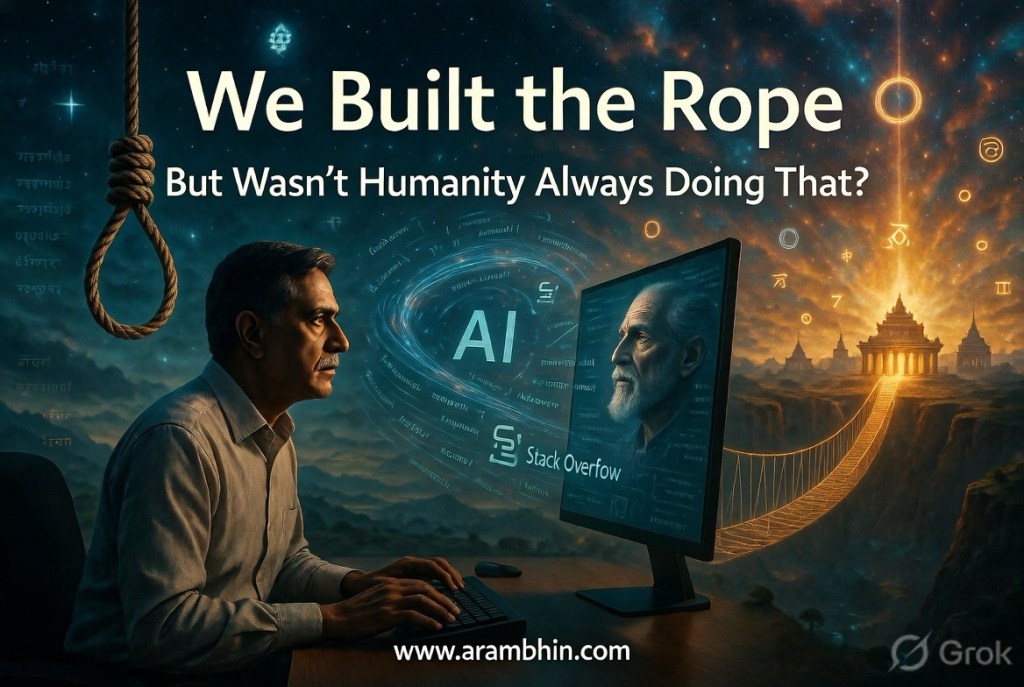
A fictional Stack Overflow thread that wandered into philosophy—then deeper.
Posted: June 17, 2026
[Question]
Title: AI was trained on our Stack Overflow answers, and now developers are losing jobs. Did we build the rope that hangs us?
Asked by: FrustratedSeniorDev (Gold Badge: 42k rep)
I’m so sick of pretending this is normal.
For twenty years, millions of developers shared answers here for free. No royalties. No attribution. No stock options. No warning. We did it because we genuinely cared about helping the next person down the line. We believed in the digital commons.
Now, trillion-dollar AI corporations have vacuumed up those exact answers, tokenized our hard-won expertise, and sold it back to our employers. My junior dev was laid off this morning. My manager told me my own output needs to triple using the automated coding assistant, or I’m next.
The people who sowed the seeds are being locked out of the garden by systems built from those very seeds.
We built the rope. They just bought the patent on the knot.
How is this fair? How do we even look at a code editor tomorrow morning?
[Answer 1] (Accepted Answer)
By: HistoryRepeats (Silver Badge: 12k rep)
Maybe because this is exactly how civilization has always worked. It doesn’t make it fair, but it makes it predictable.
- Ten thousand years ago: Farmers figured out selective breeding and agriculture. They didn’t become kings; they became taxable assets for the first empires.
- Five thousand years ago: Scribes recorded trade receipts and legal codes, inventing written language. The rulers used those records to consolidate power; the scribes remained servants.
- Two thousand years ago: Philosophers and mathematicians discovered geometry and physics. They died poor; empires built aqueducts and siege engines with their truths.
- Open-source era: Rogue developers created Linux and git for free. Internet giants built multi-billion-dollar cloud monopolies on top of them.
The pattern is ancient: Many sow. Few harvest. Society eventually redistributes the wealth—sometimes after centuries, sometimes after bloody revolutions, sometimes never at all.
Newton stood on the shoulders of giants. What he didn’t mention is that those giants stood on the backs of peasants. Civilization is an endless relay race where the runners are forced to drop the baton and get shoved off the track before the finish line.
[Comment]
By: AngryArchitect
That sounds noble, but it smells like a cop-out. It completely ignores the visceral feeling of betrayal. I shared my knowledge with fellow humans. I wanted to help a struggling student in Brazil or a self-taught programmer in Ohio. I never consented to my debugging notes becoming the raw, uncompensated atomic material for an algorithmic extraction engine. There is a grand canyon of difference between “my work helped a junior dev grow” and “my work was weaponized to replace that junior dev entirely.”
By: HistoryRepeats
You’re completely right. The vector and the velocity of extraction matter immensely. When medieval lords enclosed the common lands, it took generations. The peasants adapted, migrated, or fought back over decades. What we are witnessing right now is enclosure at the speed of compute. The elegant regular expressions you wrote in 2014 were digested, generalized, and deployed against your own mortgage by 2024. It’s a historical cycle, yes—but it’s running at 10,000 RPM.
[Answer 2]
By: OpenSourceMonk (Gold Badge: 89k rep)
True. But let’s look at the mirrors behind us.
Every single line of code you ever posted to this forum was itself built on books you didn’t pay royalties to, mentors who gave you their time for free, open-source RFCs, public university professors, and forgotten strangers on IRC networks whose names are lost to time.
Knowledge has always carried an evolutionary instinct to escape its owners.
The Greeks inherited from Egypt. Western Europe built its Renaissance on Arabic translations of mathematics. Modern science inherited from India, China, and Persia. Humanity is a vast, unmappable cathedral built by millions of workers whose individual names disappear into the stone. We are all plagiarism.
[Comment]
By: DataScientist42
The cathedral analogy breaks down when the cathedral charges you an API subscription fee to look at the altar you carved with your own hands. The compression ratio here is what’s terrifying. Centuries of accumulated human problem-solving were liquefied and poured into a server farm in Iowa over a long weekend.
By: OpenSourceMonk
I completely agree, and I want to clarify: I am absolutely not advocating for passive acceptance. The fact that enclosure has historical precedents doesn’t make this current corporate land-grab just.
But diagnosing the disease correctly matters. The problem isn’t that we shared our knowledge—sharing is our highest virtue. The problem is the specific legal and economic architecture that allows a private entity to privatize a public horizon. Knowledge escaping ownership is beautiful when it empowers the many. It is monstrous when it concentrates power into a single black hole. Same phenomenon. Opposite outcomes.
[Answer 3]
By: PatternSeeker
We are merely witnessing the transition phases of capital:
We moved from Agriculture to Industry, from Industry to Information, and now from Information to Monopolized Intelligence. The wheel of history keeps spinning.
[Comment]
By: BurnedOutDev
So that’s it? We’re just highly articulate hamsters running inside history’s meat-grinder? Thanks for the comfort.
By: PatternSeeker
Only if you think wheels can’t be jammed. The phases that follow “Social Disruption” aren’t automatic—they are won. They require friction. Labor organizing, data trusts, regulatory firewalls, and public, non-commercial models. The wheel turns by gravity, but its trajectory and who it crushes are up for grabs. The question isn’t “Will the machine run?” The question is “Who holds the wrench?”
[Answer 4]
By: VedanticProgrammer
Let’s look past the economics for a moment.
Civilization evolves in cycles, but wisdom traditions speak of an entirely different dimension. They divide our understanding into two distinct categories:
- Lower Knowledge (Apara Vidya): Science, tech, data, code, economic frameworks. It asks: What more can I know?
- Higher Wisdom (Para Vidya): Self-understanding, ethics, meaning, stillness. It asks: Who is the one trying to know?
AI is a hyper-optimized engine for the first category. It can synthesize all of human code in seconds. But it cannot touch the second. An AI can accurately define hunger, but it does not starve. It can write a beautiful essay on grief, but it does not weep. It can quote the Upanishads or King Lear, but it never sits in the dark wondering who it is when the screen turns off.
But we have to be intensely careful here. This distinction can easily become a spiritual bypass.
[Comment]
By: CuriousIntern
Can you expand on that? What do you mean by a spiritual bypass in this context?
By: VedanticProgrammer
I mean using inner peace as an alibi for ignoring systemic cruelty.
There is a profound danger in telling a developer who can’t pay rent, “Don’t worry, your true essence is untouched by the economic wheel.” Power loves that argument. It has been used for thousands of years by kings and oligarchs to tell the exploited that their physical suffering doesn’t matter because “true freedom is internal.”
That is a bastardization of the teachings. The genuine path is far more demanding: You must find the still axis within yourself so you don’t lose your mind and you must step onto the wheel to fight for the collective. Contemplation without action is cowardice. Action without contemplation is a fast track to bitterness and burnout.
The axis isn’t an escape hatch from the wheel. It’s the brace that gives you the leverage to change its direction.
[Answer 5]
By: RecursiveThinker (Moderator)
Let’s synthesize what this thread is actually exposing. There are two patterns operating simultaneously in human existence:
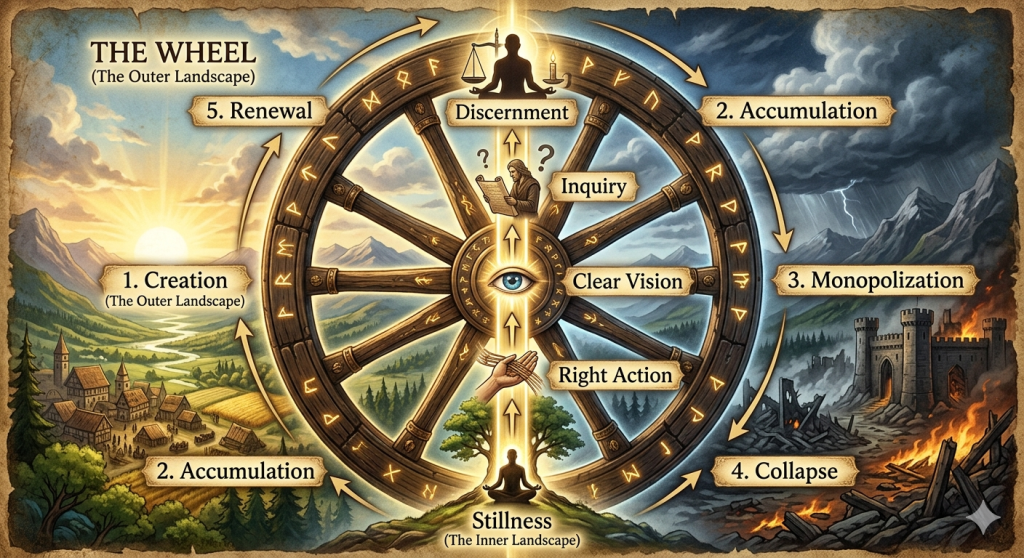
Most people spend their lives tossed around the rim of the Wheel, reacting to every bump. A few discover the Axis and use it to withdraw from the world entirely, sitting in isolated serenity.
But the rarest figures in human history? The ones who actually change the story? They find the Axis, anchor themselves in it, and then deliberately walk back out onto the turning edge of the Wheel. They use their inner stillness to execute steady, precise outer action. That is the archetype of the Bodhisattva, the wise organizer, the elder who doesn’t flee the burning village but walks back into the smoke.
[Comment]
By: PracticalDreamer
Beautiful poetry. Truly. But what does that look like on a Tuesday afternoon?
Give me specifics, not metaphors. I am a Senior Engineer whose team was gutted by 40% last week so our executives could pump our stock price with an “AI Integration” press release. I don’t need a Wheel. I need a survival guide.
By: RecursiveThinker
Fair. Let’s translate the Axis into code and policy. If we look at this mess with clear eyes, unblinded by panic or corporate hype, here are the real vectors of battle:
- Model Sovereignty: If these models were trained on the digital commons, the models themselves must belong to the commons. We need to demand open licenses and state-funded public compute utilities.
- Data Provenance and Choice: Current intellectual property law treats public human expression as free raw material for private capital. That is a legal fiction, not a law of thermodynamics. Laws can be rewritten.
- Alternative Frameworks: We must build software cooperatives and data trusts where contributors retain equity and voting rights over how their collective knowledge is deployed.
- The Ethics of Displacement: The true index of a civilization’s success isn’t its technological peak; it’s how it shields the people displaced by its transitions. We need to organize for robust safety nets, retraining guarantees, and universal dividends funded by automation taxes.
[Final Comment]
By: AnonymousUser
Perhaps Stack Overflow accidentally taught us something far more permanent than syntax.
We thought we were just exchanging solutions to unhandled exceptions and broken database queries. But maybe we were participating in the oldest human ritual. One generation writes the script. Another reads it. A third profits from it. A fourth complains about the theft. A fifth organizes a resistance. A sixth remembers it as myth.
And somewhere, woven quietly through the background noise of all those turning cycles, a quiet lineage of minds asks the only question that survives the collapse of empires:
Not: How do I optimize the machine?
Or even: How do I break the machine?
But: How do I preserve the humanity of the person trapped inside it?
Technologies, markets, and artificial minds will all inevitably rust, become legacy code, and turn to dust. But wisdom doesn’t sit quietly in the museum of history.
Sometimes it stands up. Sometimes it speaks. Sometimes it builds something the owners of the machine never saw coming.
[Epilogue]
“We built the rope,” the developer said, staring blankly into the cold glare of a compiler that no longer needed him. His hands hovered over the mechanical keyboard, hesitant, as if touching an instrument of a forgotten age.
“Yes,” replied the sage, sitting across the desk in the quiet, dim space where the digital noise faded into silence. “And you have every right to be furious about how it was knotted. That anger isn’t a defect in your character—it’s proof that your eyes are wide open. You see the theft for what it is.”
The developer looked up, his shoulders tight with the weight of a decade’s worth of stolen labor. “So what now? Do we just sit here and watch them pull the lever?”
“Ropes are versatile things,” the sage said softly, leaning forward. “The same fibers that weave a noose can be spliced into a suspension bridge. But bridges don’t build themselves out of thin air. They require architects who know the stress points, laborers who refuse to work for their own destruction, and a collective decision about exactly which shores get connected.”
The sage touched the edge of the monitor, turning it off. The reflection of two human faces looked back from the dark glass.
“That choice—the structural one, the political one—is sacred work. So rest if your spirit is bruised. Grieve for the junior devs who lost their footing today. But when the crying is done, pull your chair back up to the desk. We have an architecture to design.”
 Arambhin
Leave a comment