
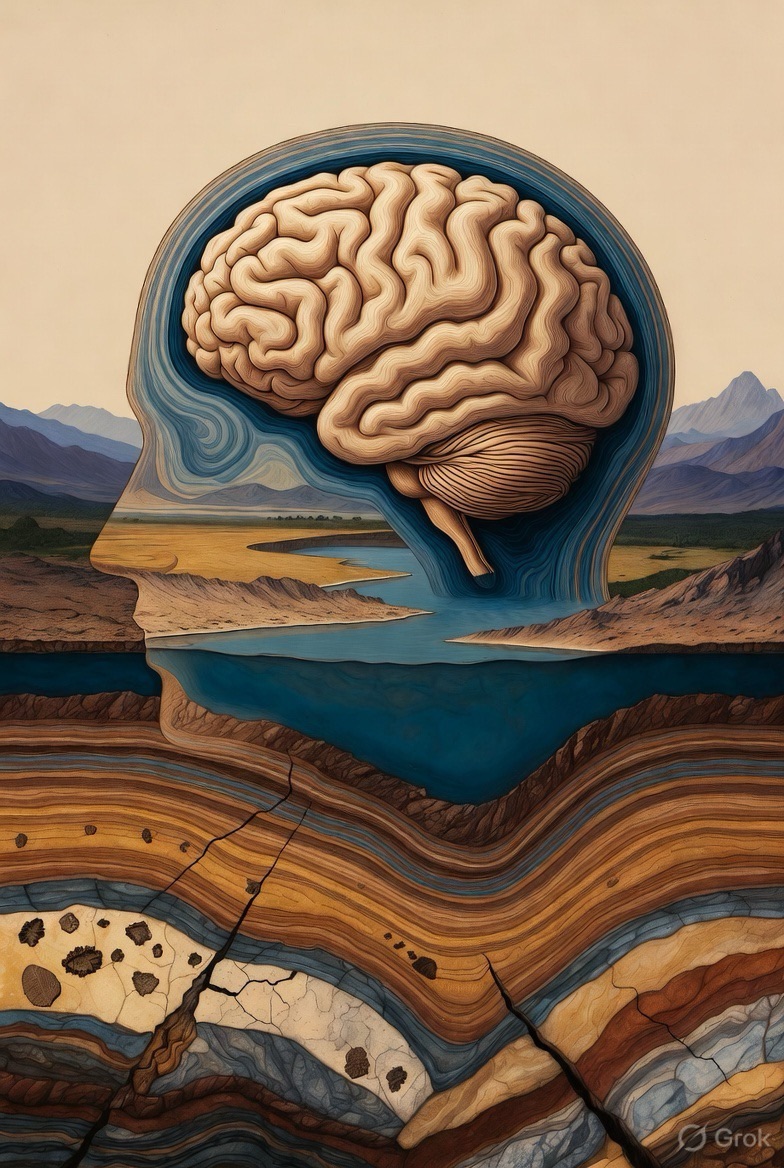
“Know thyself,” said the ancients.
Nobody told me that the path to fulfilling that command would begin with a steel hammer, a hand lens, and an obsessive fascination with the inert.
For more than a quarter-century, I lived under the comfortable illusion that I was studying the Earth. I spent my days examining the microscopic alignment of mineral grains, tracing the violent geometry of faults, reading the patient poetry of sedimentary layers, and analyzing how colossally heavy mountains came to be. I thought geology was a science of stones—objective, cold, and reassuringly external.
But somewhere between the jagged ridges of the Western Ghats and the illuminated stage of a microscope slide, a subtle realization took root. What if I wasn’t merely studying the Earth? What if the Earth, with its 4.5-billion-year resume, was quietly teaching me how to study myself?
The Day the Rocks Started Talking
After long weeks in the field, I would return home to Chennai, my rucksack heavy with fragments of terrain older than the very concept of civilization.
My wife would watch me unburden these dusty treasures onto the dining table, her expression hovering between amusement and mild resignation.
“Normal people bring back flowers or sweets from their travels,” she would say, brushing a stray grain of ancient quartz off the tablecloth. “You bring back structural debris.”
She wasn’t wrong. Over the decades, the shelves of our home slowly transformed into a museum of personal geography: a block of granite from the wind-swept Ghats, a dark, dense chunk of basalt from the Deccan Traps, a piece of weathered sandstone picked up during a solitary, reflective expedition when the career ahead felt as vast and uncertain as the landscape.
For years, they sat there as mere specimens. But eventually, the labels faded. The rocks ceased to be data points and became mirrors. I began to see that geology is not just the study of lithology; it is the grand narrative of time, pressure, transformation, and memory.
And that is precisely what the mind is.
1. Tectonic Shifts and Inner Friction
As a young geologist, the first grand concept that captivates you is plate tectonics. You learn that the continents we walk upon are never truly at rest. Invisible, colossal plates push against one another in the dark, generating unimaginable friction. The surface looks stable, but deep down, pressure builds. Eventually, something must give. An earthquake reshapes the landscape in a matter of seconds.
Human beings operate on the same structural mechanics.
We spend our lives pretending nothing is moving beneath the surface. We present a calm, curated facade to the world while, internally, titanic forces stand in opposition. Professional ambition collides with domestic responsibility. The desire for absolute freedom clashes with the call of conscience. The terror of aging rubs against the stubborn persistence of hope.
The mind has its own tectonic boundaries. When we experience an emotional crisis—a sudden burnout, a mid-life reckoning, an existential pause—we are not witnessing a random malfunction. It is a psychological earthquake, a necessary slippage announcing that something deep within the mantle of our identity has shifted, demanding a new equilibrium.
2. Sedimentary Memory and Accumulated Selves
Sedimentary rocks are the historians of the planet. A cliff face is a library. Each distinct layer represents a forgotten epoch—a season of catastrophic floods, the ash-fall of a prehistoric volcano, or the peaceful, sluggish deposition of an ancient inland sea. Millions of years of planetary experience compressed into thin pages of stone.
One evening, while looking through an old cupboard and coming across a stack of fading family photographs, the parallel struck me. My mind was entirely sedimentary.
The insecure childhood spent seeking footholds; the electric, high-velocity years of early adulthood; the sharp, jagged strata of professional failures; the quiet, heavy deposits of regret; and the bright, crystalline veins of pure joy. These experiences do not vanish; they settle. Layer upon layer, they compress under the weight of passing time.
When I refer to “myself” today, I am not pointing to a singular, monolithic entity. I am pointing to an accumulated stack of historical sediments. To understand the person standing in the present, one must learn to core-sample one’s own past.
3. The Utility of Fault Lines
In commercial geology, an enormous amount of time is dedicated to locating and mapping faults. To the uninitiated, a fault looks like a failure—a place where the continuity of the rock was fractured, broken, and displaced by stress.
But to a seasoned geologist, a fault line is where the story gets interesting. Faults are not defects; they are the paths of least resistance through which hidden forces reveal themselves. They are where deep-seated energy finds expression, often bringing valuable minerals and deep groundwater up to the reachable surface.
I used to view my own emotional fractures—the periods of deep grief, the professional transitions where the track I was on snapped completely, the times I felt entirely lost—as systemic failures. I wanted a life that was a smooth, unbroken stratum.
Now, I look at those fractures with a gentler eye. Those weren’t design flaws; they were my personal fault lines. It is precisely at the points where we break that our deeper nature is forced to the surface. Your vulnerability is not a structural weakness; it is the place where your narrative becomes visible.
4. Metamorphism and the Architecture of Suffering
There is nothing particularly impressive about a lump of common carbon or a soft bed of clay. But subject that clay to the terrifying, suffocating depths of the Earth’s crust—where temperatures soar and pressure grinds everything down—and it recrystallizes. The clay becomes a brilliant, enduring schist; the limestone transforms into elegant marble.
Metamorphism changed my entire relationship with human suffering.
When we encounter hardship—the loss of a parent, the decline of physical youth, the collapse of a project we poured our souls into—our immediate instinct is to view it as an interruption. We wait for the pressure to pass so we can resume being who we were.
But the geology of the mind teaches us that pressure is not an interruption; it is a catalyst. It does not merely crush; it reorganizes our internal alignment. The goal of enduring difficult seasons is not to emerge unchanged, boasting of our resilience. The goal is to allow the heat and pressure to recrystallize us into something tougher, deeper, and more beautifully structured than the soft material that went into the crucible.
5. Extinct Identities and Personal Fossils
Deep within sedimentary formations, we find fossils—the unmistakable impressions of organisms that once dominated the ecosystem but are no longer present. They are remnants of an old world, preserved in stone.
As I sit in the quiet of my study, I realize that I am a walking museum of my own extinct identities.
I can still find the distinct fossil of the boy who desperately sought validation from elders. Just above that layer rests the imprint of the high-velocity corporate manager, obsessed with milestones, velocity metrics, and targets, moving at a speed that allowed no time for looking sideways. Further up lies the anxious individual terrified of professional irrelevance.
Those versions of me are entirely gone; they could not survive the atmospheric changes of my life’s timeline. Yet their impressions remain etched into my psychological bedrock. We do not shed our past selves like snakeskin; we inherit them as ancestral foundations.
6. Subterranean Aquifers of the Soul
When we look at a map of the world’s water, we focus on the visible markers: the roaring rivers, the expansive lakes, the oceans. But an incredibly vast percentage of the planet’s fresh water exists out of sight, locked in deep underground aquifers, moving silently through pores in the rock, sustaining the surface flora from beneath.
The psychological parallel is profound. The world judges our lives by our visible water—our public statements, our resume highlights, our explicit achievements. But the life that actually sustains us is subterranean.
The quiet reservoir of a lifelong friendship; the silent, unspoken understanding shared across a breakfast table with a partner of decades; the unhurried moments of morning contemplation; the hidden wellspring of gratitude that requires no audience. These are the aquifers of the inner life. When the surface conditions of our lives encounter a severe drought, it is these invisible reserves that keep our roots from drying up.
7. The Erosion of the Ego Mountains
To a human eye, a mountain range like the Himalayas or the Alps appears to be the very definition of eternity. They stand high, casting long, unyielding shadows over the valleys. But to a geologist, mountains are highly dynamic, temporary monuments. They rise aggressively, but the moment they reach for the sky, the quiet forces of wind, water, and frost begin to dismantle them. Eventually, they are ground down into sand and carried away to the ocean floor.
Our constructed identities—our grand titles, our hard-won social status, our iron-clad opinions, our carefully defended egos—are the mountains of the mind. We build them up with immense effort, proud of how high they tower over others.
But time is an incredible erosive agent. Aging, wisdom, and life experience gently but relentlessly weather away the sharp peaks of our self-importance. We learn that holding onto rigid, towering opinions is an exhausting architectural feat. We allow the ego to erode, discovering that there is immense peace in becoming a fertile valley rather than a jagged, isolated peak.
Returning to the Surface
These days, when I return to Chennai from an excursion and place a newly found rock on my study shelf, I find myself smiling. I no longer see an inert piece of structural debris. I see a teacher.
The Earth has spent four and a half billion years mastering the exquisite art of patience, balance, and structural transformation. It does not panic during an ice age, nor does it despair during a volcanic upheaval. It simply folds, deposits, metamorphoses, and continues its journey through time.
Perhaps our human lives invite us into the exact same elegant process. Self-knowledge is not an act of frantic, external invention. It is an exercise in excavation.
Like a field geologist using a fine brush to clear away the accumulated dust from an ancient, beautiful fossil, our task is to carefully uncover our own layers. We do not do this to become someone else. We do it to remember the foundational rock we have always been built upon.
Geology is the autobiography of the Earth. The mind, in its quiet depths, is the autobiography of the self. And both are written with beautiful slowness, under immense pressure, one magnificent layer at a time.
In the end, the geologist and the seeker converge. We do not study the Earth merely to predict quakes or mine resources. We study it to learn the art of becoming—how to hold immense pressure without shattering, how to let old forms dissolve into new beauty, and how to trust the slow, patient writing of time.
Know thyself, said the ancients.
Perhaps the rocks have been answering all along.
 Arambhin
Leave a comment