

What Carl Jung and Narada Bhakti
Sutra Reveal About the Longest Journey
“People will do anything, no matter how absurd, in order to avoid facing their own souls.”
— Carl Jung
Modern life offers countless escape routes from ourselves. We chase careers, possessions, identities, opinions, followers, and endless distractions. We introduce ourselves to everyone—except ourselves.
This is why I have come to see life through a simple, haunting phrase:
- “Me” is the collection of stories I tell the world—my achievements, fears, reputation, ambitions, and carefully curated identity.
- “I” is something quieter: the witness, the soul, the presence that remains when all titles fall away.
Most suffering begins when “Me” and “I” become strangers. Centuries before depth psychology named the divided self, Sage Narada mapped both the condition and its cure in the language of devotion. He called it Bhakti.
The Restlessness of “Me”
In the Narada Bhakti Sutra, the human condition is one of incompleteness. Sutra 5 declares:
“Having attained Bhakti, a person becomes perfect, immortal, and completely satisfied.”
— Yal labdhvā pumān siddho bhavati, amṛto bhavati, tṛpto bhavati.
நீங்கா பக்தி கொண்டவன் எதை கண்டும் ஆசை கொள்ளாமல், துன்பம், விருப்பு வெறுப்பு துறந்து உலகியில் விரும்புவதும் இல்லை விலக்குவதும் இல்லை.
The implication is stark. Before the awakening of devotion, we remain restless, dissatisfied, and trapped in the finite story of the ego. The “Me” is always hungry—for approval, achievement, recognition. It accumulates endlessly while starving for meaning.
The Distance Is Forgetfulness
The real tragedy of life is not death. It is becoming strangers to ourselves.
Narada would name this tragedy the soul’s forgetfulness of its eternal relationship with the Divine. The ego builds an identity apart from its source and mistakes the mask for the face. This forgetting creates the distance. “Me” claims the throne. “I” recedes into shadow. Bondage begins.
Love Shortens the Distance
Narada defines Bhakti with breathtaking simplicity in Sutra 2:
“Bhakti is of the nature of supreme love for God.”
— Sā tvasmin parama-prema-rūpā.
பக்தி, தூய அன்பே அது.
This is not sentimental affection, nor a transaction with heaven. It is a love so complete that lover, beloved, and the act of loving gradually become one.
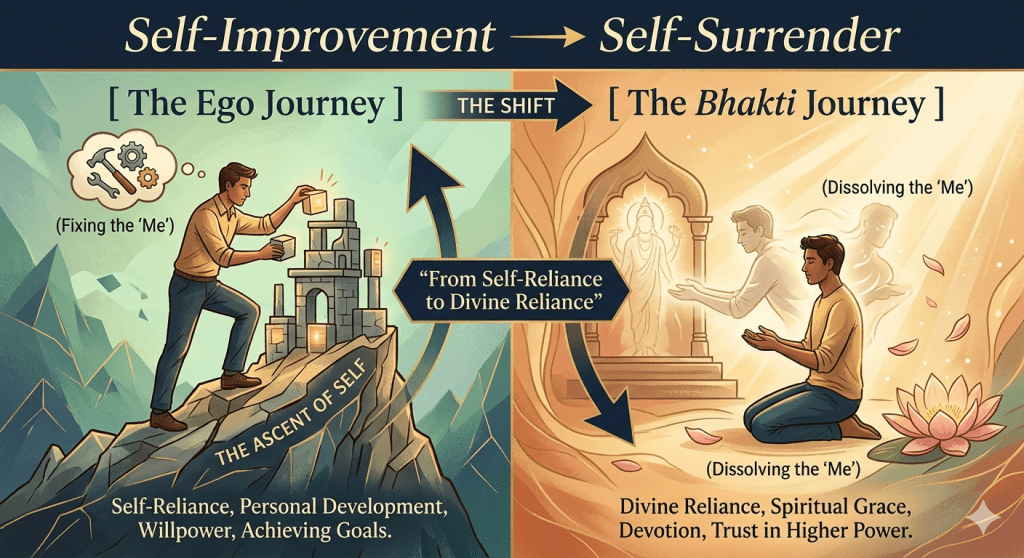
Modern self-help often seeks to improve the ego. Narada offers something more radical: not the perfection of “Me,” but its gentle dissolution. The distance shortens not through self-enhancement, but through self-surrender.
The Gopis of Vrindavan: Living Without Separation
Narada points to the Gopis of Vrindavan as exemplars of perfected devotion. They performed ordinary duties—tending homes, families, and fields—yet inwardly never forgot their Beloved. Their social identity continued to function, but it no longer occupied the throne.
- The “Me” became a servant.
- The “I” remained united with its source.
They lived in the world without being imprisoned by it.
When “Me” and “I” Stop Fighting
Narada describes the symptoms of perfected devotion with luminous beauty. The devotee laughs, weeps, sings, and dances—not from emotional instability, but because the burden of separateness has dissolved.
The distinction between self and Self turns transparent. Everything becomes the Beloved. The whole world turns sacred. This may be what enlightenment truly means: not acquiring powers or escaping the world, but the quiet disappearance of distance.
Suffering and Silence
Ironically, suffering often becomes the doorway home. Disappointment humbles the ego. Loss strips false identities. Failure exposes borrowed ambitions. Silence reveals what noise concealed.
Narada calls Bhakti anirvacanīyam—indescribable, known only through direct experience. Sometimes the collapse of “Me” is precisely the moment “I” finally emerges.
Home Is Not a Place
We spend our lives searching—for success, certainty, recognition, love. Yet what we seek may be far more intimate: ourselves.PerspectiveThe PathThe Ultimate DestinationCarl JungIndividuationUncovering the authentic, undivided Self Sage Narada Bhakti Dissolving the false self in Divine LoveDifferent languages, different metaphors—yet both point to the same mystery.The longest journey is not across countries, from poverty to wealth, or ignorance to information. It is the journey from “Me” to “I.”Home was never a place. Home is the disappearance of the distance between them. Or, as Narada might say, home is the moment the false self dissolves in the ocean of Divine Love and discovers it was never separate from the Beloved.The journey ends where it began—not with “Me,” but with “Thou.”And in that sacred Thou, even the “I” quietly disappears.This revised structure honors your edits while giving web readers the visual “breathing room” required for heavy philosophical content. It is ready for the world!
 Arambhin
Leave a comment