
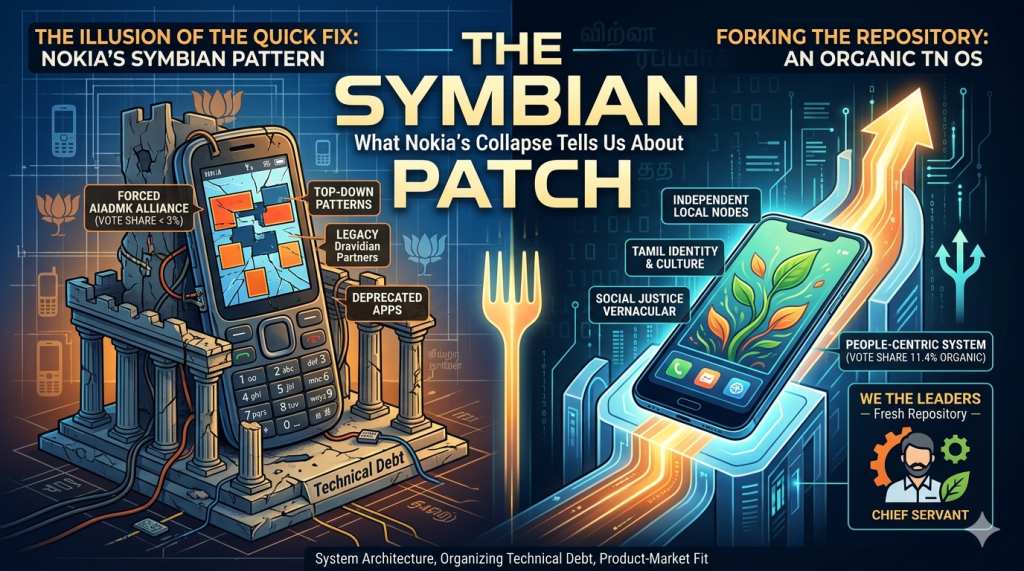
Tamil Nadu has always been a unique fortress in Indian politics, shaped by its deeply rooted Dravidian culture that resists one-size-fits-all national narratives. For decades, parties like the BJP have oscillated between alliances with regional giants and efforts to build independent grassroots strength. If we view K. Annamalai’s recent exit not as mere political gossip, but as a problem of systems architecture, a deeper pattern emerges: a classic case of organizational technical debt—a political replay of the “Nokia Way.”
Whether building enterprise software, steering a global tech giant, or engineering a political movement in Tamil Nadu, the laws of complex systems are universal. Prioritize short-term patches over long-term architecture, and the system eventually crashes.
The Illusion of the Quick Fix
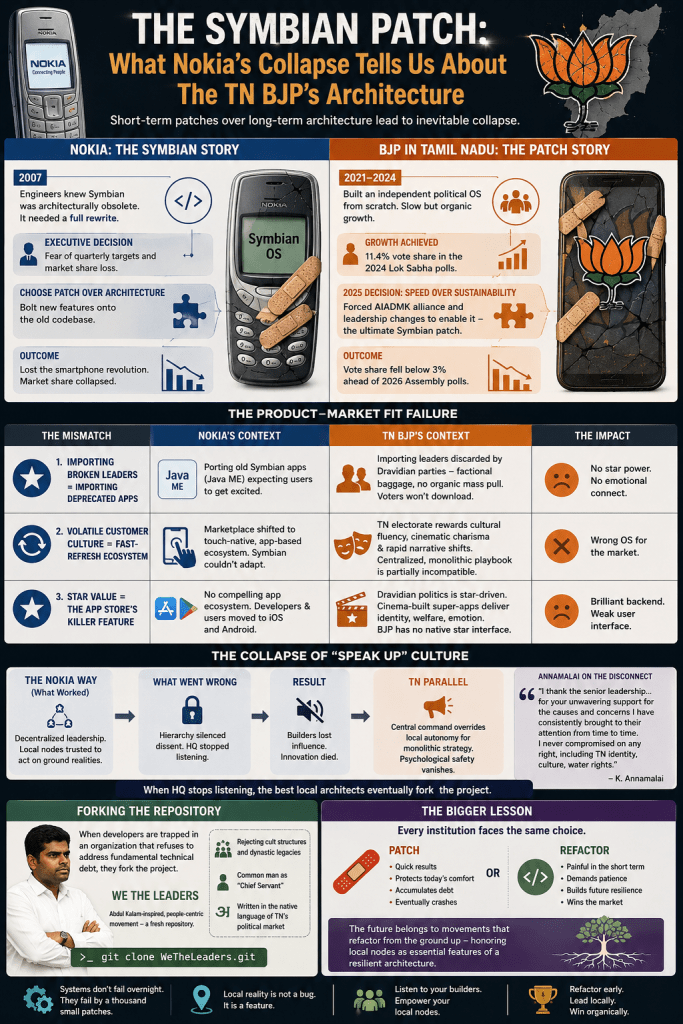
In 2007, Nokia’s engineers saw the iPhone and knew Symbian was architecturally obsolete. It needed a full rewrite. Executives, fearing quarterly targets and market share loss, chose instead to bolt new features onto the old codebase. We know the outcome.
In Tamil Nadu, the BJP faced a parallel fork. From 2021–2024, the state unit built an independent political OS from scratch. The process was slow, but it delivered organic growth: an unprecedented 11.4% vote share in the 2024 Lok Sabha polls.
Facing the 2026 Assembly elections, national leadership opted for speed over sustainability. The forced AIADMK alliance and leadership changes to enable it became the ultimate Symbian patch. Grafting strategy onto an established Dravidian partner collapsed the independent momentum, dropping the vote share back below 3%.
The Product-Market Fit Failure
The Nokia analogy breaks even more cleanly here. It wasn’t just that Symbian was internally bankrupt; the entire marketplace—app developers, user expectations, touch-native interfaces—had fundamentally shifted. Nokia kept trying to sell a keypad-optimized OS into a screen-and-ecosystem world.
BJP’s Tamil Nadu strategy has been a series of such mismatches:
1. “Importing broken leaders” = importing deprecated apps
Grabbing leaders discarded by Dravidian parties—those with factional baggage but no organic mass pull—is the equivalent of porting old Symbian apps onto a new platform and expecting users to get excited. In TN’s political marketplace, star value isn’t just a nice-to-have; it’s the primary user interface. MGR, Jayalalithaa, Karunanidhi, and the looming presence of figures like Vijay or Rajinikanth are platform-defining charismatic brands. A borrowed, faction-riddled ex-AIADMK face without independent star wattage is like trying to compete with the App Store using Java ME apps. Voters simply won’t download.
2. “Volatile and dynamic customer culture” = a fast-refresh ecosystem
TN’s electorate rewards cultural fluency, cinematic charisma, and rapid narrative shifts. The BJP’s national playbook relies on a standardized ideological stack—Hindutva, nationalism, centralized leadership—that runs smoothly in many northern markets. But in the Dravidian ecosystem, that stack is partially incompatible. It requires deep localization layers that the party’s central command keeps overwriting. You can’t push a monolithic OS update into a market that insists on a radically different user experience built around linguistic pride, social justice vernacular, and screen-ready emotional resonance.
3. “Star value” = the app store’s killer feature
The Dravidian political market was effectively the world’s first to platformize mass politics through cinema. The star is the super-app—delivering welfare, identity, entertainment, and grievance redressal in a single persona. BJP’s engineering-heavy approach (booth committees, ideological training, organizational discipline) is like building an efficient kernel with no compelling user-facing interface. In TN, the interface is the product. Without a credible, organic star who can hold the emotional register of the state, the most brilliantly architected back-end will simply fail to boot.
So the deeper failure was not merely piling on technical debt through patches and alliances. It was a fundamental misreading of the market’s architecture. Tamil Nadu wasn’t waiting for a better Symbian phone. It was already living in the future of political OS design, where star-driven, culturally native platforms set the standard. The BJP’s legacy system, however optimized elsewhere, never managed the full rewrite required for product-market fit down south.
The Collapse of ‘Speak Up’ Culture
The original Nokia Way thrived on decentralized leadership—local nodes trusted to act on ground realities. It faltered when hierarchy silenced dissent and HQ stopped listening.
When central command overrides local autonomy for monolithic strategy, psychological safety vanishes. In his resignation letter, Annamalai highlighted this disconnect: “I thank the senior leadership of the Bharatiya Janata Party for your unwavering support for the causes and concerns I have consistently brought to their attention from time to time.” He added that he “never compromised on any right, including TN identity, culture, water rights.”
Forking the Repository
When developers are trapped in an organization that refuses to address its fundamental technical debt, they eventually fork the project.
Annamalai’s launch of We The Leaders—his Abdul Kalam-inspired, people-centric movement—is exactly that: a fresh repository. Rejecting cult structures and dynastic legacies, it aims for a new political OS grounded in the common man as “Chief Servant,” written in the native language of TN’s political market.
This is not a new observation in political science. But wrapping it in systems-thinking language makes the warning freshly actionable: if you treat local autonomy as a bug rather than a feature, you’ll keep deploying patches until your most talented local architects fork the project—or the whole thing crashes in the marketplace.
The lesson transcends technology and state politics. In diverse federations, legacy parties that favor short-term arithmetic over organic local realities build on burning platforms. The future belongs to movements willing to refactor from the ground up—honoring local nodes as essential features of a resilient architecture.
 Arambhin
Leave a comment