
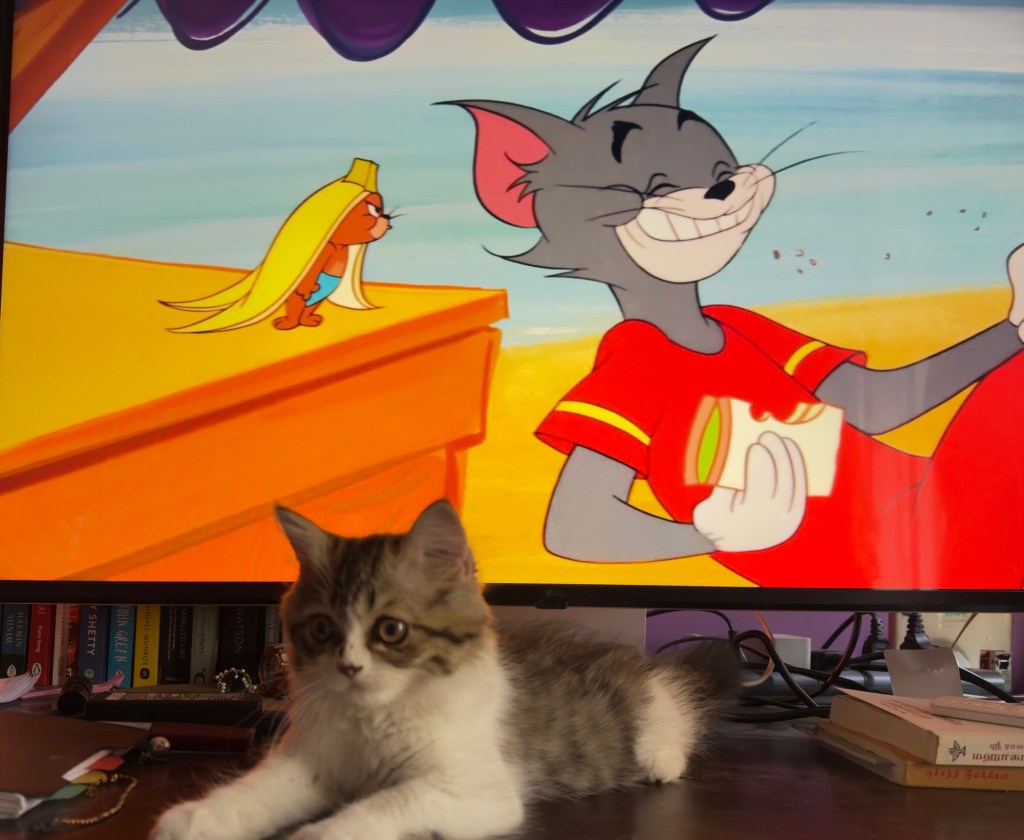
Chasing Cheese, Avoiding War, and Waiting for Nothing
I. The Cartoon Condition
We begin where all wisdom begins: with a cat, a mouse, and a piece of cheese. On the surface, Tom and Jerry is a children’s cartoon. But a catoscopist reads it as a sutra. Tom chases. Jerry evades. The cheese is never eaten for long. The trap springs on the trapper. The episode ends. Another begins.
This is not a cartoon. This is samsara—the wheel of pursuit, frustration, and repetition that most of us call life.
Most people ask: Who moved my cheese?
The catoscopist asks: Why am I chasing at all?
To see the depth of this question, we turn to two great mirrors of the human chase: the Bhagavad Gita and Samuel Beckett’s Waiting for Godot. One offers a path beyond the chase. The other shows the chase stripped of all illusion. Between them, the cheese keeps moving.
II. The Bhagavad Gita: Arjuna on the Battlefield, Tom on the Screen
The Gita opens with a crisis. Arjuna, a warrior, stands between two armies. He sees teachers, cousins, and grandfathers on the opposing side. He lowers his bow. “I will not fight.”
Krishna, his charioteer and the divine witness in disguise, does not counsel retreat. He smiles with the calm of one who sees the entire cartoon at once.
Krishna’s teaching is the first great catoscopic lesson: You are not the chaser. You are not the body, the ego, or the role. You are the witness.
Arjuna’s problem is Tom’s problem. Tom believes he is the chaser; his identity depends on catching Jerry. Arjuna believes he is the warrior whose dharma demands he fight. Without the battle or the chase, who are they?
Krishna does not dissolve the battlefield. He invites Arjuna to act within it differently. Perform your duty with full presence and skill, yet release any desperate grip on the outcome. Chase the cheese as the role requires—set the trap, swing the hammer—but know the cheese is shadow and the victory was never yours to own. Success or failure, the anvil lands or misses—the mind stays even. The action purifies rather than binds.
This is no call to half-hearted effort or clever avoidance. It is the same chase, executed brilliantly, but offered without clinging. Tom still runs across the screen. Arjuna still stands his ground. Yet neither is trapped by the cartoon, because the inner doer has stepped back. The role plays itself through you, while the witness watches, untouched.
In this light, the battlefield and the cartoon floor become one: arenas where the ego’s frantic ownership dissolves into something lighter, freer. You chase because the moment demands it, not because your peace depends on catching anything.
III. Waiting for Godot: When the Cheese Never Comes
Beckett’s Waiting for Godot is the Catoscope’s second mirror. Here, the cheese never appears. Only Vladimir and Estragon by a bare tree, waiting for Godot who never arrives. They talk, argue, fiddle with boots, consider hanging themselves. A boy brings the same message: not today, surely tomorrow.
The play ends: “Well, shall we go?” Stage direction: They do not move.
This is the chase without the cheese—pure habit of waiting. The compulsion remains even when the object vanishes. Modern life distilled: refreshing empty inboxes, doomscrolling, staying in stale situations because stopping feels scarier than the void.
The Gita gives the ladder: act without attachment, recognize the witness.
Godot shows the cliff: even without cheese, the waiting continues. The body performs the ritual of pursuit long after the mind has seen the absurdity.
Yet the catoscopic synthesis holds: Beckett is not mere despair. The witness remains—the one watching Vladimir and Estragon, the same one watching Tom and Jerry. The cartoon changes. The witnessing does not. Compassion arises for the characters who cannot stop moving (or not-moving).
IV. The Three Questions, Revisited
The original Catoscope gave us three levels:
- Who moved my cheese? (worldly)
- Why am I chasing it? (psychological)
- Who is the one chasing? (metaphysical)
The Gita answers the third directly: The chaser is not ultimately you. You are the atman—the witness. The path of acting fully while releasing ownership and fruits becomes the lived method.
Beckett exhausts the second question: Why chase? Because stopping is terrifying. The habit persists.
Together they evoke the fourth: What happens when the witness recognizes itself?
That recognition ends the inner chase. The cartoon continues—Tom flattens under pianos, Vladimir and Estragon wait—but the emotional charge drains. The second arrow of self-suffering loses its power. You play the role without being defined by it.
V. The Cheese Chase Remains – But You Need Not
Return to the screen. Tom runs. Jerry ducks. The trap snaps. Laughter track.
The Gita says: Do your duty, dedicate the fruits.
Beckett says: He’ll come tomorrow. No, he won’t. Let’s go. (They do not move.)
All are true. Some days you are Arjuna, some days Vladimir, some days the flattened Tom or nibbling Jerry. Through all, something never enters the cartoon: the one watching.
VI. A Catoscopic Practice
If the essay has opened even a small gap, the next episode of Tom and Jerry may reveal it. Sit and watch—not rooting for cat or mouse, not anticipating the next pratfall. Simply watch the cheese appear, the trap spring, the bodies tumble through impossible physics. Then notice the one who is watching all of it.
After the screen goes dark, remain there a moment. Ask gently: Who is still here?
In the ordinary hours that follow, the same seeing can seep into the day. The email must be answered, the meeting attended, the conversation held. The role calls for effort, clarity, even intensity. Yet somewhere inside the doing, a quiet non-clinging can appear. The outcome matters, and yet it does not own you. The anvil falls, the praise arrives, the plan collapses—and the inner weather stays steadier than before.
The cheese changes.
The chase remains.
The witness remains—smiling, compassionate, free.
That is the lesson of the Catoscope.
 Arambhin
Leave a comment