
Reclaiming the Uncolonized Mind in the Age of AI
We live in a house that has stood for more than a hundred years. Not merely bricks and wood, but a living witness to generations, memories, and quiet relationships.
My grandfather and father were respected teachers in our locality and the surrounding villages. Over time, our home became far more than “our house.” Its entrance remained open during school hours. Students from nearby villages would park their cycles outside, their steel tiffin boxes lining the verandah like small markers of childhood. Some drew water from our well. Others drank from the cool earthen pot kept in the shade. A few would casually ask, “Is there some pickle?” And somehow, there always was.
No one needed exact addresses or GPS to find us. They simply said, “Go near the teacher’s house.”
Even today, the mention of our village often turns conversations toward my grandfather or father — the discipline they taught, the kindness they offered, and the advice that lingered long after lessons ended. Looking back, I see that our house was never just private property. It functioned as a small social courtyard where trust, correction, care, and belonging flowed naturally between people.
In those days, communities did not merely share geography.
They shared life.
Once upon a time, identity was shaped slowly, carved by the steady hands of time and geography. A village knew your grandfather. A river knew your footsteps. That world — tactile, rooted, and witnessed — is the one I inherited.
Today, a recommendation engine knows you better than your neighbor.
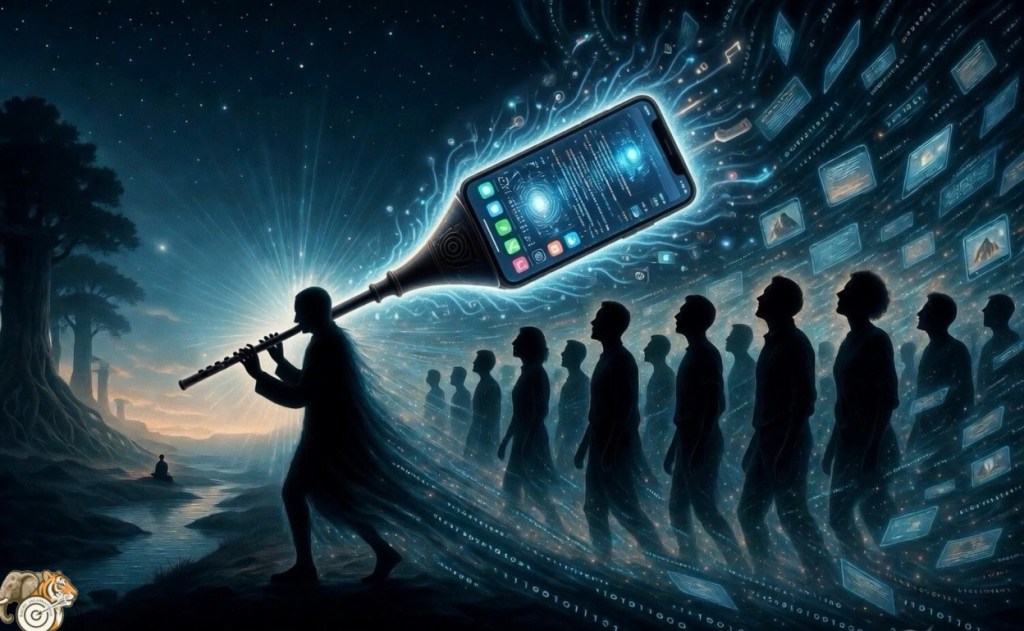
We have crossed the threshold into the age of the group algorithm. These are not just lines of code humming in distant server farms; they are invisible behavioral rivers. We are swept away in currents of micro-trends, outrage cycles, tribal fandoms, and engagement economies. The glowing rectangle in your hand has become a psychological flute, and billions now walk like algorithmic pied pipers, swaying to invisible tunes.
Somewhere inside this noise, a terrifying question emerges: Which of these thoughts are actually mine? The line between me, mine, and my mind is dissolving.
Me: From Rooted to Rendered
“Me” was once deeply experiential—forged in lived failures, physical communities, family histories, and direct encounters with a tactile reality.
Now, “me” is increasingly assembled through external mirrors: likes, metrics, follower counts, and the fleeting validation of digital tribes. Identity has become an editable profile. We no longer look at the stars and ask, “Who am I?” We look at the screen and ask, “How am I perceived?” The self has shifted from being rooted in the earth to being rendered in the cloud.
Mine: The Rental Civilization
Earlier generations owned fewer things, yet possessed a fierce sense of belonging. A small house. A handful of heavy tools. One lifelong craft. One tightly knit community.
Today, we own subscriptions, cloud storage, curated playlists, virtual skins, and thousands of unseen photos. Ownership has become infinite, yet attachment has become temporary. Even relationships behave like app updates: terms change, compatibility fails, and newer versions appear in the feed. “Mine” is no longer about stewardship; it is about conditional access. In a rental civilization, even identity feels leased.
My Mind: The Cognitive Occupation
This is where the real battle begins. The ancient world feared demons entering the mind. The modern world perfected APIs for them. Every swipe trains the machine. Every lingering pause feeds the prediction engine. Algorithms no longer merely observe our attention—they shape it. Your anger is monetized. Your loneliness is targeted.
The algorithm does not force agreement; it engineers emotional weather. Millions laugh at the same meme, rage at the same headline. From the 2020 global protests synchronized by platforms to the rapid spread of AI-generated memes in 2025, we sit thinking we are surfing the internet. More often, the internet is surfing us.
The Delineation
How do we differentiate me, mine, and my mind? The answer is not technological, but deeply human.
You must sit in the quiet and begin noticing. Notice what remains when the screen goes dark. Notice which thoughts survive the silence. Ask: What would I still love if no one validated it? Search for beliefs born from scars and experience, rather than slogans from the feed.
Reclaiming the Self
The path lies not in new productivity hacks, but in the ancient discipline of turning inward. Vedantic inquiry demands svadhyaya and relentless discrimination between the eternal atman and the fleeting maya of appearances. Andal, in her Nachiyar Thirumozhi, and Sage Narada in the Bhakti Sutras sang of a devotion so complete it dissolves the false self woven by external forces: a love so total —
பக்தி, தூய அன்பே அது
parama prema — it leaves no room for algorithmic occupation.
Thiruvalluvar warned in the Thirukkural that an undisciplined mind invites ruin, teaching that mastery
over one’s thoughts is the foundation of a worthy life.
Kural 540 (Chapter 54: Absence of Mind / நினைத்தொழுகல்):
உள்ளிய தெய்தல் எளிதுமன் மற்றுந்தான்
உள்ளிய துள்ளப் பெறின்
Translation: One can easily accomplish what one thinks of, if only one keeps thinking of it steadfastly.
In this spirit, one protects consciousness not through rules of restriction alone, but through sadhana—daily practices of silence, mantra, and unmediated encounter with the divine in the ordinary. Return to the breath. Return to the ground beneath your feet. Let the mind steep in unhurried contemplation until the foreign currents lose their pull. Only then does the colonized mind remember its original freedom.
The Ultimate Luxury
The real luxury of the future will not be wealth, virality, or endless connectivity. It will be the uncolonized mind — the quiet inheritance of that old house where life was shared without mediation, where attention belonged to the present moment and not to distant algorithms.
It is the freedom to sit in silence like the sages of old, to feel unmanufactured emotions, to think thoughts that have not been suggested, and to meet reality with bare hands and open eyes. In the age of the group algorithm, the greatest rebellion is not to shout louder into the void.
It is to return, again and again, to the still centre within — and finally hear your own mind, clear and sovereign, once more.
 Arambhin
Leave a comment