
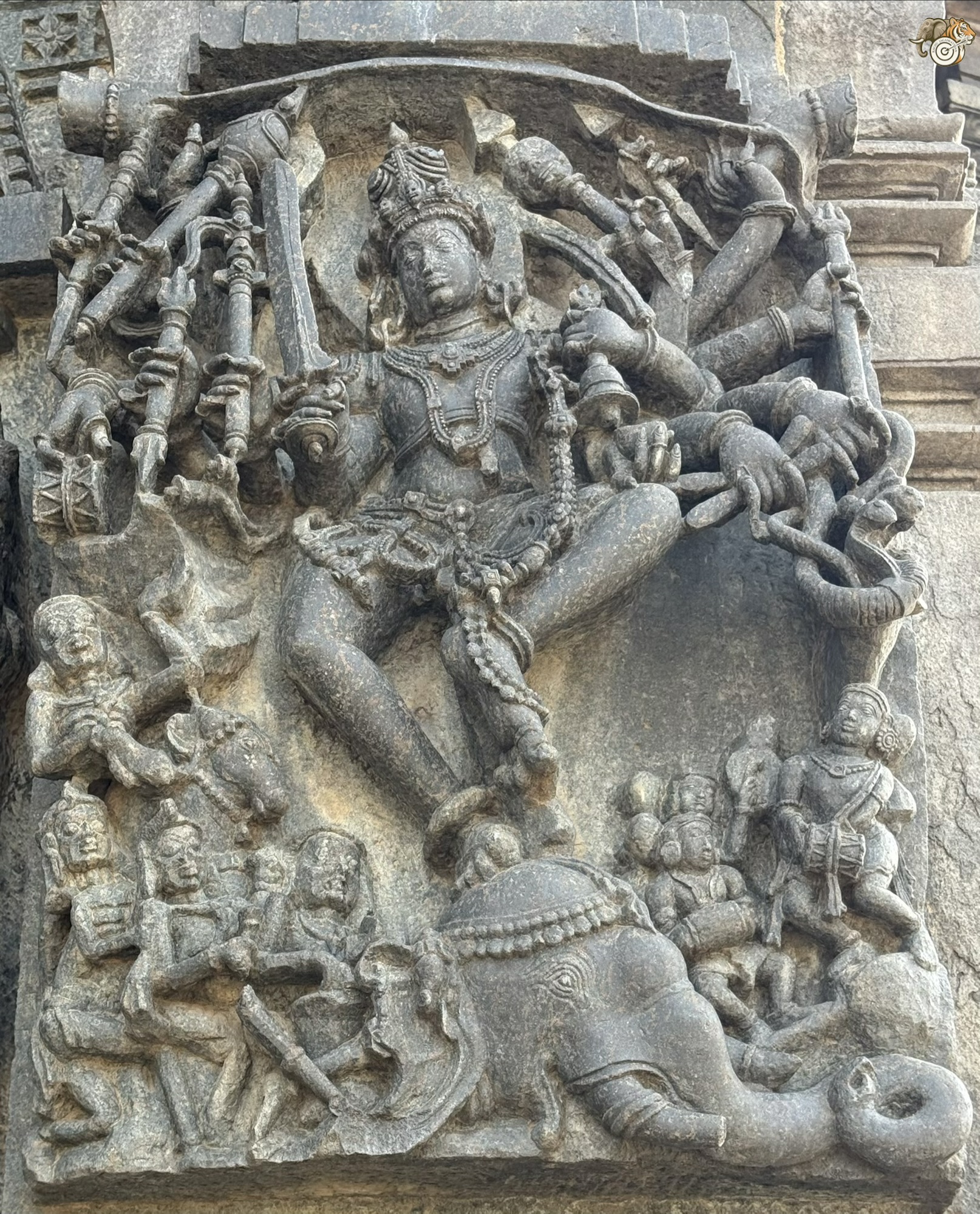
There is something about elephants that stirs a feeling beyond words. Whether encountered in a dense forest, along a winding jungle road, or within the sacred precincts of a temple, they seem to awaken an ancient memory buried deep within us. Yet my visit to the magnificent Chennakeshava Temple was different. Standing before the soapstone masterpiece of Gajasamharamurti, carved centuries ago by Hoysala artisans and preserved through invasions, destruction, and time itself, I found my mind wandering through stories, symbols, and forgotten questions. What began as admiration for a sculpture slowly became a reflection on the elephant, the ego, and the enduring power of stone to speak across generations.
There is a profound intersection where ancient Tamil poetry, two-thousand-year-old stone architecture, and the pathways of human consciousness converge into a single living truth. To truly understand a Hoysala Architecture or Dravidian Temple carvings, we must stop viewing it as a mere relic and begin reading it as a highly resilient, self-sustaining sacred space—designed to awaken and refine the human spirit.
Consider this verse from Manikkavasagar’s Thiruvasagam:
இந்திரனும் மாலயனும் ஏனோரும் வானோரும்
அந்தரமே நிற்கச் சிவன்அவனி வந்தருளி
எந்தரமும் ஆட்கொண்டு தோட்கொண்ட நீற்றனாய்ச்
சிந்தனையை வந்துருக்குஞ் சீரார் பெருந்துறையான்
பந்தம் பறியப் பரிமேற்கொண் டான்தந்த
அந்தமிலா ஆனந்தம் பாடுதுங்காண் அம்மானாய்
Translation:
“Indra, Vishnu, Brahma, and the other celestials stood suspended in the heavens. Yet Shiva descended to earth in grace, taking all directions under His sway, His form smeared with holy ash. He melts our very thoughts—the glorious Lord of Perundurai. He severs our bonds and grants boundless bliss. Come, let us sing of our Lord!”
In these lines, even the highest celestial powers remain suspended in distant realms. Ultimate reality descends directly to the earth to awaken the soul and dissolve all illusions.
What began as admiration for a sculpture slowly became something else — as though the stone itself had pulled my thoughts loose from their usual grip. Standing there, I understood why Manikkavasagar wrote சிந்தனையை வந்துருக்கும் — he melts our very thoughts. The Gajasamharamurti was not waiting for me to think about it. It was doing something to the thinking itself.
Slaying the Burden of the Mind
Place this verse beside the intricate carvings of Gajasamharamurti—the Shiva who slays the elephant demon. The poetry comes alive in stone. To a mind exhausted by the restless pace of modernity, this ancient carved form offers a powerful interruption and release.
The sculpture captures dynamic energy in stone: multiple arms convey a single, sweeping motion of triumph. At its heart, this is a story of profound liberation. The elephant demon represents the heavy, accumulated burden of the ego—the weight of conditioning and endless desires we carry through life. The deity’s fierce grace delivers the force needed to shatter those bonds and bring freedom.
This stone embodies true simplicity. Not mere withdrawal, but the absolute freedom of living entirely in the present—the powerful release of past wounds and future fears, leaving only pure, unburdened awareness.
The Sacred Architecture of Consciousness
How does this state of presence endure across millennia while fashions and trends fade so quickly? Because the ancient artisans created a living sacred design attuned to the human spirit.
Entering a temple is like stepping into a sanctuary for the soul’s deepest complexities. The scent of camphor and wet granite signals that you have left worldly noise behind. Every element serves a deliberate purpose:
Sub-shrines: Facing an obstacle? Turn to the shrine of Ganesha. Seeking wisdom and clarity? Approach Dakshinamurthy. Each form offers focused grace for specific needs of the heart and mind.
Circumambulatory Paths (Prakaras): Walking barefoot through the concentric stone corridors, the seeker gently releases daily anxieties, fears, and attachments. With every round, the outer noise fades and inner stillness grows.
The Sanctum (Garbhagriha): By the time one reaches the dim, oil-lit inner chamber, the burdens of the ego have been lightened. Here, the seeker does not come with demands but enters the heart of silence—a complete renewal of the spirit.
A Temple Open to All
The true genius of this sacred design is its openness to every kind of seeker. From the casual visitor to the devoted pilgrim, from the one who simply looks to the one who chants and meditates, each person finds their own way within it.
The temple welcomes all. The casual observer is moved by the beauty and endurance of the stone. The devotee pours forth prayers and songs of love. The seeker of deeper silence uses sacred sound and inner focus to transform the mind. The stone receives every approach and offers back exactly what the heart is ready to receive.
Reclaiming the Inner View
There is an ancient, deliberate order here: to see, to say, and to let the mind sway in devotion. Yet modernity’s tragedy lies not in lack of access, but in the loss of direct connection.
We have allowed external voices—trending opinions, commercial rituals, and second-hand narratives—to come between us and the living presence. “Pay and pray” transactions have replaced quiet inner transformation. We now often experience these sacred spaces through the eyes of others rather than our own direct encounter.
The temple remains one of the last untouched sanctuaries—provided we approach it as intended. It cannot be truly known through screens or borrowed stories. It calls for our physical presence. It asks us to step away from constant distraction, set aside the weight of outside opinions, and touch the cool stone with our own hands.
Only then can we restore the inner view—choosing to live neither in the past nor the anxious future, but in the pure, unburdened peace of the present.
The ancients did not build temples merely to house gods. They built resilient architectures for human consciousness. The stone remains because the problem it solves remains: a restless mind, tangled in its own loops, searching for the still point from which reality can be seen directly.
Leave a Reply