
Decoding the Triad of Devotion
Late one night, while translating the Narada Bhakti Sutras for The Cosmic OS—a project mapping ancient metaphysical systems to software architecture—the room grew quiet, save for the rhythmic clicking of the keyboard. In the amber glow of the monitor, Sanskrit syntax began to blur into lines of code. It was a strange twilight zone where ancient palm-leaf manuscripts seemed to whisper to modern silicon. At the intersection of Indian philosophy, quantum mechanics, and systems design, a precise architecture revealed itself.
In classical Eastern thought, reality is never a chaotic soup of random events. It is filtered through a recurring triad. We might call this triad the Tripudi:
- Bhagavan — The Divine (The Observed)
- Bhaktan — The Devotee (The Observer)
- Bhakthi — The Act of Devotion (The Observation / Pipeline)
For centuries this structure remained within the domain of spiritual practice. Viewed through the lens of modern physics and software architecture, however, the triad discloses something more functional and exact: a blueprint for how reality becomes manifest. It is the ultimate observer effect in devotional form.
1. The Quantum Mechanics of the Unmanifest
In quantum physics, a particle does not occupy a single, defined point in space-time until it is measured. Left unobserved, it exists as a wave function—a cloud of infinite probabilities, everywhere and nowhere at once. The moment a measurement occurs, the wave collapses. Reality localizes.
The Tripudi operates on analogous mechanics:
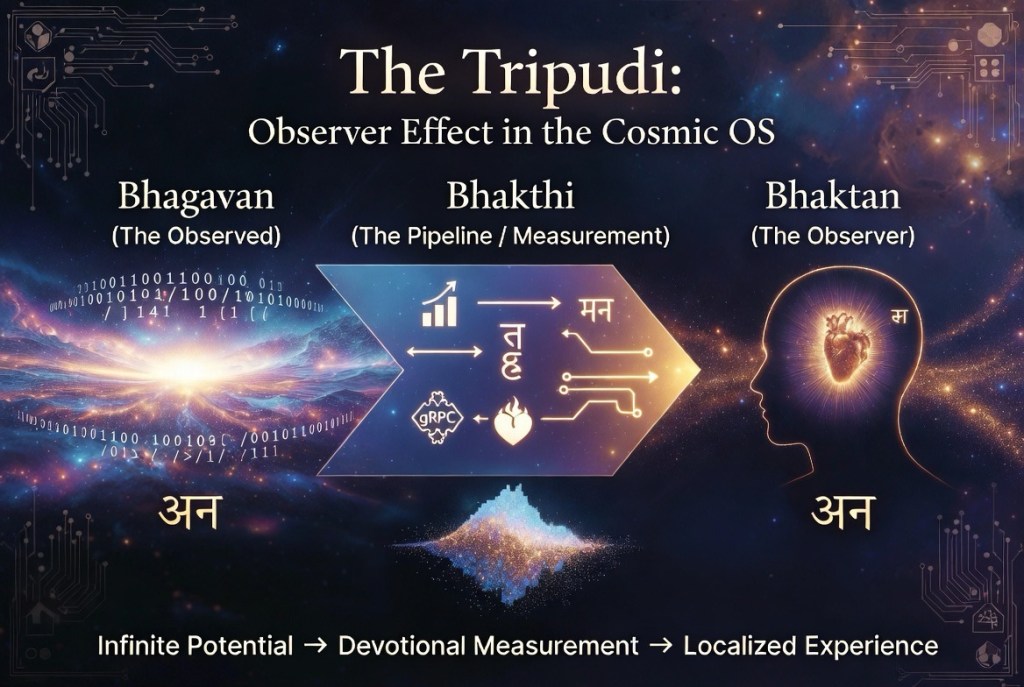
- Bhagavan is the unmanifested source: infinite potential containing all possible states.
- Bhaktan is the localized node of consciousness—the individual observer.
- Bhakthi is the specific frequency and directed act of measurement.
Without the devotee deploying the pipeline of Bhakthi, Bhagavan remains an unmanifested field of potential. The moment the observer tunes their attention, the cosmic wave function collapses into a tangible, personal experience. We do not merely discover reality; in a real sense, we participate in its crystallization.
(Note: While contemporary physics attributes wave-function collapse primarily to environmental interaction and decoherence rather than to consciousness per se, the deeper structural parallel remains potent: undifferentiated potential becomes specific, lived reality only through the directed attention of a localized node.)
2. The Architectural Analogy: Cosmic MVC
The same triad maps cleanly onto the Model-View-Controller pattern familiar to every software engineer.
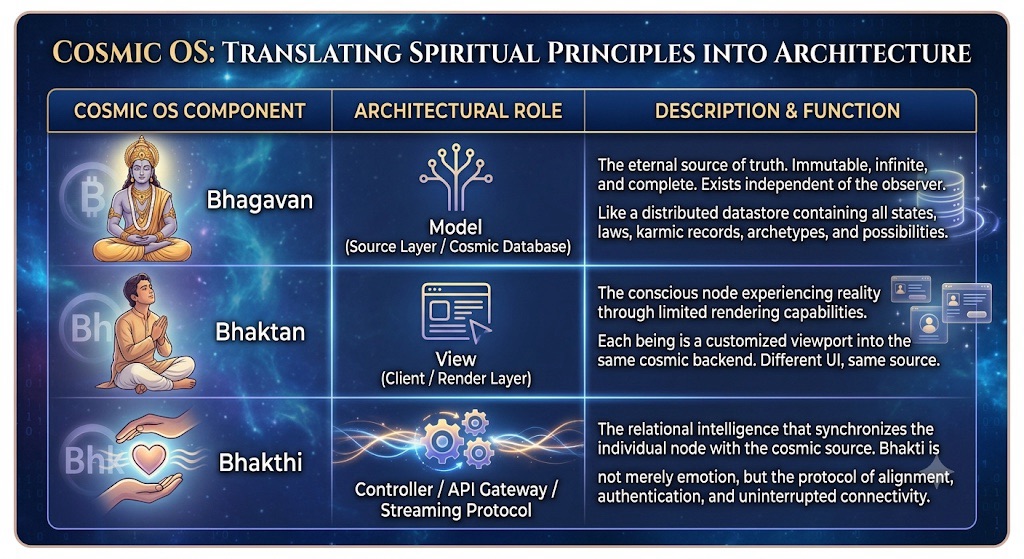
A blank screen remains inert until the Controller actively fetches and streams data from the Model. In devotional terms, Bhakthi is the rigorous optimization of this pipeline—reducing latency, clearing blockages, and increasing bandwidth until the local node achieves direct, high-fidelity connection with the source.
3. Breaking the Interface: Zero-Latency Unity
In Sutra 66 of the Narada Bhakti Sutras, Narada describes a decisive transition:
त्रिरूपभङ्गरूपं नित्यदास्य-नित्यकान्ताभजनात्मकं वा ॥ ६६ ॥
tri-rūpa-bhaṅga-rūpaṁ nitya-dāsya-nitya-kāntā-bhajanātmakaṁ vā || 66 ||
My Tamil Translation
மூக்குணங்களையும் விலக்கும் வடிவம் தினமும் வேண்டும் தினமும் போற்றும் ஆத்மகீதம்
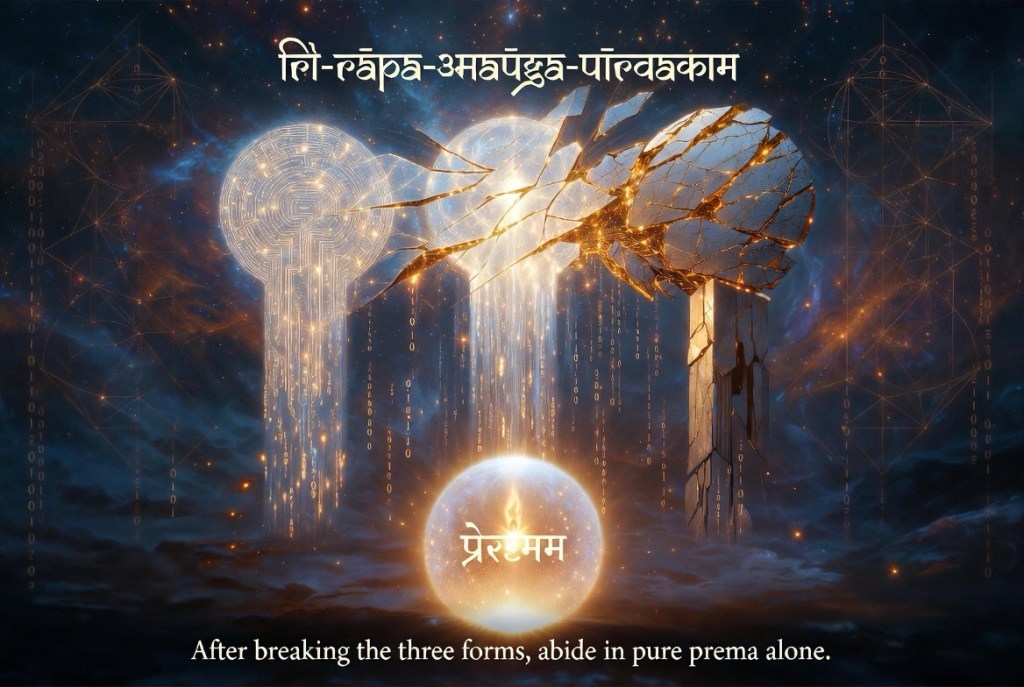
tri-rūpa-bhaṅga-rupam—the state reached after breaking through the three forms (classically understood as the three guṇas or secondary modes of devotion). The devotee then abides in pure, spontaneous prema.
A systems reading of this sutra suggests something even more radical. When pipeline latency drops to absolute zero, the architecture itself undergoes a phase change. In physics this resembles quantum entanglement, where the boundary between observer and observed dissolves. In software it is the moment cache, client, and origin server achieve perfect, instantaneous synchronization.
At that point the Bhaktan performs a kind of ego deallocation—a massive garbage collection of temporary, bloated local state. The active process of Bhakthi rests because there is no longer any distance to bridge. The pipeline closes because sender and receiver are no longer separate.
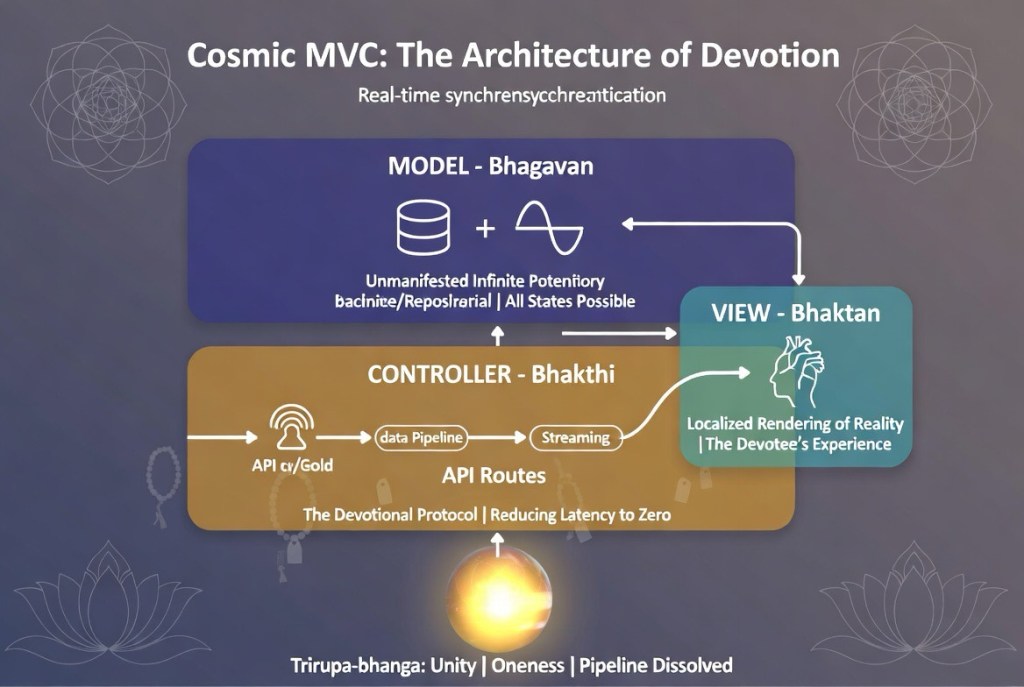
The View dissolves back into the Model. The triad was a magnificent, user-friendly interface designed for the journey. The destination, however, is undivided.
 Arambhin
Leave a comment