
The last period before lunch was always dangerous. Not because of exams or unfinished homework, but because that was when philosophy tended to break the fragile peace of a classroom.
Inside Class 12-B, the Chennai humidity had slowed everything to a crawl. Half the students were trading election memes on hidden phones. The other half argued, in fierce whispers, whether Vijay could become a bigger political force than the stars who came before him.
Mr. Sundaram walked in without the usual textbook. He carried a bundle of yellowing photocopies tied with frayed red string and smelled faintly of old paper and camphor. He placed the bundle on the desk and waited.
From the back bench, a voice called out, “Sir, are you joining politics too if Vijay wins?”
The class erupted in laughter. Mr. Sundaram did not frown. He simply leaned against the blackboard until the noise subsided.
“No,” he said quietly. “But all of you joined politics a long time ago.”
The laughter died. Even the ceiling fan seemed to slow.
“Tell me,” he continued, untying the string, “when a cinema hero delivers a punchline on a three-storey screen, what happens in the theatre?”
“Whistles, sir!”
“Mass edits on Reels!”
“Fan wars!”
He nodded. “And when the Thirukkural offers two lines on how to rule a nation justly… what happens?”
A nervous silence. Then someone muttered, “Exam question, sir. Section C, two marks.”
The class laughed again, but it was thinner this time. Mr. Sundaram turned to the board and wrote in clean, sweeping letters:
We turned wisdom into a syllabus, and entertainment into scripture.
He set the chalk down and let the words hang in the heavy air. The discomfort that followed was almost physical. Ashwin lowered his hand from his chin. The boy at the back suddenly found the scratches on his desk fascinating.
“Sir, times have changed,” Ashwin said after a moment, fingers tapping his phone. “We have AI, Python, global startups. How is a two-thousand-year-old poetic meter going to help us build anything? It doesn’t scale.”
Mr. Sundaram walked over to Ashwin’s desk and tapped the phone lightly.
“This hardware is modern. The glass, the silicon. But if the operating system inside becomes corrupted, will the best app save it?”
“No, sir. It crashes.”
“Exactly. Language is not just a tool for buying groceries or texting. It is a civilisation’s operating system. It holds the logic of how we treat our parents, how we govern, how we bear grief. Corrupt the OS and the apps stop working, no matter how shiny the phone looks.”
He returned to the front and carefully flattened one of the photocopied sheets.
“We speak often of the physical treasures taken during colonial times—the bronzes, the Koh-i-Noor. But consider the Anaimangalam copper plates, sent to Leiden centuries ago. They recorded land grants, water rights, administrative ethics. The real loss was not the copper. It was that we forgot how to read what was written on it. We kept the modern infrastructure but lost the literacy that once held it together.”
He wrote four words on the board:
Aram, Anbu, Porul and Ozhukkam
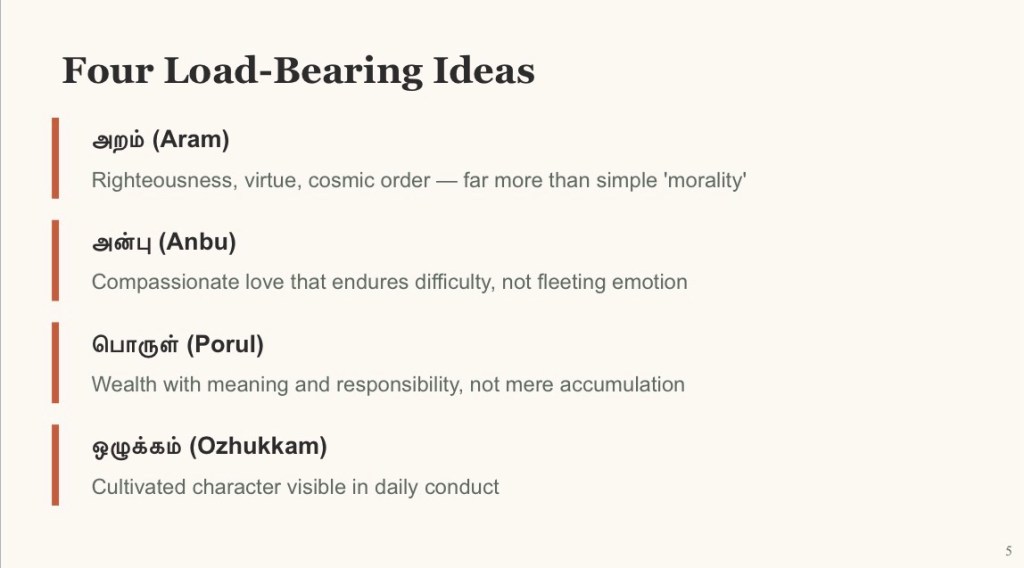
“Today we squeeze these vast ideas into small English words,” he said. “Aram becomes ‘morality.’ Anbu becomes ‘love.’ It is like pouring the Indian Ocean into a plastic bottle. You lose the depth, the movement, the life.”
A boy at the back, no longer smirking, asked, “Then why do we only study it for marks, sir?”
Mr. Sundaram’s smile was small and tired. It is the same with our temples and traditional properties. We preserved the structures but abandoned the logic that once governed them. We turned sacred spaces into assets and ancient responsibilities into optional customs.”
Another student tried to bridge the gap. “But sir, why do we still chase actors and politicians so desperately? Why do we need heroes in dark theatres?”
“Because humans are storytelling creatures,” Mr. Sundaram replied. “Every society looks for living symbols to hold its identity. Our epics understood this. They asked the question fan clubs rarely ask: Does this leader serve aram, or only power?”
For once, no one had a quick reply. The political memes on their phones suddenly felt small.
A quiet girl in the middle row spoke for the first time. “Are we losing the language, sir?”
Mr. Sundaram looked out at the horn-blaring traffic and the giant movie posters.
“No language disappears overnight,” he said. “It dies when people stop thinking through it. When a generation can explain complex game lore and stock trends in perfect detail but cannot decode a single couplet of its own heritage, something shifts. We do not notice the descent because we are still using the same sounds while the meaning drains away.”
The lunch bell rang, loud and mechanical. Nobody moved.
Mr. Sundaram began retying the red string around his papers. “Cinema can inspire you. Politics can mobilise you. Technology can empower you. But only your roots can hold you steady when everything else is moving too fast.”
He glanced at them, and for the first time that period, a small, genuine smile appeared. “And please do not write any of this in tomorrow’s test. The board will think I am starting a revolution.”
Soft laughter followed as the students finally stood. Ashwin lingered by the desk, backpack slung over one shoulder.
“Sir… can you suggest a commentary on the Thirukkural? One that explains how it actually works, not just the meanings?”
Before leaving, he turned back once more and wrote:
“ஒழுக்கம் விழுப்பம் தரலான் ஒழுக்கம் உயிரினும் ஓம்பப் படும்.”
Thirukkural
“Conduct gives true greatness;
therefore character must be guarded even more carefully than life itself.”
Then he looked at the students and said quietly:
“A nation is not saved by loud speeches alone.
It survives through the everyday character of its people.”
Mr. Sundaram reached into his pocket, took out his old book.
உயிர் உயிரிடம் பெறுகிறது.
Ashwin where can I download the book?. Some knowledge can’t be downloaded, It can only be received in person, That is the transmission in a last period before lunch, when the humidity has slowed everything to a crawl and the wisdom arrives without the textbook.
 Arambhin
Leave a comment