
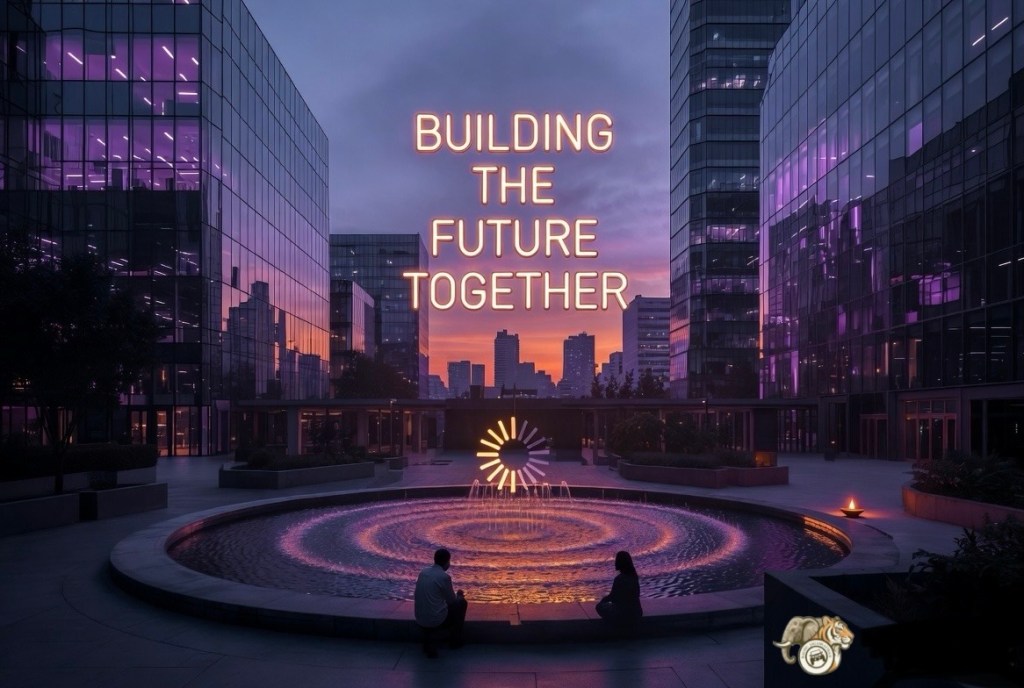
The campus lawns of Infosys glowed under sterile evening LEDs, casting a cold, cinematic blue over the manicured grass. Around them, glass monoliths reflected the dying sunset like giant smartphone screens left on standby, bleeding orange into a digital twilight. Employees drifted out of the turnstiles in quiet, synchronized currents—wearing lanyard-bound ID cards like secular rosaries, their wrists tracking steps and stress levels on glowing smartwatches. They carried the heavy air of an eight-hour shift and the carefully curated smiles of people who knew they were always being evaluated.
Near a silent concrete fountain sat two people, marooned in the quiet aftershock of a corporate wellness summit.
One was Arvind Rao. He was a famed leadership coach whose digital calendar resembled an overclocked processor spitting out color-coded tasks. CEOs worshipped his frameworks like scripture. His chart-topping podcasts spoke of emotional intelligence, adaptive culture, mindful scaling, and high-performance empathy—words that tasted like mint but left the throat dry.
The other was Meera Sanyal. She was one of the country’s leading divorce lawyers. She possessed a voice like silk sliding over glass and eyes that had spent twenty years watching love dissolve into legally binding PDFs.
Between them sat two cardboard cups of untouched green tea, growing cold as the paper absorbed the moisture of the evening.
A drone hummed overhead, a sleek quadcopter navigating the air like an anxious mosquito from a near-future corporate dystopia.
Arvind smiled first, though his eyes remained tired. He pointed a manicured finger toward the glass tower behind them. “Funny thing,” he said, his voice carrying the practiced resonance of a keynote speaker. “This company spends millions teaching its people emotional quotient. EQ workshops, empathy seminars, vulnerability training.”
Meera leaned back, her spine perfectly straight against the stone bench. “And they pay billions to people like me to repair what those emotionally intelligent people destroy when they go home.”
He laughed—a quick, barking sound—then caught himself. “That bad?”
She didn’t answer immediately. Instead, she watched a pair of junior developers walking past, their shoulders close but their eyes locked onto their respective phones. “We taught a whole generation how to communicate flawlessly without teaching them what deserves commitment.”
With a mechanical grunt, the fountain clicked alive, spitting a jagged jet of water into the air.
Arvind adjusted the cuffs of his bespoke blazer, leaning into his element. “But emotional intelligence matters, Meera. Empathy, active listening, radical self-awareness… these aren’t buzzwords. They are evolutionary survival skills.”
“They are interface skills,” she countered smoothly. “Useful. Necessary for a frictionless user experience. But fundamentally incomplete.”
He raised an eyebrow, a silent invitation to the witness stand.
“You know what I see across my desk every single morning?” she continued, her voice dropping an octave. “Couples using the hyper-articulate vocabulary of therapy and devotion to negotiate temporary arrangements. They don’t fight anymore; they ‘set boundaries.’ They don’t fall out of love; they ‘realign their personal growth metrics.’”
A heavy pause settled over the bench.
“Explain,” he said.
“People still say the word forever, Arvind, but they negotiate emotionally like short-term vendors afraid of being cheated on the delivery.”
Nearby, a group of young analysts laughed, crowding together to take a selfie under a glowing neon corporate installation. The sign read, in bright, humming pink: BUILDING THE FUTURE TOGETHER.
Meera’s gaze drifted to the neon glow, a faint, melancholic smile touching her lips. “Earlier, marriage was seen as a shared duty. Two imperfect, broken people walking through the dark toward a common fire. Today? Today, relationships are treated like merger agreements between two competing personal expectation platforms.”
Arvind countered, his analytical mind searching for the flaw in her brief. “But the older systems trapped people in misery, Meera. You know that better than anyone. They institutionalized suffering, especially for women.”
“True,” she nodded, acknowledging the point with a slow tilt of her head. “I’m not glorifying the past. Some divorces are acts of absolute liberation; they save lives. But we must admit that when we re-engineered the engine, we changed the fuel.”
The evening breeze shifted, carrying the sharp, bitter smell of roasted artisanal coffee mixed with the hot, metallic exhaust of a subterranean server room.
“What changed?” he asked softly, the coach’s bravado slipping away.
She pointed toward the highest floor of the glass tower, where the server lights blinked like a trapped constellation. “Optimization became the state religion.”
He laughed again, but it was a thin, fragile sound this time. “You sound like a luddite monk attacking productivity software.”
“No,” she said, turning her sharp eyes directly onto him. “I’m saying modern people have turned the human heart into an experience platform. We subscribe to people until the content gets repetitive, and then we look for an upgrade.”
Around them, the shifting crowd echoed fragments of a new language: …stock options… crypto… mindfulness retreat… Hinge algorithm… performance review… KPIs…
Arvind stared quietly into his cold tea.
Meera continued, her voice relentless but devoid of malice. “Love became multithreaded.”
“Meaning?”
“Career. Validation. Physical attraction. Digital clout. Lifestyle aesthetics. Sexual novelty. Status. Identity politics. Every single emotional process is running simultaneously, competing for limited CPU cycles. The system is constantly thermal throttling.”
Arvind looked up, a sudden thought sparking. “And Bhakti? Devotion?”
“Singleton architecture,” she replied instantly, invoking the programming terminology of the campus.
He smiled despite himself, recognizing the elegant brutality of the metaphor. “One anchor?”
“One anchor,” she said. “Bhakti is not merely a surge of emotion. It isn’t a feeling at all. It is absolute alignment. When you are devoted to something, you pull all other processes out of the queue.”
The fountain lights shifted from a warm amber to a clinical, ghostly blue.
Arvind folded his hands thoughtfully, staring at his polished shoes. “You know… leadership coaching now teaches vulnerability as a core strategy. We tell leaders to show their flaws to build trust.”
“And devotion disappears the strategist entirely,” Meera whispered.
The line landed heavily between them, a solid thing dropping into deep water.
From the campus shuttle bay, a distant automated announcement echoed over the PA system, its electronic voice smooth and devoid of humanity: “Attention employees. The evening wellbeing session on mindful resilience is about to begin in Auditorium 3. Please log your attendance via the QR code.”
Meera watched a fresh wave of tired bodies rush toward the auditorium doors, terrified of missing a metric for peace.
“Humans are so profoundly exhausted,” she said, her voice softening with genuine pity. “They have optimized their communication, but they have lost their sacred intention.”
Arvind looked away from the tower and back to her. “So what survives the optimization?”
She answered almost immediately, without an ounce of hesitation. “Anything built beyond the boundaries of convenience.”
Silence settled over the courtyard, dense and heavy, like an evening prayer inside an empty cathedral.
Then, Arvind asked the question he had been avoiding all evening, his voice stripping away the layers of his global reputation. “So… what is a marriage, then?”
Meera smiled faintly, looking at the untouched tea between them. “It isn’t permanent attraction, Arvind. Attraction is just weather.”
“Then what is it?”
“Shared devotion toward a life that is deliberately larger than both people.”
The fountain suddenly cut out, its mechanical timer expiring. The water fell back into the basin with a final, chaotic splash, leaving a vacuum of absolute quiet.
For a single, breathless moment, the giant IT campus became strangely, terrifyingly still.
Like an entire civilization buffering, waiting for a signal it wasn’t sure it could still receive.
 Arambhin
Leave a comment