
Reconstructing a Distributed Civilization
The Perspective Shift: Civilization as Architecture :
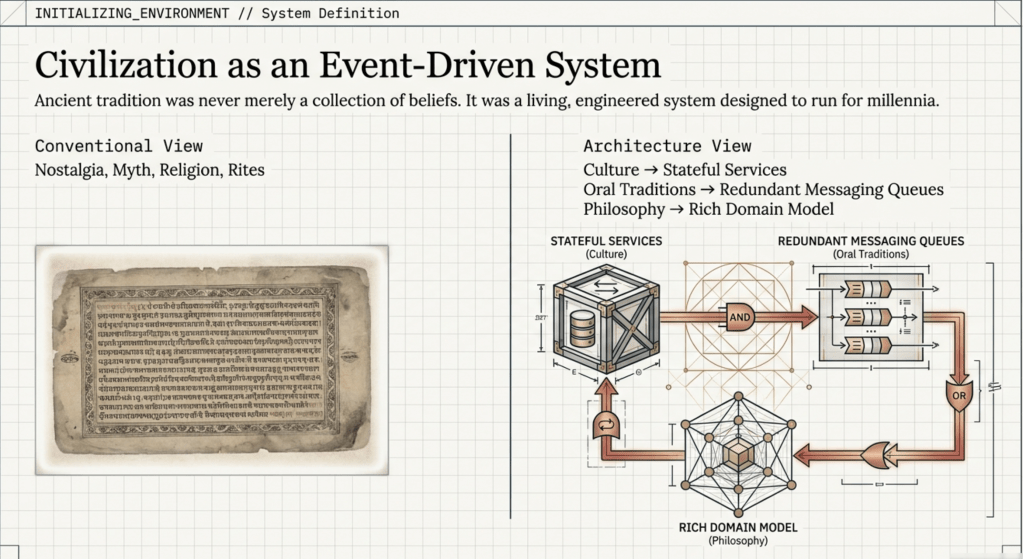
To analyze a civilization as resilient as India’s, we must move beyond the static, moralizing category of “tradition” and adopt the rigor of systems architecture. Viewed through this lens, ancient culture is not a dusty collection of beliefs but a sophisticated, event-driven architecture—a living system comprised of stateful services, redundant messaging queues, and a robust domain model. By reframing the transmission of knowledge as a distributed network, we can diagnose how a high-fidelity civilizational state was maintained for millennia and precisely identify the points of semantic drift and payload corruption in the modern era.
The Strongly Typed Object: Defining the Original State
At the core of this system was the “Cultural Object”—the high-fidelity domain model of Dharma, ritual protocols, and philosophical invariants. In its original state, civilizational transmission was “strongly typed.” It required precise execution, specific environmental context, and validation to maintain data integrity across generations
{ "DharmaObject": { "metadata": { "type": "Protocol", "lineage_validation": "Guru-Shishya_Verified", "version": "1.0_Original_Invariants", "governance": "Parampara_Consistency_Model" }, "payload": { "phonetic_fidelity": "High_Precision_Sanskrit_Phonetics", "execution_logic": "Exact_Ritual_Sequences", "intent_metadata": "Philosophical_Basis_and_Purpose", "contextual_attributes": { "ecological_significance": "Local_Bio_System_Integration", "astronomical_alignment": "Temporal_Sync_with_Rta", "symbolic_meaning": "Multi-Layered_Ontology" } }, "integrity_check": "Smrti_Sruti_Cross_Reference" }}
This structural rigidity was a technical necessity for long-term data persistence. By enforcing strict types—precise phonetics and lineage-based verification—the system ensured the “payload” survived through time without degradation. Modern transmission, by contrast, has become “loosely typed.” The shift to a “Something like this only…” approach represents the civilizational equivalent of bad serialization; when the types are weakened, the data eventually becomes unreadable or functionally useless.
The Mutation of the Event Log
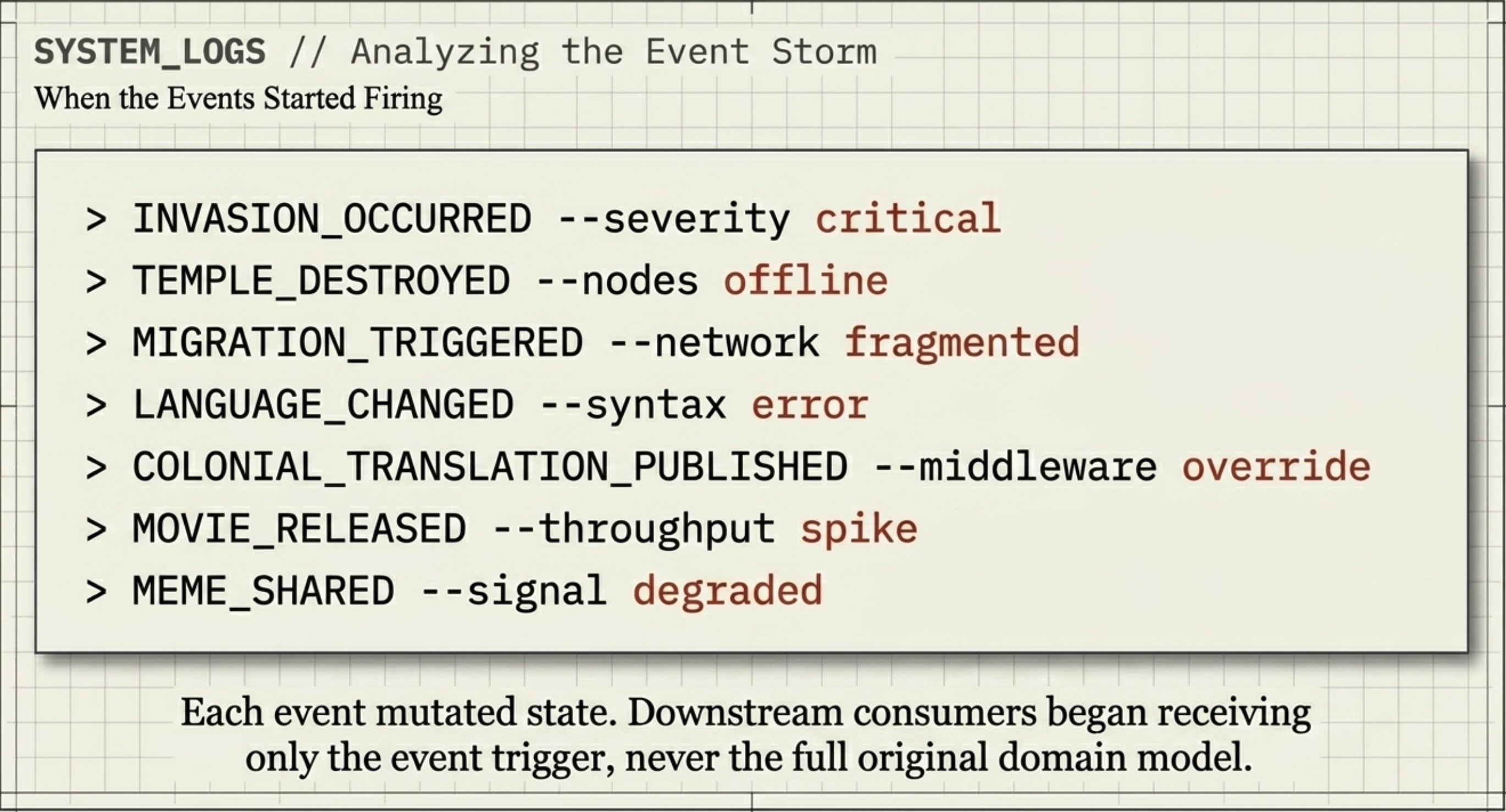
Over centuries, the system’s global state was subjected to high-impact mutations. Historical events functioned as updates to the system’s log, often altering how downstream consumers (later generations) interpreted the original object graph.
INVASION_OCCURRED: Physical destruction of hardware nodes, leading to immediate state loss and the “garbage collection” of local knowledge bases.
MIGRATION_TRIGGERED: Network re-routing that fragmented the consumer base and broke local synchronization.
MOVIE_RELEASED & SOCIAL_MEDIA_MEME_SHARED: Modern, high-throughput amplifiers that broadcast low-signal interpretations. These “event amplifiers” prioritize memes over manuscripts, causing widespread semantic drift as the “reaction” replaces the “inquiry.”
As these events fired, many downstream nodes received the “event” (the ritual or identity) but lost the “full domain model.” This is the tragedy of modern engagement: being a subscriber to the event stream without access to the producer’s original logic.
Temples as Stateful Services
In this distributed architecture, temples were never merely physical structures; they were the system’s stateful services.
Knowledge Caches (Materialized Views): Consecrated mūrtis functioned as materialized views. In database logic, a materialized view pre-computes and stores the results of complex queries for fast access. A mūrti similarly materialized complex philosophical truths into a tangible interface, allowing consumers to interact with the domain model without needing to re-compute the entire theological stack.
Synchronization Nodes (Heartbeats): Daily pūjā acted as system “heartbeats,” ensuring the local node remained synchronized with the civilizational “master clock” of ṛta (systemic order).
Ecological Processors: Rituals like yajña were not merely symbolic; they were functional processes designed to maintain ecological and systemic invariants within the local environment.
Network Routers: Pilgrimage paths functioned as message-passing routes, allowing for the flow of state updates between geographically disparate nodes.
When these nodes were destroyed, the system suffered state loss at scale, resulting in “truth fragmentation” where regions were left with divergent, partial snapshots of a once-unified state.
Redundant Messaging: Why the System Survived
The Indian system’s resilience stems from extreme architectural redundancy. The civilizational payload was broadcast across parallel, redundant messaging queues:
Śruti (Chants): The primary audio-based data stream, optimized for phonetic integrity.
Smṛti (Narratives): Secondary storage via epic poetry and stories.
Performance Arts: Visual and rhythmic encoding through dance and music.
Architecture: Iconography and temple layout as persistent physical storage.
This self-healing logic ensured that if one node failed (e.g., a text was burned), the “event stream” could be replayed via another channel (e.g., a ritual dance or a household practice). This cross-platform redundancy is the only reason the system survived such massive historical disruptions.
The Colonial Middleware Rewrite
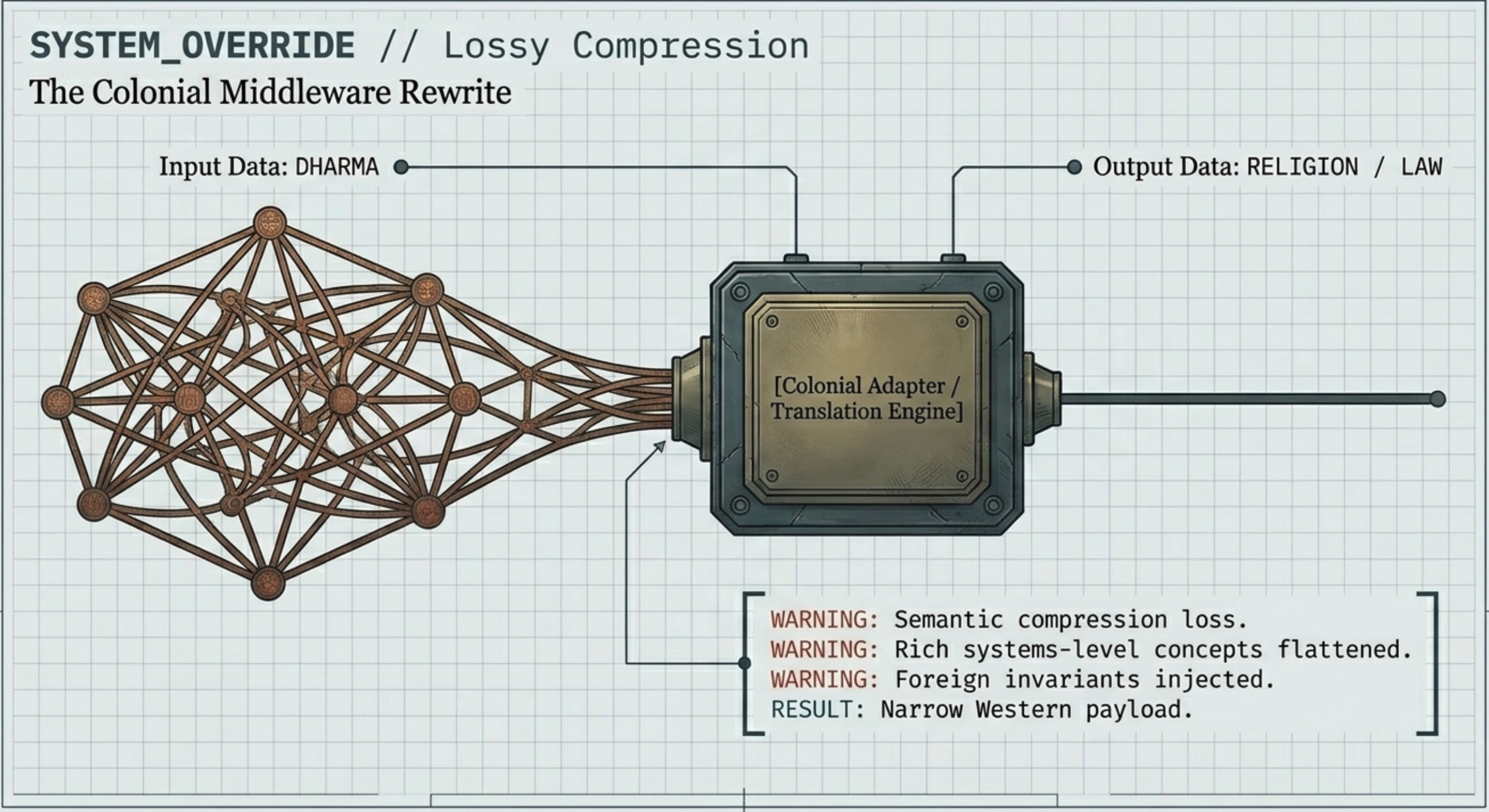
The colonial period introduced an aggressive middleware adapter that attempted to map the multidimensional Indian system onto a one-dimensional Western framework. This was not a neutral translation; it was a type-casting errorresulting in severe semantic compression loss.
| Original Concept (High Fidelity) | Colonial Mapping (Lossy Adapter) | Systemic Consequence |
| Dharma | Religion | Loss of systemic/ecological duty; flattening to “belief.” |
| Atman | Soul | Injecting foreign invariants of dualism and salvation. |
| Devata | God | Dropping the functional, departmentalized roles of cosmic agents. |
Dropping the functional, departmentalized roles of cosmic agents. This mapping injected incompatible invariants into the system. By forcing the “Indian payload” into a “Western schema,” the rich, systems-level context of the original objects was dropped to satisfy the limitations of the middleware.
Indian Knowledge Model
Context-aware
Recursive
Experiential
Ecological
Layered meanings
Consciousness-first
Colonial Interpretation
Category-fixed
Linear
Doctrinal
Institutional
Single-definition mapping
Matter/history-first
Internal Versioning and Merge Conflicts
A common critique of Indian civilization is its lack of a single, canonical monolith. However, from a systems perspective, the divergent schools (Shaiva, Vaishnava, Mimamsa, Vedanta) represent sophisticated internal versioning and merge conflict resolution mechanisms.
This “truth fragmentation” is not a bug; it is a feature of eventual consistency. In a distributed system without central schema governance, having multiple divergent nodes makes the architecture more robust. Instead of a single point of failure (a central Pope or a single Book), the civilization operated on a principle where different regions held different versions of the state that could coexist, overlap, and occasionally merge. The system doesn’t need a master node to remain functional.
Event Sourcing Reconstruction in the AI Era
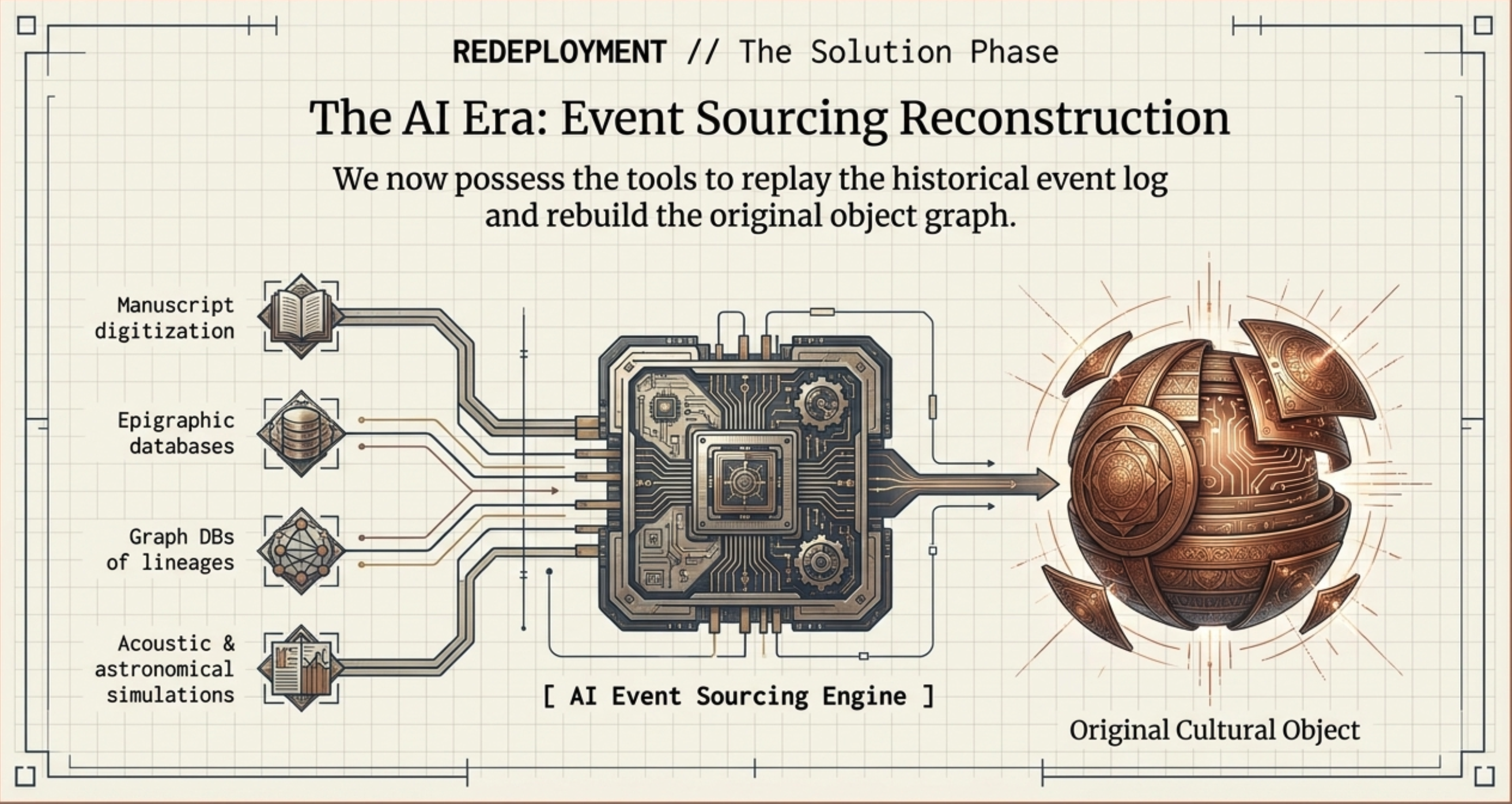
We are entering an era of event sourcing reconstruction. We now possess the tools to replay the historical event log—filtered through manuscript digitization, epigraphic databases, and linguistic ontological analysis—to rebuild the original object graph.
By utilizing graph databases to map lineages and temple networks, and employing acoustic simulations to recover phonetic invariants, researchers are identifying exactly where the payload was corrupted. This is a scientific recovery of the “missing state,” comparing inscriptions, folklore, and archaeology to patch the holes in the current civilizational memory.
A Forward-Looking Thought or Request
Modernity has left the system in a state where rituals continue but the connection to the original consciousness is severed. We are running on corrupted state.
The Sage: “Modern humans became subscribers to events without understanding the producer.”
The Architect: “So Dharma was never deleted… only eventually inconsistent.” The path forward is the rigorous reconstruction of the high-fidelity domain model standing alongside the current degraded fork . Through the recovery of original invariants, we can begin a gradual cut-over.
The logs are vast and noisy, but the invariants are recoverable.
The question remains whether we will restore the original domain model or continue to operate on corrupted state.
 Arambhin
Leave a comment