
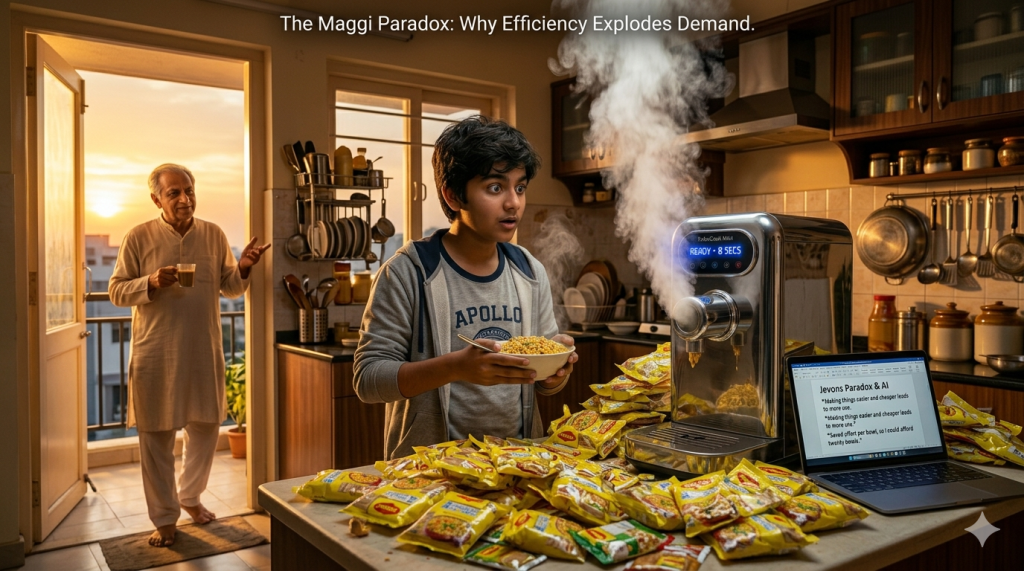
Arjun was fifteen, perpetually hollow-bellied, and firmly convinced that physics homework was a personal vendetta declared by the universe. To Arjun, time wasn’t measured in minutes; it was measured in the agonizing interval between a stomach growl and the first slurp of masala-infused comfort.
Then came the RoboCook Mini. The tagline was a siren song: “Perfect Maggi in 8 seconds.”
Not the “wait for the kettle” purgatory. Not the “stirring the pot” boredom. Just eight seconds of digital alchemy. Arjun lobbied his parents for three weeks with a strategic display of suspiciously high grades and a suspicious lack of backtalk. Finally, the sleek, chrome box sat on their counter.
Phase 1: The Illusion of Sanity
The first bowl was a revelation. A button press, a sharp hiss of pressurized steam, and a ceramic bowl of edible lightning appeared.
“Efficiency,” his father declared, nodding at the low-wattage LED. “This will save us a fortune on gas and time. Technology, Arjun, is about doing more with less.”
Everyone assumed the curve of consumption would remain flat while the effort plummeted. They were, predictably, wrong.
Phase 2: The Noodle Singularity
Because the barrier to entry had vanished, the “Noodle Threshold” disappeared. Previously, Arjun only made Maggi when he was starving. Now, he made it because he was bored.
He made a bowl after school. He made a “tactical bowl” during a loading screen. He made a midnight bowl because the moon looked particularly yellow. Within a month, the kitchen didn’t just smell like spices; it felt like a processing plant. The pantry, once a fortress of organized groceries, was now a hollowed-out ruin.
Within a month, consumption had risen 400%. The electricity bill spiked — the machine was efficient but it never slept. Arjun himself had acquired a sodium-induced glow where vitality once lived.
The Waste: A mountain of yellow plastic wrappers that seemed to mock the “Green-Tech” sticker on the machine’s side.
The machine was so perfect it had become a vacuum for the family’s resources.
The Balcony Lesson
Arjun’s grandfather, a man who still brewed coffee with the patience of a mountain, watched the chaos from the balcony. That week, Arjun had submitted three AI-generated history essays; each was polished, poetic, and confidently wrong. In the piece on South Indian history, the AI had confidently argued that the legendary sculptors of the Belur Chennakeshava Temple—who labored for 103 years to turn soapstone into lace—had actually been working in North India, commissioned by an emperor who wouldn’t be born for another three centuries. Arjun hadn’t even checked.
You’ve stumbled into a trap, Arjun,” the old man said, gesturing to the laptop and the noodle machine. “You think you’ve saved time. But you’ve actually just lowered the price of your own appetite until it became infinite.
Arjun frowned, holding his fourth bowl of the day. But the machine is efficient! It’s doing exactly what it’s supposed to do.
Exactly, his grandfather replied. That is the Jevons’ Paradox. When you make a resource cheaper to use, we don’t use less of it. We find a thousand new ways to waste it. You saved effort per bowl, so you decided you could afford twenty. You saved effort per sentence on your essay, so you decided you didn’t need to understand Belur.
The Final Threshold
Arjun looked at his bowl, then at the glowing screen of his laptop. The world wasn’t getting quieter because of efficiency. It was about to get much, much louder.
So what do I do? Arjun asked. Throw the machine away?
The grandfather smiled, looking past the chrome and the steam toward the setting sun. The machine is just a mirror, Arjun. It only shows you how much you are driven by the hunger of the moment. Ancient wisdom tells us that the instrument—the pot, the pen, or the AI—never needed repair. It is the one holding the instrument who must decide.
He took a slow sip of his tea. When capability is infinite, the only thing that matters is the quality of the one choosing. The question isn’t what the machine can cook in eight seconds. The question is: now that you can have everything instantly… do you have the taste to know what is worth making?.
The singularity isn’t when the machines outthink us.
It’s when the cost of a good idea falls to eight seconds… and suddenly the limiting factor isn’t intelligence anymore. It’s taste, judgment, and what the hell we actually want to do with all that newfound abundance.
Arjun staring at his fourth bowl and his laptop screen? That’s us right now. The yellow wrappers are piling up. The data centers are glowing. The question isn’t whether the machine was a bad idea.
The question is: now that gluttony is infinite… what are we going to cook with it?
 Arambhin
Leave a comment