
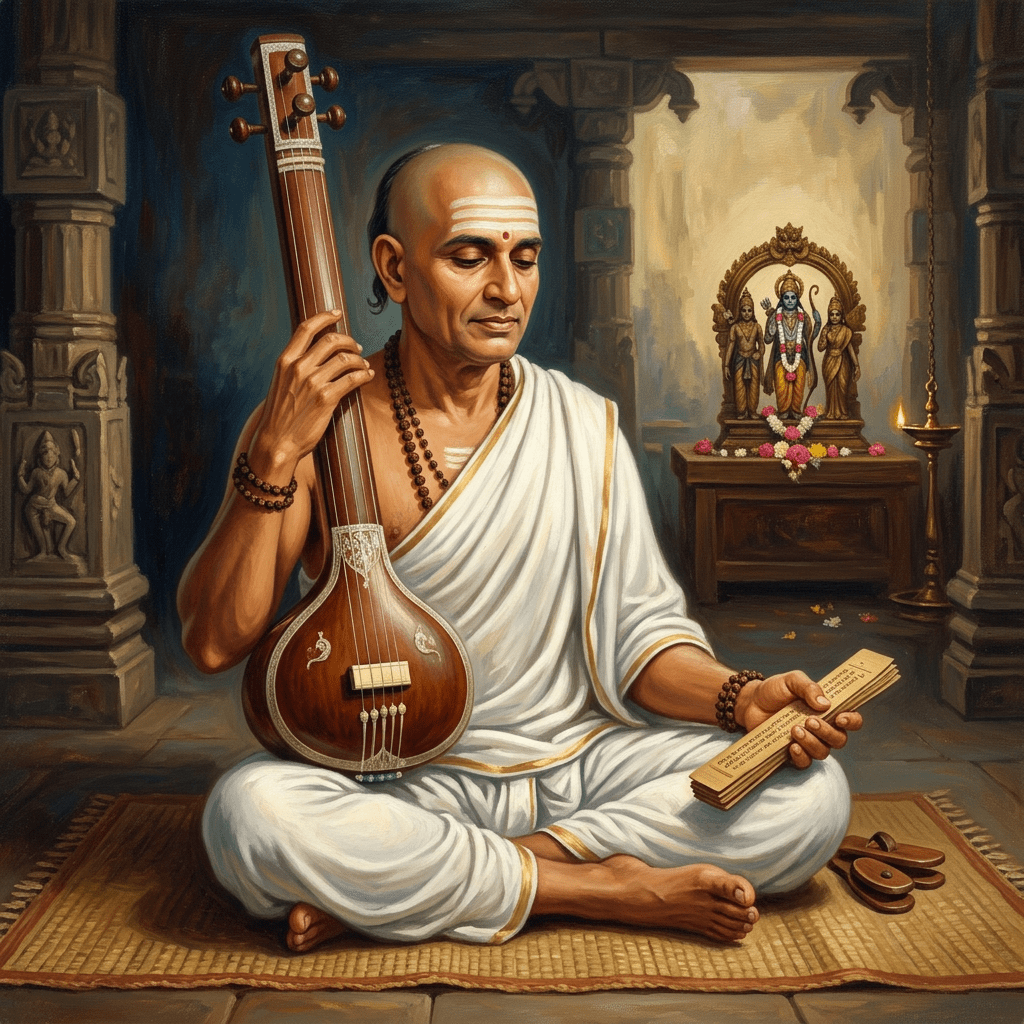
The Day Music Ceased to Be Sound and Became Life
Monday morning. Agni Natchatram scorched the streets of Chennai, election fever clawed at every corner of the mind. Yet something in me veered off the familiar urban rhythm. A random YouTube shuffle offered up a single link, and within fifteen minutes the world outside dissolved.
It was MD Ramanathan’s Reetigowla in Dwaitamu Sukhama — the one connoisseurs still call heavenly. I had laughed at the claim. Then the first phrases began to unfold. I found myself pausing the video, scribbling a Tamil translation of the lyrics that had suddenly become urgent:
இருவேறானதா சுகம் ஒன்றானதா சுகம்…
Is the bliss in two parts, or is the bliss in the One?
The rest of the day vanished. TV debates, victories, defeats — none of it mattered. The mind had slipped into a seamless oneness with the song.
What a quiet, complete Tyagarajalization.
There is a precise moment, perched precariously between a note and its fading echo, where the world undergoes a quiet alchemy. The mind — that restless, frantic collector of meanings — simply pauses. It isn’t a pause of comprehension; it is a pause of absorption.
That silence is where we begin.
When we first encounter the music of Saint Tyagaraja, we treat it like an inheritance: a dusty trunk of kritis to be catalogued, performed, or debated over coffee. We weigh renditions like gold merchants, asking which raga is more taxing or which artist possesses the swiftest tongue.
But Tyagaraja’s music has no interest in your appraisal. It is not waiting for your applause. It is waiting for your alignment.
When that alignment clicks into place — like a key turning in a lock you didn’t know was bolted — the experience opens into three distinct movements.
Movement One: Raga as Realization
At first, the doorway is mere vibration.
A raga is not encountered as a scale, but as a ghost haunting your own internal corridors. Reetigowla manifests as a question that refuses the indignity of an answer — a lamp carried into a room you have lived in your whole life but never actually seen.
Ragas are not external constructs. They are internal weather patterns. A phrase lingers; a glide between notes feels like a thought bending toward sudden insight. You are no longer just the listener. The music isn’t entering you; it is uncovering you.
Movement Two: Music as Inquiry
Then comes the weight of meaning.
The kritis begin to speak, but they do not shout. They whisper like a private realization you’ve been hiding from yourself.
In Dwaitamu Sukhama, Saint Tyagaraja poses a question that is a trap laid for the ego doing the asking:
இருவேறானதா சுகம்?
ஓன்றானதா சுகம்?
தூய ஆனந்தமா சொல்லேன் மனசே
பரமாத்மா ஜீவாத்மா வேறா
பிரம்ம ஞானமறிந்தவன் எவ்வாறு தொழ
ராமன்வழி சரனாகதியே வழிவழியோ
ராகஜீவன் தியாகராஜன் வந்தவழியோ
Is duality the comfort, or is unity the truth? Is the bliss in the separation of the soul and the divine, or in their collapse?
The song doesn’t demand an answer; it demands a confession. Are you truly separate from what you seek? Or is that separation a costume you’ve grown too fond of wearing?
In Nada Tanumanisham, the deity is stripped of stone and myth. Shiva is not “out there.” He is Nada — the fundamental hum of existence. The universe is not material; it is resonant.
The kriti is no longer performing for you. It is performing on you.
Movement Three: Tyagarajalization
If you stay in the current long enough, the riverbank disappears.
The boundary between the observer and the observed liquefies. There are no fireworks here, no lightning bolts. It is quieter — The hush is not just sound’s absence but a turning of the world’s hinge in the unseen. Attention becomes steady without effort. Reverence arrives without the performance of piety.
This is Tyagarajalization.
Raga is no longer heard; it is inhabited. Music is no longer interpreted; it is breathed. The self is no longer defended; it is surrendered.
Everything becomes a single, continuous field of experience. You are no longer managing your life; you are rendering it. Your thoughts move with the intent of swaras, your actions find the pulse of laya, and your soul stabilizes into the unwavering drone of the sruti.
The Question That Remains
We live in an era of infinite access and vanishing presence. More sound surrounds us than any generation before — and yet genuine listening has become rare, almost countercultural.
Tyagaraja’s work is a stubborn resistance to this thinning of the spirit. Not the tool, but the tug away from listening. Just an alignment of the mood not rejection of the modern world. An insistence that the inner one still exists and still matters.
His kritis are not endpoints. They are entry points.
If you approach them as songs, they will remain beautiful. If you approach them as inquiries, they will become transformative. If you stay with them long enough, they may become something else entirely — not a practice you return to, but a frequency you begin to inhabit.
And in that state, the question stops being “Am I listening to music?”
It becomes: “What is this music revealing as me?” .
Listen: MD Ramanathan — Dwaitamu Sukhama, Reetigowla
Today marks the birth of the man who didn’t just compose music, but mapped the architecture of the human soul. To listen to him today is not an act of nostalgia; it is a recalibration. On this day, we don’t just remember his notes—we try to find the frequency he lived on.
 Arambhin
Leave a comment