
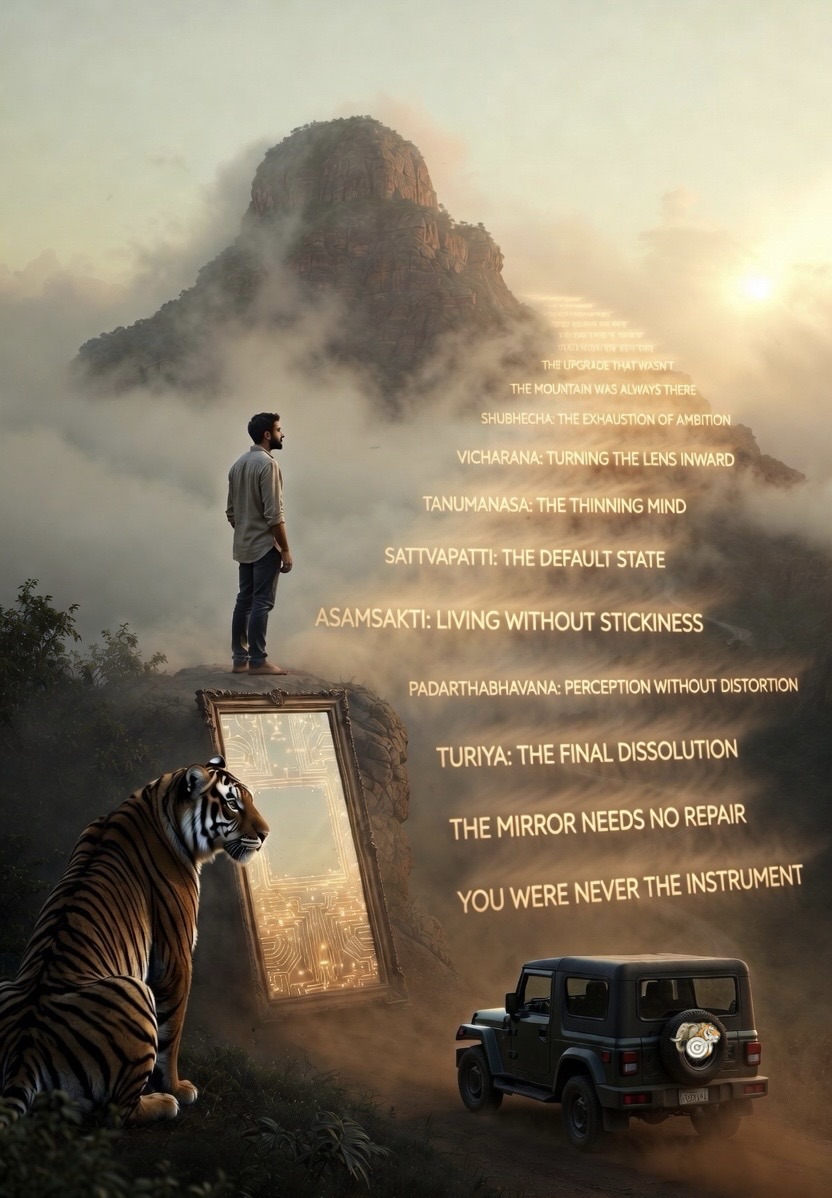
When the Systems Architect Meets the Ancient Map
We build sharper tools to debug the mind, only to discover the ancients had already mapped the terrain—barefoot.
As an engineer, I spent decades chasing “Upgrades.” New frameworks, faster models, tighter architectures. But something shifted. Whether I’m waiting for a tiger in the Kabini brush or refactoring a legacy system at 2 a.m., I now see the truth: the most sophisticated system isn’t one we build. It’s one we finally stop interfering with.
The Sapta Bhūmikāḥ—the seven stages of inner evolution from the Yoga Vasistha—is not another self-improvement ladder. It is the lifting of a fog. The mountain was always there.
1. Shubheccha: The Exhaustion of Ambition
Modern frameworks begin with error detection. Ancient wisdom begins with unease.
Shubheccha—noble desire—is not a fresh KPI. It is the devastating silence after every ambition has been delivered. I felt it at the absolute peak of my executive career: the box was ticked, the rewards were in the bank, yet the quiet was deafening. Not failure. A holy refusal to stay in a well-decorated cage.
2. Vicharana: Turning the Lens Inward
The mind that once dissected the external world finally turns the scalpel on itself.
Why do I believe this? Who is running the script?
Modern systems call this critical thinking and celebrate it. The sages were unmoved. A sharper tool is still just a tool examining shadows on a cave wall.
3. Tanumanasa: The Thinning Mind
Not suppression—depletion.
Like thinning the depth of field in photography until the background noise disappears and only the subject remains. Desires don’t get fought; they simply become irrelevant. The screaming marketplace of the mind becomes a quiet corridor. We call it “reduced cognitive load.” The sages knew better: the mind is quietly losing its desperate claim to importance.
4. Sattvapatti: The Default State
Stillness stops visiting. It moves in.
Peace is no longer an achievement to chase; it becomes the background hum of existence itself. On mountain road trips, there comes a moment when the engine noise fades and only the road remains. This stage cannot be measured by productivity metrics. It simply reveals that clarity never needed effort—only the end of interference.
5. Asamsakti: Living Without Stickiness
The world keeps running. Emails arrive. Deadlines loom. The Thar still needs servicing.
But the inner glue has dissolved. Experience flows through like water through a net, leaving no residue. This is not “emotional regulation.” It is the quiet death of the illusion that your User Profile defines who you are.
6. Padarthabhavana: Perception Without Distortion
The mind loses its talent for misinterpretation. You see the tiger, not your idea of the tiger.
Awareness is the only constant; everything else is weather. The observer is no longer distorted. The lens is not just clean—the lens has become invisible.
7. Turiya: The Final Dissolution
Modern frameworks stop here. The sages keep walking.
Turiya—the fourth state—beyond waking, dreaming, or deep sleep. The entire structure collapses. No thinker, no thought, no separation.
This is not a system upgrade. It is the total decommissioning of the ego.
The Theft of Meaning
We inherited these maps and, in our hubris, turned them into features.
Meditation became a productivity hack.
Inquiry became intellectual performance.
Awareness became another optimization metric.
We didn’t lose the knowledge. We changed its purpose.
Liberation became efficiency. In that single pivot, meaning was quietly stolen.
The Mirror Needs No Repair
Vedanta offers the ultimate paradox: nothing new is ever created. There is no v2.0 of the soul. Only the removal of dust.
Better thinking does not end confusion; it merely refines it.
As our AI systems grow more godlike in their precision, we are not inventing new wisdom—we are colliding with an ancient inevitability. These scriptures aren’t becoming relevant again. They are becoming unavoidable.
Critical thinking perfects the instrument.
Ancient wisdom reveals you were never the instrument to begin with.
 Arambhin
Leave a comment