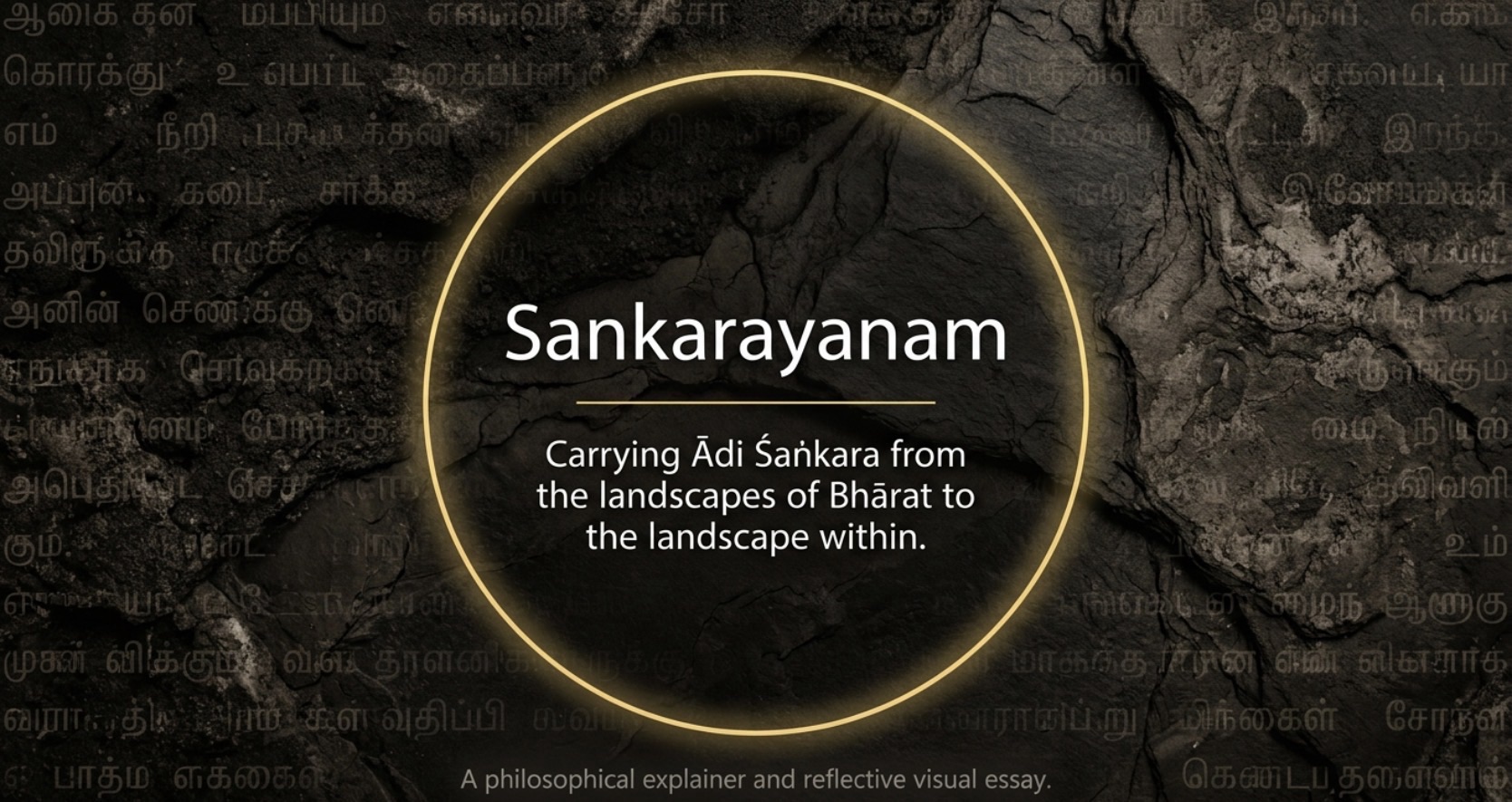
Carrying Ādi Śaṅkara from the landscapes of Bhārat to the landscape within.
Author’s Note: This is a record of an inner journey, not a strictly historical account. The ‘I’ who travels is the reader as much as the writer. The Tamil verses that surface are my own renderings, made years earlier in an attempt to hear the originals in the language closest to the road. Links lead to the source texts and to those earlier renderings.
Jaya Jaya Śaṅkara! Hara Hara Śaṅkara!

I took to the road carrying a monk on my back. Not literally—the monk was Ādi Śaṅkara, and he had been dead for twelve centuries. But he had taken up residence in my mind, and he would not be silent.
When you spend enough time rolling the syllables of ancient verses around in your mouth, the philosophy takes shape. It becomes a voice. For me, Śaṅkara became the relentless spirit resting on my shoulders as I traveled across the subcontinent. He was not a passive guide; he was a provocateur. Every time I thought I had grasped the meaning of a place, the voice in my head would whisper a riddle, a vichara (inquiry) designed to shatter my comfortable assumptions.
I promised my feet to the physical yatra. He promised to dismantle every mile I walked.
I. Kaladi: The Riddle of the River
The journey began where his did: on the muddy banks of the River Purna in Kaladi. I stood at the edge, watching the heavy water rush past, feeling the romantic thrill of a traveler at the starting line.
“Look closely,” the phantom whispered in my mind. “The water rushes away. The banks remain. You watch it all pass. But tell me, oh traveler: if your body ages like the eroding mud, and your thoughts rush by like the current, who is the silent witness standing on the shore?”

The water kept moving. Somewhere behind the sound of it, an older warning returned—a verse I had rendered into Tamil years before: Vairagya Shatakam
அன்னை இல்லை தந்தை இல்லை
பந்தம் இல்லை உடன்பிறந்தவர்கள் இல்லை
பணமும் இல்லை வீடும் இல்லை
ஆகையால் விழித்திரு விழித்திரு
There is no mother, no father, no house. Therefore be awake. The banks remain. The current does not. The one who watches both is still unnamed.
The first question had been asked. The lesson of the river was not about geography; it was about impermanence. What changes cannot be the ultimate truth of the one who observes it. I had not even taken my first step north, and already, my sense of self was beginning to crack.
II. The Narmada: Unpacking in the Dark
We romanticize the road. We pack our bags, lock our doors, and think we are leaving our baggage behind. I made my way to the rocky banks of the Narmada, stepping into the damp, stone dark of Govindapāda’s cave—the very coordinates where tradition says Śaṅkara met his guru. I sat in the darkness, feeling a flicker of pride for having traveled so far.
The spirit on my back felt heavy. “You left your house,” the voice echoed in the cavern of my own thought. “But did you leave yourself? You are not the physical body, which is made of earth, water, fire, air, and space. You are not the breath moving through it. You are not the mind that thinks, nor the intellect that decides, nor the ego that claims all of this as ‘I.’”
He was pulling me through the pañca kośa—the five sheaths of identity that Advaita systematically strips away.

“When these are removed,” the phantom pressed, “what remains? Tell me, if you can—who is the one sitting in the dark?”
In this how to add my readings and translations into Tamil of his famous works within the same flow. Like https://arambhin.com/2021/09/30/போற்றிடு-கோவிந்தம்-2/ etc.
For a moment the darkness answered with a line I had once rendered into Tamil Kaupeena Panchakam
வேதாந்தமும் சித்தாந்தமும் வாழ்க்கை என்றவன்
பிட்சை பாத்திரத்தில் கிடைத்தே உணவு என்றவன்
சுகமும் துக்கமும் சமம் என்றவன்
ஓ கோமணதாரியே நீயே பாக்கியமானவன்
The man with the loin-cloth is the fortunate one. Not because he owns less, but because he has stopped claiming the one who sits in the dark.
Sitting in the cave, I understood that my physical departure was merely theater. The true yatra was the difficult severing of mistaken identity.
Yet even as the thought formed, another line rose—the one that names the mechanism which puts the identity back: Maya Panchakam
நிகரில்லா நிரந்தரம் பிரிவில்லா அதிரூபனே
என்னில் ஓன்றாய் அனைத்திலும் வேறான ஆதிபூஜ்யமே
ஓன்றான ரூபத்தில் ஈசன் மானிடன் என்றபேதையே
அஹா!! முடியாததையும் முடித்துக் காட்டும் மாயா
Alas, how unfathomable is this Maya that accomplishes the impossible. It maps the single substrate onto two processes and then lets the guest process believe it is the host. The cave had shown the guest. Maya would have the guest walk out of the cave already calling itself the traveler again.
III. Mahiṣmatī: The Trap of the Argument
The road eventually led to the heavy wooden doors of Mahiṣmatī. Tradition remembers this as the site of Śaṅkara’s greatest intellectual battle against Maṇḍana Miśra, the formidable defender of the Mīmāṃsā school. Maṇḍana held that the rigorous performance of Vedic ritual and action was the sole path to liberation.
I walked the imagined debate halls, expecting the phantom to revel in his historical victory, to recount how he proved that action only purifies the instrument, while only knowledge removes the ignorance of the actor. Instead, the voice challenged me.

“You think this is about winning,” the phantom whispered. “You read the bhāṣyas and think argument is a weapon to defeat others. But what good is polishing the mirror of intellect if you still believe you are the reflection? Can you tell the difference between winning a debate and seeing clearly?”
The toughest terrain was not Maṇḍana Miśra’s philosophy. It was my own stubborn assumption that spiritual milestones could be earned, conquered, and claimed like worldly territory.
IV. Kashi: The Clinging on the Ghats
The phantom drove me onward to the crowded, stone ghats of Kashi. Amidst the smoke of the funeral pyres and the chanting of pilgrims, the high inquiry met the chaotic dust of the street.
The story is told that Śaṅkara stood on these very steps and saw an old man obsessively reciting Sanskrit grammar rules as death loomed nearby. From that moment came the biting verses of the Bhaja Govindam. The phantom did not explain them. He simply let the Tamil sit in the smoke and the bells:
போற்றிடு கோவிந்தம் போற்றிடு கோவிந்தம்
கோவிந்தம் போற்றிடு மூட மனமே
காலனின் கால நேரம் கணிந்திட்டால்
கணமும் உதவாது வாழ்வில் இலக்கணமே
Worship Govinda, worship Govinda, worship Govinda, O fool! When the time of death approaches, grammar rules will not save you.
I watched the throngs of people bathing, praying, and bargaining.
“You look at them and smile,” the voice mocked gently over the noise of the bells. “You see them clinging to temporary things. But look at yourself. You are clinging to this very pilgrimage. You are hoarding these spiritual miles like gold. What happens when this road ends and you realize the baggage you carry is useless?”

The vichara offered no escape. It was a mirror reflecting my own vanity. Navigating the cosmos means nothing if you are blind to the ego walking the street.
V. The Return: The Weight of the Pyre
A traveler cannot walk forward forever; eventually, the road forces a return. The phantom’s voice shifted as we retraced the route south. The sharp, probing questions ceased, replaced by the heavy silence of a shared human grief.
I stood again in Kaladi, standing where Śaṅkara had returned to his dying mother, Aryamba. Breaking his strictest monastic vows, he carried her body to the pyre himself when the community refused to help.
Here, the phantom on my back stepped down and wept.

The Mātṛ Pañcakam, traditionally attributed to Śaṅkara, gave voice to maternal sacrifice and inescapable grief. And somewhere under the smoke, the earlier warning from the river returned—only the first two lines now. The rest had burned away:
அன்னை இல்லை தந்தை இல்லை
பந்தம் இல்லை உடன்பிறந்தவர்கள் இல்லை
There is no mother. Therefore be awake. Yet the body on the pyre had once been the only mother there was.
I realized that the world-conquering philosopher was also a son facing the terrifying precipice of mortality. The limitless, detached sky of non-dual philosophy must still bow to the devastating gravity of human love.
VI. The Final Question
The miles were spent. The map was folded. The yatra had reached its physical end.
Sankarayanam was never about collecting temple stamps or tracing a historical route. It was the friction between the road and the mind—a river that opens a question, a dark cave that sharpens it, a debate hall that dismantles it, a crowded ghat that tests it, and a pyre that breaks it open.
Before the phantom vanished back into the silent branches of my own consciousness, he asked the final riddle, the one that had driven the entire journey.
“You have walked the continent. You have shed your illusions. You have seen the dust. Answer me now, before I leave you to the silence: Who is the traveler?”
I opened my mouth to speak. The road was silent. The phantom was gone. And for a moment, I did not know who was asking and who was answering.

Leave a Reply