A year after a death, a drive that would not take the music, and the old choice between the army and the person who would not fight.
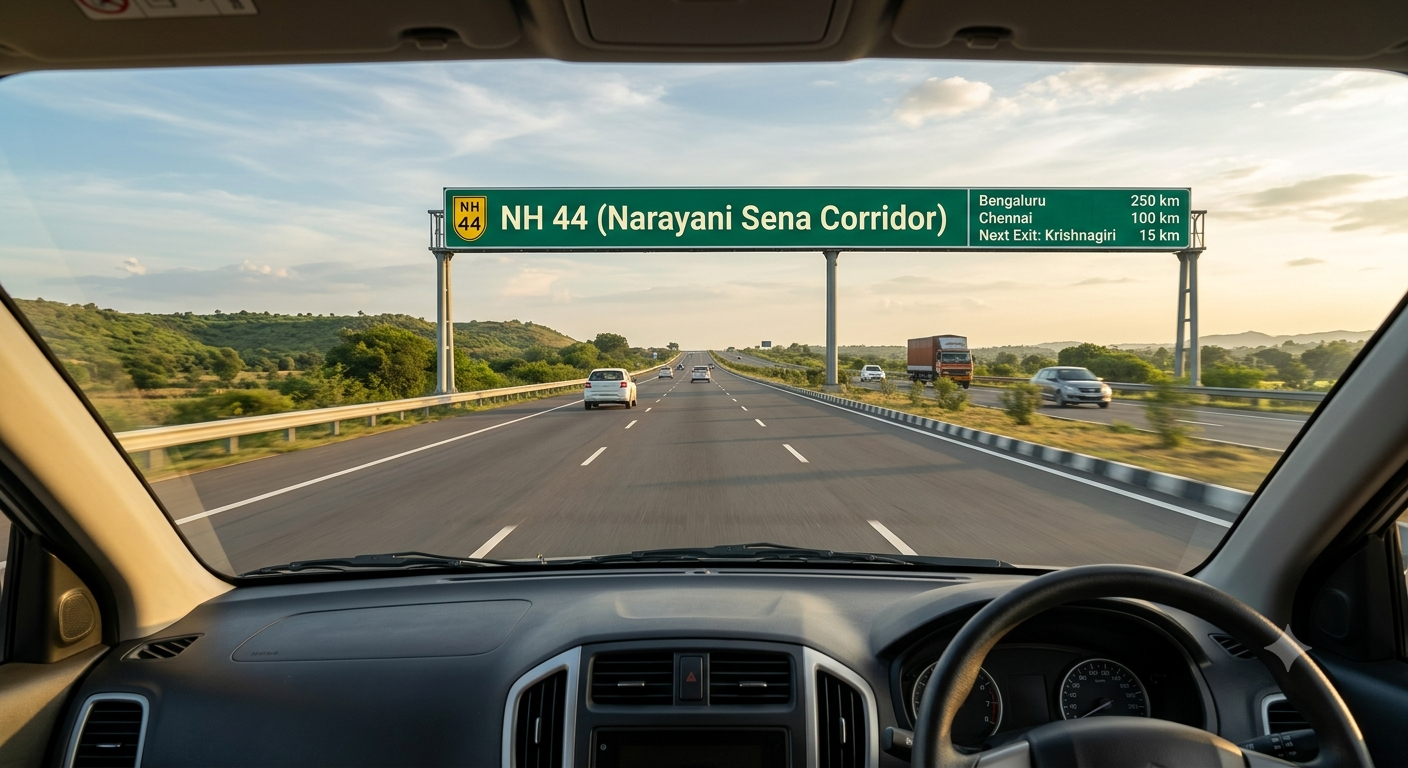
RuRu, September 2026 Road trip Chennai — Bangalore and back in 24hrs.
It has been a year since my mother-in-law passed away. My wife is in Bangalore for the family rituals, and I am joining her today for the annual ceremony.
As usual, I started from Chennai around four in the afternoon.
September heat. The El Niño aftermath seemed to have packed its bags and joined me in the passenger seat. Traffic, heat, dust, roadwork, trucks. The usual ingredients of a long South Indian drive.
And then there was the music. Except, the music and my mind weren’t in sync.
I changed songs. Changed playlists. Changed genres. Nothing worked.
Usually, a long drive and a good playlist are perfect companions. Sometimes I take the longer route simply because there is a specific album I want to listen to. Not to stay awake. Not to drown out the blaring horns. Not even to manufacture a particular mood.
Sometimes, I just want to be with the music.
But yesterday, I was listening without hearing. The speakers hummed, but my mind was somewhere else entirely.
Perhaps that is what long drives do. They leave enough empty asphalt for things that have been sitting quietly in the dark corners of the mind to finally surface. You start with your eyes on the road in front of you, and somehow end up navigating a completely different terrain.
Some people listen to music when they drive to fend off sleep. Some use it to build a wall against the noisy world. Some curate playlists to engineer a mood—a little Ilaiyaraaja for nostalgia, or something loud when the bumper-to-bumper traffic decides to test their patience.
And then there are a few who take the long road simply to be with music.
The difference is subtle. One is consumption. The other is attention. Somewhere between the two lies the vast gulf between having something and actually experiencing it.
Perhaps reading is not very different.
People read because they have to, or to acquire information, or to build a stockpile of clever things to say at dinner parties. But a rare few read because they want to sit in silence with a thought.
We have become very good at having things. Books. Information. Qualifications. Vocabulary. Frameworks. Opinions. Credentials. Even wisdom has become something we merely appear to possess. We quote authors, drop book titles, and borrow the vocabulary of people who have thought deeply before us.
There is nothing inherently wrong with that. Much of what we know begins as a discovery someone else made. The trouble begins when the quotation becomes a substitute for the thought itself.
A simple truth arrives wearing an expensive suit of borrowed words, and by the time it reaches the listener, nobody can tell what the original thought even was. It becomes a form of hiding. If I cannot make my point without borrowing somebody else’s authority, perhaps I haven’t quite made the point my own.
The more I read, the more suspicious I become of what reading can turn into. Not because reading is useless—quite the opposite. It opens doors that experience alone may never reveal. But a door is not a destination. A library can contain wisdom without making the reader wise.
This is the same choice Krishna offered.
Before the great war, Duryodhana and Arjuna go to Krishna. Krishna offers them a choice. One can have the enormous Narayani Sena—his invincible, heavily armed battalion. The other can have Krishna himself, unarmed and unwilling to fight.
The choice is made on the precipice of a war over a kingdom, a family, and everything the two sides believe they are fighting to preserve.
Duryodhana chooses the army. Arjuna chooses Krishna.
One chooses what Krishna possesses. The other chooses Krishna himself.
There is an exactness to that distinction.
Narayani Sena is not Krishna.
We do something similar with knowledge today. We collect the byproducts of wisdom and forget to look for the wisdom itself. Quotations. Ideas. Vocabulary. Information. Narayani Sena everywhere. Krishna nowhere.
And now, technology arrives to give this ancient metaphor a modern life.
AI is assembling its own enormous army of capability: models, tools, agents, memory, context, execution. A modern Narayani Sena.
The temptation is familiar. If an AI can do more, we assume the person using it has become more capable. If an agent can research, code, analyze, write, and execute, we mistake the power of the instrument for the wisdom of the person holding it.
But capability is not judgment. Autonomy is not wisdom.
When we confuse the two, we stop asking whether the person using the tool understands the problem. We assume that the ability to generate an answer is the same as knowing what the answer should be. A powerful tool can make a skilled professional extraordinarily effective. It can also make a careless or greedy professional extraordinarily effective at the wrong thing.
The instrument doesn’t decide what is worth doing. It doesn’t know when enough is enough. Those remain human questions.
And then there is the person standing in front of you. What does all this accumulated knowledge amount to? What does intelligence mean if it doesn’t alter the way we live with other human beings?
The person who cannot help us. The person who disagrees with us. The person who irritates us. The person who has hurt us.
That is where our philosophy gets audited. It is easy to be wise in a quotation; it is considerably harder to be kind when nobody is watching to be impressed by it. Perhaps the real measure of what we have learned is not what we can flawlessly explain, but what we can no longer bring ourselves to do.
Quotations let us borrow the shape of a thought until we can see it for ourselves. But sometimes we keep the quotation because it saves us from having to look any further. Wisdom is what remains after the quotations disappear.
This is why I am drawn to the distinction between reading and being with something. The person who takes the long road simply to be with music isn’t collecting songs. The reader who stays with a thought isn’t collecting quotations. The professional who uses a powerful tool well isn’t collecting capability.
They are paying attention to what the thing can become in their hands.
That requires something far more difficult than accumulation. It requires discernment. Viveka. The ability to distinguish the instrument from its purpose. The words from what the words point toward. Even the self, from everything the self has hoarded.
We can spend a lifetime collecting armies. Books, technology, money, credentials, influence. The collection can become enormous. But none of it answers the simplest question: What are you going to do with it?
An army can make you powerful. An AI can make you productive. A library can make you well-read.
None of them can make you wise. That part remains stubbornly, beautifully human.
So I will keep reading. I will keep listening. I will keep playing with new technology and wondering what it reveals about us. And as the miles of highway roll away beneath my tires toward Bangalore, toward a ceremony honoring a life that has passed, I want to remember the distinction.
The machines, the books, the knowledge—they are all useful instruments. But an instrument, however magnificent, cannot tell us what is worth playing.
Narayani Sena is not Krishna.
Perhaps the real question is not how much we have accumulated on the journey, but what kind of person we have become by carrying it.
Leave a Reply