Music to the Ears
A Personal Essay on Music, Memory, and Attention
I have always been fascinated by how music finds its way into our lives.
Not just the music itself, but the machines that carry it, the places where we hear it, the people who introduce it to us, and the strange memories that remain long after the music has stopped.
Over the last fifty years, the music player has gone through an extraordinary transformation. From the large speakers that occupied a corner of the living room to tiny earbuds hidden inside our ears. From something the whole family could hear to something that can belong entirely to one person. From waiting for a song to arrive to having almost every song available instantly.
But perhaps the more interesting story is not how the music player changed.
It is how we changed as listeners.
My Father’s Record Player
My memories begin in the early 1980s.
My father was a great lover of music. Classical music, cinema songs, old Hindi melodies, old Tamil songs. He could also pick up his harp and play some of those melodies himself.
Then he bought his first record player.
To us, it was a fascinating machine. The large speakers stood proudly in the room. They weren’t something you could hide. They occupied space, and when they played, the entire room seemed to know that music had arrived.
My father also taught us that a good player mattered. Not because it could make the music louder, but because it could make you hear what was actually inside the music.
And then there were the songs that simply belonged to the room. “Aap Jaisa Koi” – sung by Nazia Hassan, composed by Biddu – with its effortless groove and Nazia’s fresh, unguarded voice. “Laila O Laila” – sung by Amit Kumar and Kanchan, composed by Kalyanji–Anandji – which arrived like a burst of colour and refused to sit still. And “Kya Dekhte Ho” – sung by Mohammed Rafi and Asha Bhosle, composed by Kalyanji–Anandji – where two legendary voices traded phrases with such ease that you almost forgot they were two separate singers.
These weren’t just songs. They were events. The whole room participated, whether it wanted to or not.
He made us listen for the music behind the music.
I understood much later what he was teaching us. A good music system doesn’t create better music. It reveals more of the music that is already there.
That may have been my first lesson in audio quality, but more importantly, it was my first lesson in attention.
The Cassette
The record player had another companion: the cassette recorder.
My father would record rare concerts broadcast on All India Radio and preserve them for future listening.
That was a remarkable advantage. If you heard something rare on AIR, you didn’t have to hope that it would be broadcast again. You could record it. Keep it. Listen to it later. A live performance that had existed for an hour in the air could now live on a cassette for years.
The machine had given sound a memory.
I eventually discovered another use for that same machine.
One evening during my school study holidays, my mother was busy chatting with our favourite neighbours, Mangalam Patti and Rayar Mami.
That was our old-school social media. News travelled from house to house through conversations. No WhatsApp. No notifications. No forwarding. Just people, coffee, and conversation.
I was sitting at a table nearby, and I quietly picked up the cassette recorder.
I pressed Record.
For about fifteen minutes, I silently recorded their conversation. Later, I played it back to my mother. That little experiment changed the nature of gossip and enquiry at home.
My first recording wasn’t a concert. It wasn’t a song. It wasn’t even an AIR broadcast. It was fifteen minutes of neighbourhood conversation. A playful act, but it was also my first recording experience.
My father had discovered that a cassette could preserve music.
I discovered that it could preserve a moment.
When a Song Becomes a Place
Years later, music taught me something else.
In 1992, we were travelling to Bangalore for my father’s friend’s daughter’s marriage. It was a long road journey. Around a 2 a.m. pit stop, I heard a song from a nearby tea shop: “Chinna Chinna Aasai” from Roja.
It was A. R. Rahman’s first film.
I liked the song immediately.
But something much more interesting happened. The song became attached to the place where I heard it. Even today, when I hear Chinna Chinna Aasai, I don’t first think about the movie.
I think about that tea shop. The highway. The darkness. The 2 a.m. stop. The journey to Bangalore.
The song has somehow stored an experience that wasn’t actually part of the recording. And perhaps that’s one of the most beautiful things about music. We don’t always remember a song because of the song. Sometimes we remember the song because of where it found us.
The recording preserves the sound. Memory preserves the experience.
That is why hearing a favourite song unexpectedly from somebody else’s radio, a passing vehicle, or a roadside tea shop can feel completely different from deliberately searching for the same song on our phone.
One finds us. The other waits for us.
The Strange Thing About Repetition
This makes me think about repetition.
Repetition is wonderful for learning. Hear something repeatedly and we begin to recognise patterns. Familiarity grows. Memory becomes stronger.
But is repetition always good for experience?
Play your favourite song once in an unexpected place and it can stay with you for decades. Play the same song twenty times in a loop through your earbuds and you may eventually skip it.
The song hasn’t changed. Our relationship with it has.
Perhaps there is a difference between wanting to hear something again and simply allowing it to keep playing. Chosen repetition can deepen an experience. Automatic repetition can flatten it.
And today, repetition has become almost effortless. We have moved from a world where music was scarce to one where music is almost infinite. Earlier, if I wanted to hear a particular song, I might have to find the cassette, borrow it, buy it, wait for it on the radio, or hope someone played it.
Today, I can simply search. I don’t need to ask: “Do I have this song?”
I ask: “Can I play this song?”
That is an extraordinary change. But perhaps abundance changes the way we value listening.
Yet Some Music Never Becomes Noise
Then I have to contradict myself.
Because there is music I can hear again and again without losing the feeling.
M. S. Subbulakshmi’s Suprabhatam.
Vishnu Sahasranamam.
The Sikkil Sisters’ Kanda Sashti Kavacham.
These aren’t merely recordings that I happen to enjoy repeatedly. They can become part of a rhythm of life. Here, repetition doesn’t necessarily reduce the experience. It can deepen it.
Perhaps because this kind of listening isn’t about novelty. It is about returning.
The recording remains the same. But the listener changes. The words may be the same. The melody may be the same. Yet we hear them differently at different stages of life.
With some music, repetition makes us familiar with the song. With other music, repetition makes us familiar with ourselves.
Maybe that is why some music becomes ritual rather than entertainment. You don’t listen because you haven’t heard it enough. You listen because hearing it is itself the experience.
Then the Earbud Arrived
And somewhere along this journey, the music player disappeared.
Not literally. It became smaller and smaller until we stopped thinking of it as a separate object.
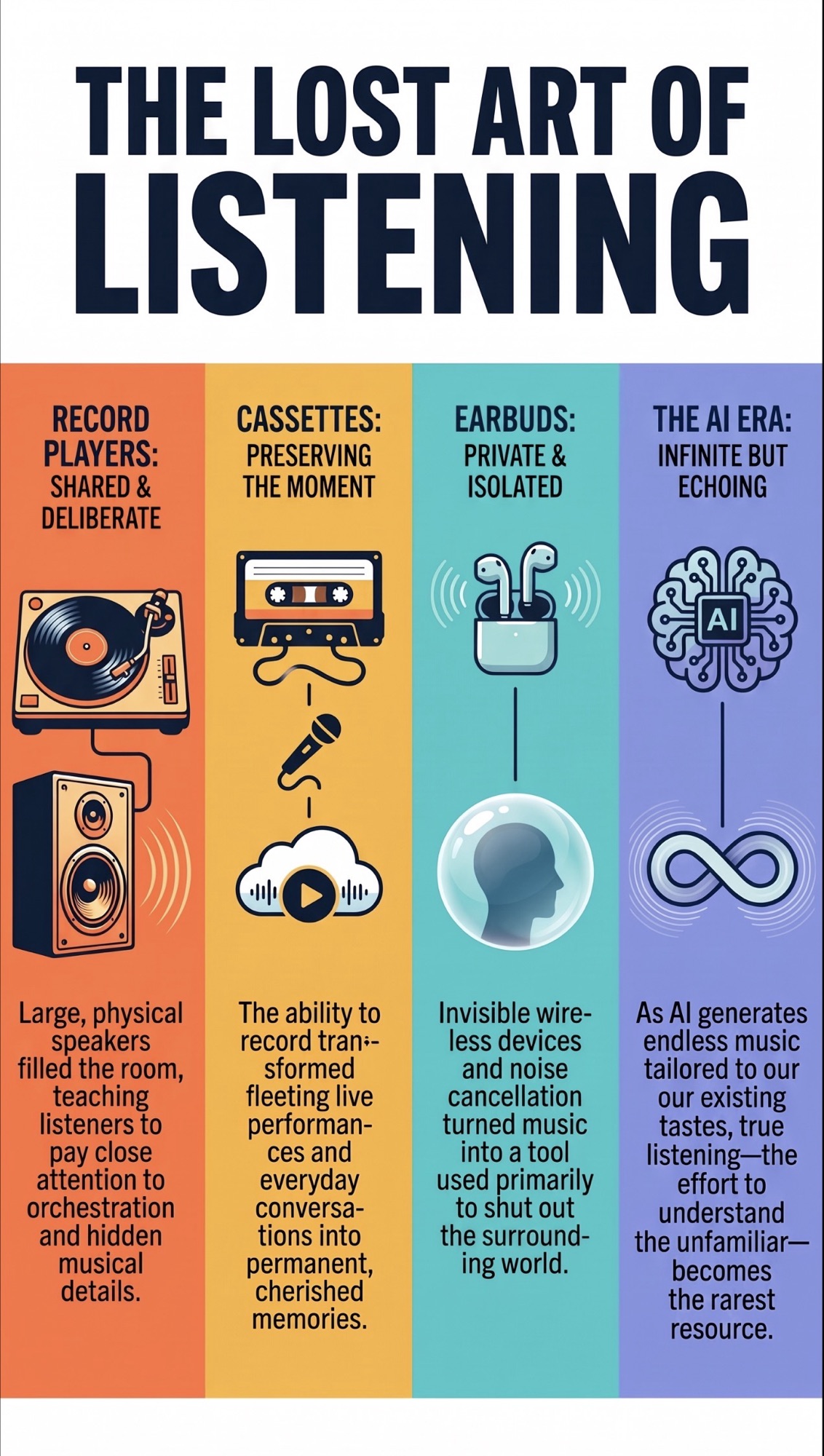
The record player became the cassette player. The cassette became the CD. The CD became the MP3. The MP3 player became the phone. And eventually, the music player became two tiny wireless objects sitting inside our ears.
The hidden earbud.
That changed something fundamental.
The old tower speaker added music to the room. The earbud can remove the room from our experience. On a train, it can remove the railway noise. In a café, the conversations disappear. At work, the surrounding sounds vanish.
With noise cancellation, the world can become remarkably quiet. We have built a device that can simultaneously play music and prevent us from hearing almost everything else.
And perhaps that’s why we increasingly use music not because we want to listen to music, but because we don’t want to listen to the world.
Walking? Earbuds.
Working? Earbuds.
Travelling? Earbuds.
Waiting? Earbuds.
Sometimes even silence seems to require a soundtrack. And then I wonder: Is the music still music if we are not actually listening to it? Sometimes the music itself becomes just another layer of noise.
We can hear without listening. We can listen without experiencing.
Repetition, Communication, and Propaganda
This sensory isolation leads to another concern.
Repetition is powerful. It can teach. It can create familiarity. It can comfort. It can also reinforce a message.
Propaganda has always understood the power of repetition. Hearing the same message again and again can make it familiar, and the human mind easily mistakes familiarity for proof.
Perhaps this is where the modern information world and the modern music world strangely meet. We are surrounded by messages. We are surrounded by music. We are surrounded by notifications. We are surrounded by recommendations. We are surrounded by sound.
More communication doesn’t necessarily mean more understanding.
More listening doesn’t necessarily mean more experience.
Perhaps the real scarce resource isn’t music anymore.
It is attention.
And Then There Is AI
Which brings me to an odd thought about where music might go next.
Classical music often asks something from the listener. A raga can take time to reveal itself. A sophisticated orchestration may require repeated listening before we notice everything happening inside it.
My father taught me exactly that with Anne Anne Sippai Anne. You don’t just hear the song. You learn how to hear it.
Much contemporary music can work differently. The hook arrives quickly. The structure is familiar. Repetition makes the song increasingly recognisable. There is nothing inherently wrong with either approach. They simply ask different things from the listener.
And this is where AI-generated music becomes fascinating. AI can learn the patterns of what we already enjoy. Melody. Rhythm. Instrumentation. Arrangement. Mood. It can instantly generate music that sounds perfectly familiar.
Want something relaxing? Here.
Something energetic? Here.
Something nostalgic? Here.
Something that sounds like the songs you loved twenty years ago? Here.
Tomorrow, perhaps we won’t even search for music. The machine will make it for us on the fly.
But then another question appears. If music is generated specifically to exactly match what we already like, will it expand our taste? Or will it simply keep giving us more of ourselves?
Perhaps great art needs some resistance. Something unfamiliar. Something that makes us listen twice. Something we don’t immediately understand. Something that slowly reveals itself.
Repetition teaches the ear what to expect. Just as the hidden orchestration on my father’s record player required deliberate effort to uncover, great music teaches the ear to expect differently.
From the Laughing Tower to the Hidden Earbud
When I look back, the transformation is almost unbelievable.
My father’s record player made music physical.
The cassette made music preservable.
Recording made sound repeatable.
The journey to Bangalore taught me that music could become memory.
Repetition taught me that familiarity could either deepen or diminish an experience.
Spiritual music taught me that repetition can also become ritual.
The earbud made music private.
Noise cancellation made it possible to shut out the world.
Streaming made music almost infinite.
And AI may eventually make music itself entirely infinite.
We have become extraordinarily good at putting music into our ears. But perhaps that was never the difficult part.
The difficult part was always listening.
My father taught me to listen to the orchestration. The cassette taught me that sound could be preserved. Mangam Patti and Rayar Mami accidentally taught me that recorded sound could preserve a moment. The 2 a.m. tea shop taught me that a song could preserve a place. And the music I return to even today reminds me that some sounds are not meant merely to entertain us. They become part of us.
Maybe that is the real journey from the laughing tower speaker to the hidden earbud.
The technology has become smaller. The library has become larger. The waiting has almost disappeared.
But the distance between hearing something and truly experiencing it has not changed. It still requires the same old technology: the human ear.
And, perhaps more importantly, the attention behind it.
RuRu is a writer and music lover who believes the best listening happens when we pause long enough to notice what’s really there—both in the music and in ourselves.
Leave a Reply