
A Independence Day Reflection
Every August 15, India remembers the freedom that ended colonial rule. In 1947, a nation became sovereign—able to determine its own course rather than live under the will of another.
But independence raises a far more difficult question when applied to the individual:
What does it mean to govern oneself?
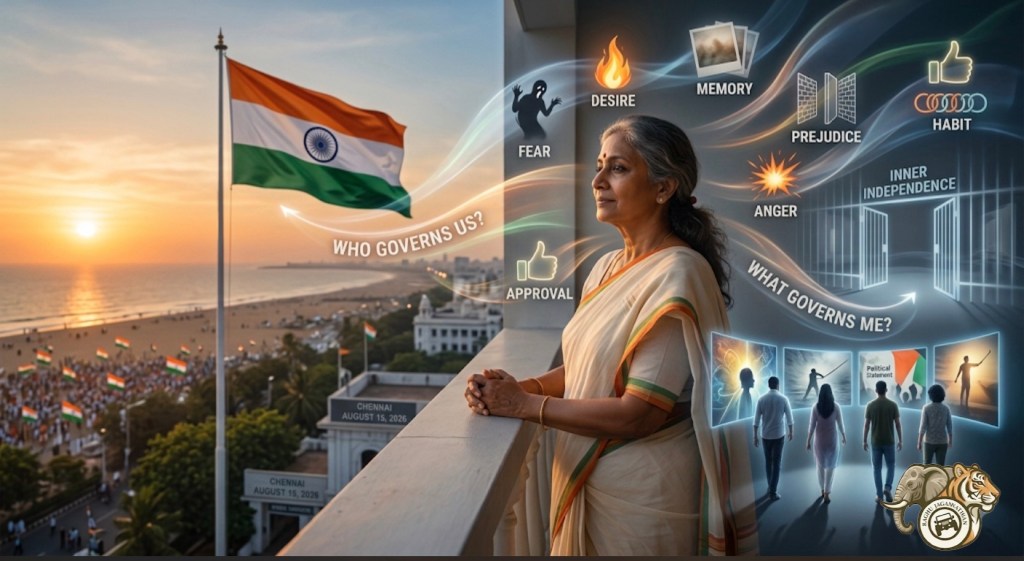
A person may live in a free country and still remain governed by fear, desire, memory, prejudice, anger, approval, and habit. Political chains can disappear while subtler ones forge themselves within. The deeper question of liberation is not merely Who governs us? but What governs me?
Imagine four close friends walking out of a cinema after watching the same film. They witnessed the same images, heard the same dialogue, felt the same music, and saw the exact same ending. Yet, each carries away an entirely different film.
One sees an act of genius. Another sees a miserable failure. A third extracts a fierce political statement. The fourth remembers a single, quiet scene that moved him to tears.
There was one film on the screen, but four distinct experiences of it.
We do not merely receive reality. We interpret it. And then, we make the dangerous mistake of forgetting our interpretation. We allow our interpretation to become reality itself.
In this space, desire becomes preference. Preference crystallizes into attraction and aversion. Agreement becomes belonging. Belonging becomes identity. Identity creates an us and, inevitably, a them. What began as a simple preference hardens into rigid division.
The problem is not difference—difference is inevitable, the natural state of the world. The problem begins when we mistake our interpretation for truth. When that happens, disagreement is no longer something to understand; it becomes something to defeat.
Vedanta takes this inquiry even further.
I see the tree. I hear the music. I notice my thoughts and emotions. We naturally conclude: I am the observer.
But Advaita asks us to investigate even that observer. If thoughts can be observed, am I my thoughts? If emotions can be observed, am I my emotions? The body changes. The mind changes. The contents of consciousness change like clouds passing across a sky.
The deeper question is: What is the nature of the awareness in which both the observer and the observed appear?
The most sophisticated prison may be the one whose walls are made of thoughts, and whose prisoner firmly believes he is free. Freedom from the mind does not mean destroying the mind. It means no longer being completely ruled by it. There is a vast difference between using the mind and being used by it. Between having an identity and being imprisoned by one.
This realization changes the very meaning of love.
It is easy to love those who agree with us. The harder task is to remain human in the presence of profound disagreement. We can disagree without dehumanizing. We can oppose injustice without cultivating hatred. Love does not require sameness. Attachment often does.
India’s political independence answered: Who shall govern us?
Inner freedom asks: What governs me?
If anger commands me, am I free?
If praise elevates me and criticism destroys me, am I free?
If fear determines my choices, am I free?
If another person’s hatred dictates whom I hate, have I surrendered my freedom to them?
Perhaps this is the unfinished freedom struggle: to see a thought without becoming it, to recognize desire without being ruled by it, to encounter difference without creating an enemy, and finally, to inquire into the very “I” that claims ownership of experience.
On August 15, we remember the freedom of a nation.
Perhaps we can also remember the freedom of the human being.
The first independence changed who governed India.
The second asks: Who governs me?
And the deepest freedom begins when we have the courage to investigate the answer.
 Arambhin
Leave a comment