
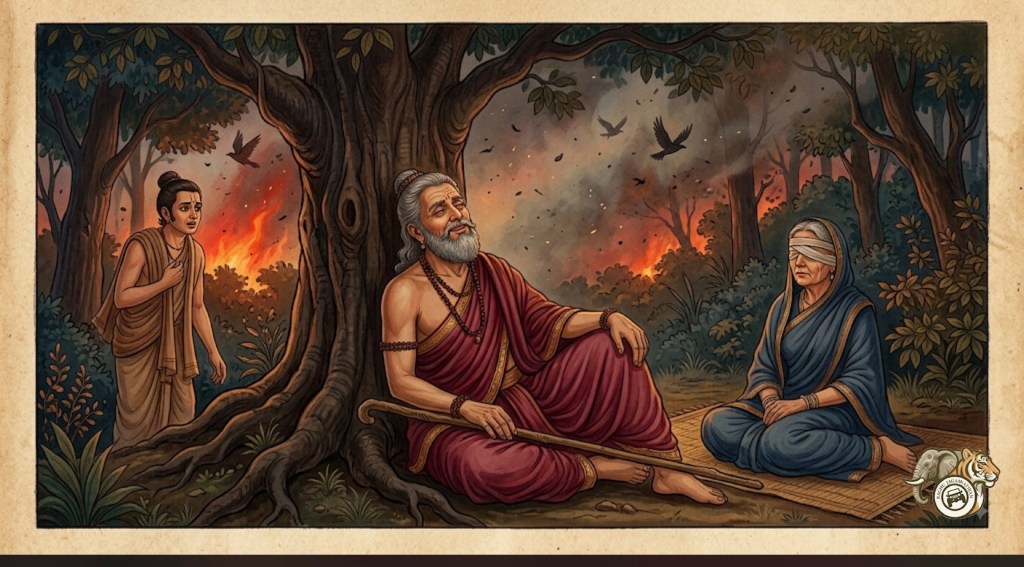
The forest had been unusually still that evening, heavy with the breathless anticipation that precedes a storm.
Dhritarashtra sat beneath the sprawling canopy of an ancient sal tree, his scarred fingers resting on the rough wooden staff across his knees. He could hear the forest breathing. The brittle rustle of dead leaves. The frantic warning cry of a peafowl somewhere beyond the hermitage. The distant, hollow crack of a rotting branch.
Then, faintly, another sound. A low, hungry hiss.
Gandhari heard it too.
“Smoke,” she whispered, her voice like dry parchment.
Sanjaya had already risen, the rustle of his robes sharp in the quiet. “The wind has changed.”
Dhritarashtra smiled. “I know.”
Sanjaya looked down at him. For a moment the old king seemed almost amused by the scent of pine and ash drifting through the trees.
“You were about to tell me where the fire was,” Dhritarashtra said.
“I was.”
“You need not.”
Slowly, Sanjaya sat back down.
There was a long silence, measured only by the creeping warmth in the air.
Then Sanjaya asked, “Maharaja, do you remember the first time you were told that you would not be king?”
Dhritarashtra’s fingers tightened around the staff.
“I remember the room.”
“You could not see the room.”
“No. But I remember the silence.” He ran his hand over the worn wood. “They spoke gently. That is what I remember most. People speak gently when they are delivering a hard truth.”
“Was it because you were blind?”
“They said so.”
“And did you believe them?”
“For many years.”
The forest stirred. The hiss in the distance was growing into a roar.
“Perhaps that was my first mistake,” the king murmured. “I spent too long asking whether blindness had taken the throne from me. I should have asked what kind of king I would become if I received it.”
Sanjaya said nothing.
“Pandu became king.” There was no bitterness in his voice now. “He was younger. Strong. A warrior. The kingdom needed someone who could stand before armies and be seen.”
“And later, you became king.”
“Yes.”
“Did that satisfy you?”
Dhritarashtra laughed quietly, a sound that barely escaped his chest. “A throne does not cure the desire for a throne.”
The wind moved through the trees, bringing with it a sudden, stifling wave of heat.
“I thought I wanted the kingdom. Later I discovered that I wanted something smaller.”
“What?”
“My son to have it.”
Sanjaya lowered his head. “Duryodhana.”
“My son,” Dhritarashtra corrected. He paused. “That distinction ruined me.”
The fire had not yet reached them, but the orange glow was beginning to paint the edges of the darkening forest.
“I knew what Duryodhana was becoming.”
“You knew?”
“I knew.”
“Then why did you not stop him?”
Dhritarashtra’s face hardened. “Do you think blindness prevented me from hearing Vidura?”
“No.”
“From hearing Bhishma?”
“No.”
“From hearing Krishna?”
“No.”
“Then do not blame my eyes.”
Sanjaya looked at him. The king’s voice had dropped to a fragile whisper.
“That is the truth I have spent half my life avoiding.” Dhritarashtra turned his sightless face toward the burning trees. “My blindness was given to me. My other blindness I cultivated.”
Sanjaya remained silent, letting the heat of the admission settle.
“There was a time when Vidura would enter my chamber and tell me what I did not want to hear,” Dhritarashtra continued. “I would become angry. Then I would send him away. Later, I would call him back.”
“Why?”
“Because I needed the truth. But only until the truth became inconvenient.” He smiled bitterly. “Do you know what attachment does, Sanjaya? It does not make you ignorant. It makes you selective.”
The crackle of a burning thicket echoed from the edge of the hermitage.
“Duryodhana would speak. I would hear a son. Vidura would speak. I would hear a critic. Bhishma would speak. I would hear an old man bound by his vows. Krishna would speak. I would hear a threat to everything my son believed was his.”
He stopped, swallowing dry air. “Same words. Different ears.”
Sanjaya looked toward the blazing horizon. “And Gandhari?”
Dhritarashtra became utterly still.
“She covered her eyes,” Sanjaya said.
“I know.”
“Why did you let her?”
The king’s hand moved slowly across the staff, tracing a knot in the wood. “I have asked myself that question many times.”
“Could you have stopped her?”
“I could have tried.”
“What would you have said?”
Dhritarashtra’s lips moved, but no words came. The roaring forest answered for him.
At last he said, “I should have told her, ‘Do not become blind because I am blind.’” His voice broke. “‘Your eyes must become my eyes.’”
He breathed deeply, pulling soot into his lungs.
“Instead, I accepted her blindness as love.”
“Was it not?”
“Perhaps. But a king should be suspicious of any love that reduces the number of people willing to see.”
Sanjaya stared at the old man.
“That is what I understand now,” Dhritarashtra said. “Gandhari did not need to see for herself alone. She could have seen for me. For our children. For the kingdom. We had enough people who were blind in different ways.”
A flaming branch crashed to the forest floor somewhere in the darkness. Dhritarashtra turned toward the sound.
“Bhishma could see.”
Sanjaya waited.
“He saw what was happening. He understood the danger. Yet his vows held him to the throne and the house.”
“Was that blindness?”
“No.”
“Then what was it?”
“When a vow becomes more important than the reason for which you made it, the vow becomes a chain.”
“And you?”
Dhritarashtra smiled without joy. “I had no vow.”
“What held you?”
“My son.”
Silence hung between them, heavier than the smoke.
“Perhaps that was worse.”
The smell of ash was suffocating now. The heat pressed against their skin like a physical weight. Sanjaya stood.
“Maharaja, we should go.”
“Where?”
“Away from the fire.”
“Where shall we go?”
Sanjaya had no answer.
Dhritarashtra reached down and touched the warm earth beside him. “I have spent my entire life trying to move events away from the fire.” He laughed softly. “Pandu. Duryodhana. The dice. Draupadi. The exile. The kingdom. The war.”
He counted them with his trembling fingers.
“Each time, I thought there was still time.”
“There was.”
“Yes.” His hand stopped. “That is what makes it unbearable.”
Sanjaya sat back down on the scorched earth.
Dhritarashtra nodded, almost to himself. “Hindsight shows you how many doors were open when you were certain there was only one.”
He lifted his face toward the searing wind. “Tell me, Sanjaya. What do you think Kurukshetra was?”
“A war.”
“No.” He waited, letting the heat wash over him. “It was a thousand small decisions.”
Sanjaya looked at him through the thinning veil of smoke.
“Each person carried a blindness into that field,” the king said. “I carried attachment. Gandhari carried chosen blindness. Bhishma carried his vows. Drona carried obligation. Karna carried loyalty. Duryodhana carried desire. Yudhishthira carried his attachment to the rules he had chosen. Arjuna carried confusion.”
“And Krishna?”
Dhritarashtra was quiet for a long moment.
“Krishna carried none of our excuses.”
Even the forest seemed to fall quiet beneath the roar of the flames.
“He did not remove Arjuna’s responsibility. He did not promise him victory. He did not tell him that the outcome would belong to him.”
“What did he give him?”
“A way to see.”
Sanjaya waited.
“That is what I failed to learn,” Dhritarashtra whispered. “Before a great decision, you must look through many eyes. Listen to the person who disagrees with you. Listen to the person who has nothing to gain. Ask what your attachment is hiding. Ask what your fear is exaggerating. Ask what your ambition refuses to see.”
He touched his chest, right over his failing heart. “But after all that, you cannot live by a hundred opinions.”
“What then?”
“One principle.”
“Which?”
Dhritarashtra turned his sightless eyes toward his charioteer. “Dharma.”
The word remained between them.
“You see through many eyes,” he said, “but you cannot decide through many desires. You must finally ask one question: What is the right thing to do?”
“And after that?”
“Do it.”
“What if it fails?”
Dhritarashtra was silent for a long time. The flames were licking at the edges of the clearing.
“That is the question that destroyed me,” he finally answered. “I wanted the right outcome so badly that I abandoned the right action.” He leaned back against the rough bark of the sal tree. “Krishna understood what I did not. Your duty is to the action. Not to the fruit.”
The fire was upon them. Flocks of birds burst from the canopy in panicked clouds.
Sanjaya stood again, shielding his face from the intense heat. “Maharaja.”
Dhritarashtra did not move.
“The fire.”
“I hear it.”
“We must leave.”
“No.”
“Why?”
The old king smiled. “All my life, I wanted to control what would happen next.” He placed his staff deliberately on the ground beside him. “I have no desire to do so tonight.”
“Are you afraid?”
Dhritarashtra listened. The forest was no longer quiet. Branches cracked like shattering bone. Terrified animals tore through the undergrowth. The wind carried a wall of heat toward them.
He thought of Hastinapura. Of Pandu. Of Gandhari. Of Vidura. Of Bhishma. Of Duryodhana. Of the sons who had once filled the palace with noise.
Then he thought of the dice. The court. Draupadi’s voice. Krishna’s warning. The five villages. The war.
All the moments when someone had tried to make him see.
He closed his eyes. Then he opened them. It made no difference. But something inside his soul had shifted.
“Sanjaya.”
“Yes, Maharaja?”
“For the first time, I do not need you to tell me where the fire is.”
Sanjaya stood beside him, lowering his hands. Neither spoke again.
The flames entered the clearing. And the blind king finally understood the difference between losing one’s sight and refusing to see.
The fire consumed the trees. It consumed the hermitage. It consumed the last shelter of a king who had spent his life trying to preserve what could never be preserved.
But there was one thing the fire could not take.
At the end of his life, amidst the ash and the ruin, Dhritarashtra had finally learned to see.
Not the kingdom. Not his sons. Not the future.
Himself.
 Arambhin
Leave a comment