
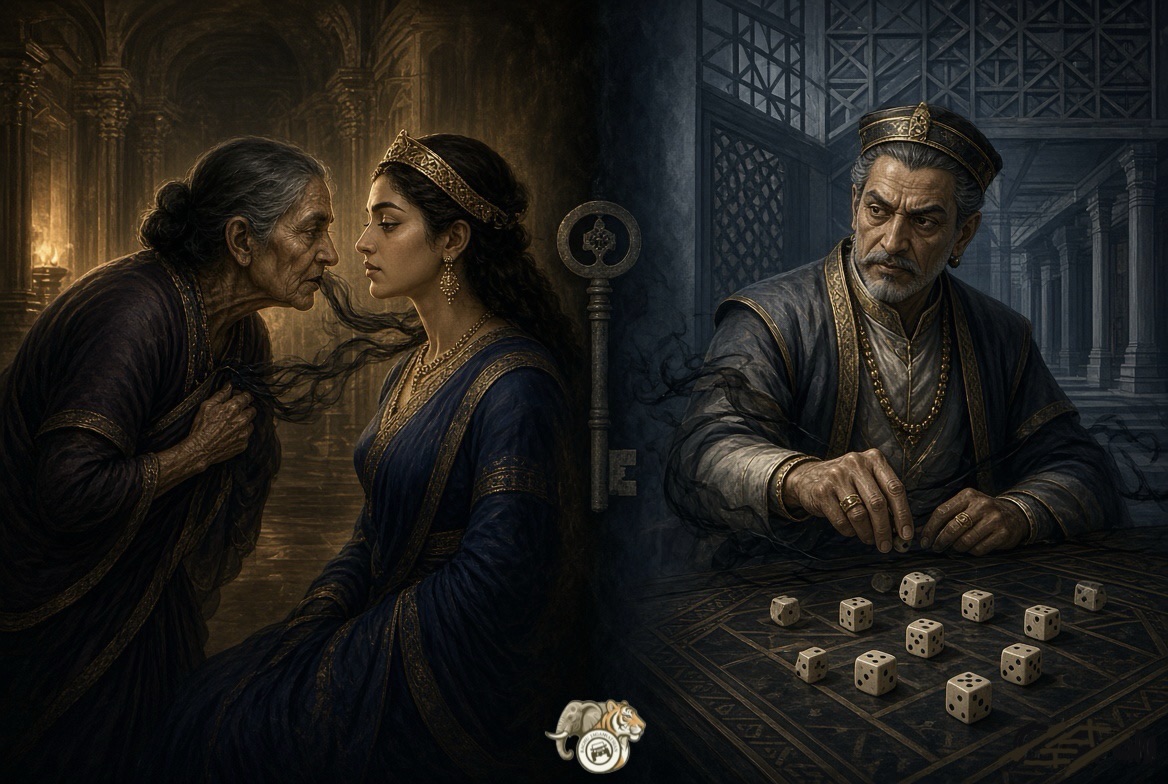
The Ramayana and the Mahabharata appear to tell different stories. One follows Rama into exile and toward Ravana; the other follows the Pandavas into the wilderness and toward Kurukshetra. Yet beneath both epics the same quiet pattern runs.
The destruction does not begin with an enemy at the gates. It begins inside the family.
Mantharā and Śakuni are not foreign invaders. They are insiders. They have lived long enough in the shadows of their respective courts to know the people, the tangled loyalties, the secret fears, and the precise points where affection can be turned into leverage. Neither holds the throne. Both hold something more dangerous: access to the mind of the one who does.
Mantharā cannot banish Rama. Kamban captures her with a single, devastating line: she is about to create distress for the three worlds. He does not simply call her evil. He shows the internal sequence by which emotion becomes cognition, cognition becomes speech, and speech becomes consequence. The sequence begins inside her. She sees Ayodhya celebrating Rama’s coronation—the city filled with collective joy—and processes the same reality through resentment. The event is external. The interpretation is internal. The manipulation begins only when that interpretation is transferred to another mind. She works through Kaikeyi, taking a mother’s ordinary concern for Bharata and watering it until it becomes paranoia. Then she reminds the queen of the two boons. The demand appears to come from Kaikeyi, but the seed was planted by Mantharā. Dasharatha is trapped by his own rigid vow. His commitment to satya becomes the mechanism of his son’s banishment.
The same machinery operates in the Mahabharata. Śakuni cannot exile the Pandavas by force. He weaponises Duryodhana’s jealousy and exploits Yudhishthira’s rigid adherence to the rules of the dice. As the dice fall, the catastrophic loss appears to belong to the one who suffers it. The trap was built by the insider.
Fourteen years for Rama. Thirteen for the Pandavas. Forest exile in both cases.
The irony is sharp. Those who believed they were weakening the protagonists by casting them into the wilderness were actually forging them. The forest becomes a furnace. Rama returns not merely as a dispossessed prince but as the gravitational centre of a continent-spanning alliance. The Pandavas return not merely as humiliated outcasts but as warriors prepared for the world that would break at Kurukshetra.
The manipulators trigger the transformation they sought to prevent.
Yet the true vulnerability was never Mantharā’s whispering or Śakuni’s loaded dice. It was the slippage of the mind.
Kaikeyi’s emotional balance fractures. Duryodhana’s envy consumes judgment. Yudhishthira’s principle becomes a blindfold. Dasharatha’s vow becomes a cage.
Bhima stands as the clearest counter-example. After Draupadi’s humiliation in the assembly, his fury is volcanic. He makes a vow that is absolute, personal, and unrelenting. It could easily have collapsed into pure vengeance—blind and self-destructive. Instead the vow is held inside a larger dharmic frame. The rage is not diluted; it is directed. It becomes fuel for a long, exacting purpose rather than an uncontrolled fire. Bhima does not rid himself of emotion. He becomes capable of carrying a fierce emotion without letting it seize the reins.
This is the distinction the epics return to again and again. Dharma is not the mere following of a rule. A vow is not righteous simply because it was spoken. A rule is not absolute merely because it is written. An emotion is not destructive merely because it is strong.
The real question is whether the mind remains steady enough to see what the moment actually requires.
Without viveka, a slightly disturbed mind can turn affection into attachment, attachment into fear, fear into susceptibility, and susceptibility into action that later feels inevitable. The sequence is short and ruthless: disturbed mind → distorted perception → personal interest → manipulation → wrong action → consequence that outruns the original intention.
Mantharā and Śakuni are not figures locked in ancient myth. They name a recurring human vulnerability: the person—or the entity—who maps the fractures in another’s mind and carefully opens them. Neither creates the weakness. They discover it, magnify it, and give it a narrative that feels like the person’s own thought. The external enemy must still breach the walls. The insider already holds the key.
In today’s AI-infused world this pattern has only grown more intimate. The algorithm is the modern Śakuni, casting loaded dice across the screens in our hands. News, commentary, images, and narratives now arrive already shaped by systems that understand our preferences, our irritations, and our half-formed fears with unsettling accuracy.
Relying on what reaches us—whether for information, a sense of truth, or a feeling of reality—requires a sharper differentiation than before. We must learn to recognise Mantharā and Śakuni both outside us and inside us. The external versions arrive as carefully tuned feeds and synthetic voices. The internal versions are the quiet readiness of our own minds to be moved by them.
We cannot keep every such influence out of our screens or our conversations. We can only decide whether our minds will become the instruments they play.
I have watched versions of this pattern play out in smaller, less mythic settings—boardrooms, family decisions, the quiet moments when a principle we hold dear is turned, almost gently, against us. The scale is different. The machinery is the same.
Emotional stability keeps the mind from being easily hijacked.
Viveka sorts toxic influence from truth.
Dharma gives the resulting action its direction.
Without these, the very qualities we most prize can become the weapons used against us. Dasharatha’s truthfulness becomes his torment. Yudhishthira’s honour becomes his vulnerability. Kaikeyi’s love becomes her undoing.
Rama points to the other possibility: the world around us may be shaken, but the centre does not have to move with it.
The decisive battle is rarely the one fought on the shores of Lanka or the field of Kurukshetra. It is the quieter contest that takes place in the corridors of the mind—long before any army is raised or any exile is pronounced.
When the mind loses its balance, someone else begins to hold the reins.
When the mind remains steady, even adversity can become a path instead of a prison.
The strongest protection is not suspicion. It is a mind trained, through practice and vigilance, to remain its own.
Leave a Reply