Before the machine became the memory, there was a question.
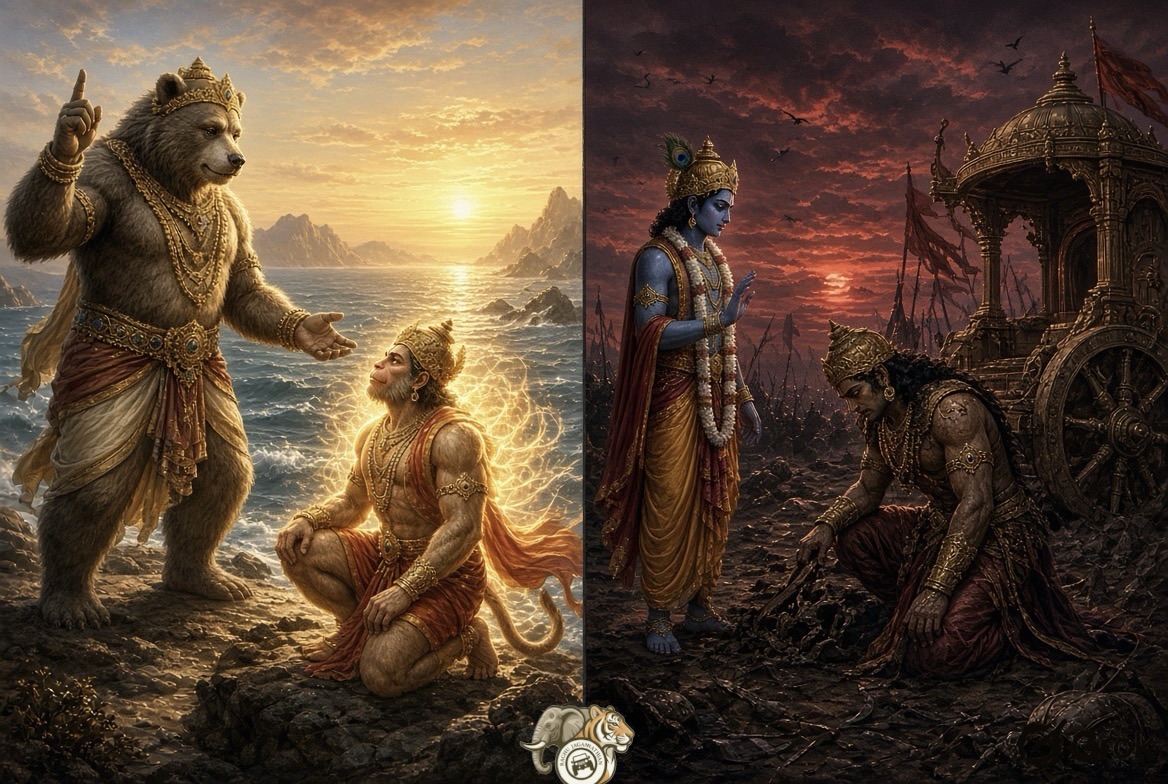
The Ramayana gives us Hanuman. He possesses extraordinary abilities—unfathomable strength, the power of flight, invincibility—but at the critical threshold of his journey, he does not fully remember them. He sits on the shore in doubt, his vast powers inaccessible. It takes Jambavan, the ancient bear-king, to speak to him, to remind Hanuman of exactly who he is and the cosmic weight he carries. The knowledge had not disappeared; it was simply barricaded, unreachable until the right voice turned the lock. Hanuman hears, remembers, and acts. A continent is crossed. A war is won.
The Mahabharata offers a darker mirror. Karna, the secret eldest Pandava, possesses formidable knowledge of warfare and celestial weapons. But a curse, earned through a desperate deception, ensures that at the decisive moment before his death, he cannot recall the mantras needed to invoke his most devastating weapon. The knowledge exists in his mind. The retrieval fails. The chariot wheel sinks, and Karna falls.
Two ancient epics, two outcomes, one enduring architecture: Know. Forget. Need. The difference between triumph and tragedy is not whether the knowledge was ever acquired. It is whether it can arrive when the moment violently demands it.
We have never lived in an age with so much memory. And yet, we have never depended so little on our own.
I can barely remember the phone numbers of the people I love most. My phone remembers them. I don’t need to know the way; the map remembers. I don’t hold my schedule in my head; my calendar remembers. We have gradually, quietly outsourced the very act of remembering. Most of the time, this feels like progress. It frees the mind. Until the device disappears. Lose a phone without a backup, and suddenly an enormous section of life goes dark: payments freeze, authentication fails, faces vanish, documents become unreachable. For something so small, the amount of human life suspended upon its memory is terrifying.
We have not eliminated memory. We have externalized it.
But external memory carries its own native vulnerabilities. A device with insufficient storage chokes. A system with a memory leak—where programs stubbornly hoard memory they no longer need—gradually consumes itself. Corrupted memory produces hallucinations. A machine may be perfectly capable of performing a task, but without the memory required to sustain its context, the task dies.
This becomes infinitely more consequential with Artificial Intelligence. AI is not merely another machine that uses memory; it is an entity whose usefulness depends entirely on what it can remember about us—our conversations, our griefs, our preferences, our unfinished thoughts. Without context, every conversation begins again in a void. Without continuity, assistance degrades into repetition. Without memory, intelligence is stripped of its history.
This is where the ancient stories transition from literature to diagnostic tools.
Hanuman’s problem was not an absence of knowledge, but a failure of recall. Karna’s tragedy was not ignorance, but retrieval blocked at the moment of survival. The insight is surgically precise: Knowledge that cannot be retrieved when required is functionally equivalent to knowledge that was never there.
Modern computing understands this perfectly. Data may exist in cold storage, but if the index is broken, the application is blind. A language model may contain the sum of human information, but if the relevant context window is missing, it cannot surface the truth. A person may have learned a vital lesson decades ago, but under the crushing gravity of panic, the knowledge remains buried.
Memory, therefore, requires three dimensions:
Knowledge: What exists.
Recall: What can be retrieved.
Timely Retrieval: What can be summoned into consciousness the exact second the situation demands it.
That third dimension is where memory transcends data and becomes intelligence. It is not enough to store the right thing; it must arrive at the right moment. Hanuman needed a prompt. Karna suffered from the absence of one. The prompt is the retrieval mechanism, and without it, the archive is silent.
Ancient traditions understood this architecture in their bones. The Vedas were preserved for generations through oral transmission, supported by fiercely structured methods of memorization. The critical insight here is not simply that ancient minds were exceptional. It is that they designed a foolproof architecture for memory. Knowledge was not trusted to a single, fragile human mind. It was networked through teachers and students. It was recited in intricate mathematical patterns, embedded in ritual, and reinforced through rhythm.
They did not merely store knowledge; they created multiple, overlapping pathways through which knowledge could survive. If one human node failed, the tradition lived on. The community itself was the backup. They built a distributed, serverless system—a living redundancy ensuring that retrieval would outlast the failure of any single component.
The principle endures: the greatest memory system is not the one with the largest capacity. It is the one that can survive its own breaking.
Then came the machine.
We decided that human memory was too small, too mortal. So we invented external memory: clay tablets, printing presses, libraries, photographs, magnetic tape, hard disks, cloud storage, smartphones. And now, AI.
The trajectory is staggering: Mind → Manuscript → Machine → Cloud → AI.

Every leap pushes more memory outside the self. Every leap grants us godlike capacity. But every leap tightens the tether of dependency. The smartphone does not merely contain our contacts; it contains our access to reality. The cloud does not merely store our photographs; it guards our personal histories. Soon, AI will remember our choices, projects, and patterns across decades, building a synthetic memory layer around human consciousness. The ultimate assistant will not be the machine that can answer every question, but the machine that remembers what matters to you.
Yet, this raises a profound problem that sheer storage capacity cannot solve. If AI can remember everything, should it?
Memory is not valuable merely because it is exhaustive. Memory demands curation. Some things must be fiercely retained. Some things must be allowed to expire. Some things should be remembered only until a task is complete. And some things deserve permanence because they are the very architecture of our identity. The challenge of our age is not building larger memory. It is building meaningful memory.
Memory can be a cursor. A cursor blinks; it points. It tells us precisely where we are and waits to navigate where we are going. The past becomes telemetry for the next move. Experience transforms into guidance. Mistakes become feedback. Memory pulls consciousness forward.
But memory can also become a curse. A person can become entombed in an old failure. A society can be held hostage by an ancient grievance. We can remember everything about an injury, except how to let it go. The same memory that builds identity can become a shackle.
The question is no longer whether we should remember more. It is what deserves to be remembered. And deeper still: who should remember it?
For thousands of years, the answer was: We must remember. Then, civilization shifted the burden: Our books can remember. Then: Our machines can remember. Then: The cloud. And now: AI.
We are approaching the twilight of our own recollection, a point where our machines will remember more about our lives than we consciously do. This should not merely frighten us; it should make us pause. Because memory is not merely a museum of the past; it is the mechanism by which the past participates in the present.
If we succeed in building machines that remember everything, what must the human still hold on to?
Perhaps the answer is not a storage problem. Perhaps what we must retain is the memory that tells us who we are, what we have learned, what we must never repeat, and where we wish to go. But equally important: we must remember what to release. Because meaning—unlike data—cannot be statically stored. It can only be remade, re-forged each time we retrieve it, in the light of who we have become.
If we build machines that remember everything, we may discover that the ultimate human necessity was learning how to forget.
Memory should not keep us facing backward. It should give us a cursor. A point of orientation. A way forward. The machine will hold the data. The human must hold the meaning.
Leave a Reply