Us and Them: The Forgotten Operating System
A few days ago I was listening to Pink Floyd’s Us and Them. It is one of those rare songs that does not demand attention; it waits for silence. The melody drifts like a quiet question while the lyrics simply expose the invisible walls we have built. After all, we are only ordinary men. No villains. No heroes. Just ordinary people drawing extraordinary boundaries.
The song moves through war, poverty, indifference and division without raising its voice. It observes a world that has forgotten something essential. As the music faded, one thought remained: What if “Us and Them” is not the disease, but only the symptom? Perhaps the real fracture began much earlier—when “You” became disconnected from “Yourself.”
⸻
A faded photograph is enough. Not because it captures a moment, but because it awakens a civilization that once lived quietly inside our homes.
I remember my grandparents’ house, steeped in the faint scent of morning camphor and damp earth. Every day began with familiar instructions, delivered before the sun had even risen.
“Take a bath before breakfast.”
“Wash your feet before entering the house.”
“Don’t come near the pooja room without bathing.”
“Clean your hands and mouth after eating.”
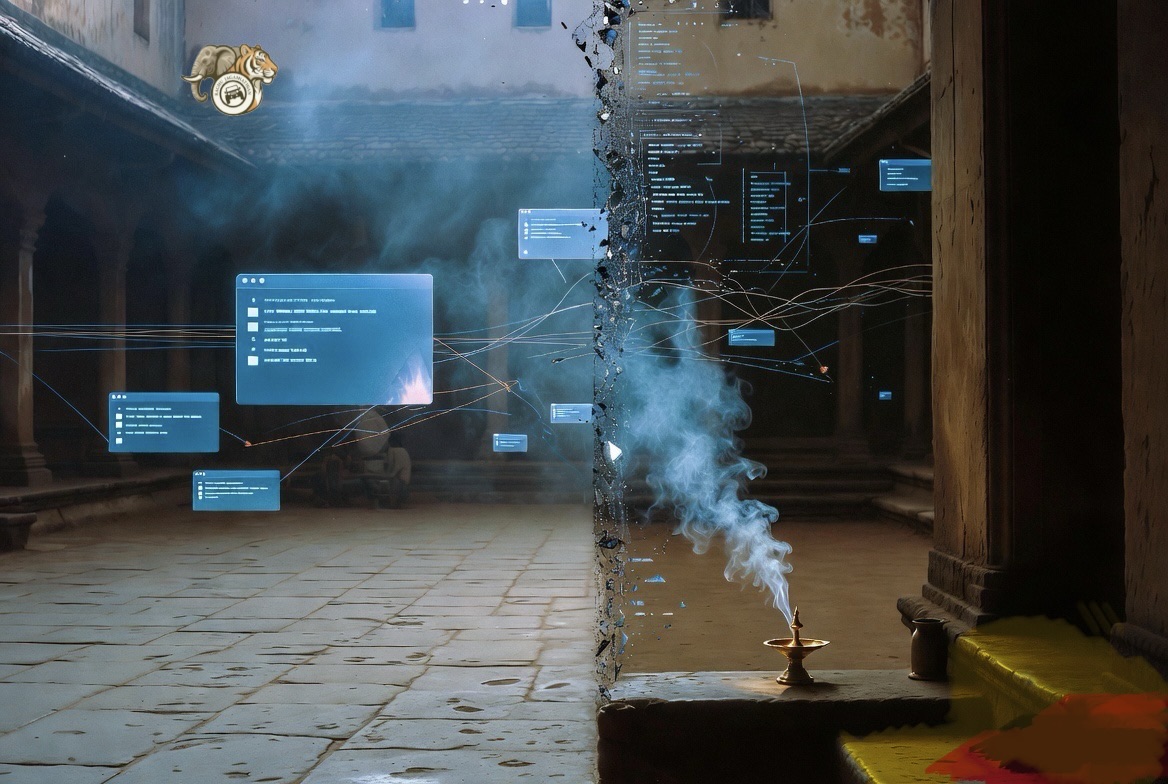
As children standing on the cold stone floor, these sounded like unnecessary restrictions. Today, bathed in the cold blue light of our screens, we recognise the same principles through different words: hygiene, boundaries, access control, security, clean-room protocols. The vocabulary has changed; the wisdom has not. My grandparents never studied microbiology, neuroscience or cybersecurity, yet they instinctively understood a timeless principle: what enters the body, the home, the mind and the sacred space should enter with awareness.
These were not merely rituals. They were daily exercises in discipline—Dharma expressed through ordinary life. History reminds us that some customs hardened into unjust discrimination, and those distortions deserve to be questioned. But it would be equally mistaken to dismiss every inherited discipline as prejudice. Dharma has always adapted to deśa, kāla, pātra—the place, the time and the person change; the principle remains.
⸻
The Mahābhārata carries the same lesson. Krishna never begins with weapons; he begins with Dharma. When he held up the mirror, the great warriors did not look away. Bhīṣma knew where he had compromised. Droṇa knew where attachment had clouded his wisdom. Karṇa knew the cost of standing beside Adharma.
Only through this acceptance did they surrender what had made them invincible. Their defeat did not begin with arrows; it began with recognition. Duryodhana and Śakuni chose another path, where every warning became an argument and every failure someone else’s fault. The battle outside merely completed the battle they had already lost within. That is the difference Dharma makes: it does not make us perfect; it makes us accountable.
The Kurukshetra of our time is not fought with chariots and arrows, but with algorithms and notifications. We are more connected than any generation before us—tethered to every device, network and opinion—except our own consciousness. We have forgotten why we live, what we serve, and how individual purpose is meant to harmonise with the welfare of the whole.
Information has become infinite. Attention has become fragmented. Meaning has become scarce.
A processor handling too many signals develops latency. A mind carrying too many desires develops confusion. Decisions slow. Judgement clouds. Not because we lack intelligence, but because consciousness has no quiet place from which to choose.
Our ancestors approached this differently: silence before prayer, bathing before worship, fasting before festivals, reflection before action. These were methods for reducing interference before decision. Dharma was the art of filtering noise and aligning purpose.
⸻
This is why I see the Puruṣārthas not as four destinations, but as four disciplines for navigating modern noise.
Dharma is the righteous operating system.
Artha is not merely wealth, but the meaningful allocation of our most precious modern resources: time, energy and attention.
Kāma is living without becoming a slave to adharmic, algorithmic attraction—keeping desire within the boundaries of Dharma rather than serving it.
Mokṣa is the ultimate liberation: disconnecting self-worth from infinite scrolling, digital validation and the restless ego.
Live righteously. Build meaningfully. Desire wisely. Let go gracefully. Practised together, they transform life itself into the path.
⸻
Modern civilisation has become remarkably good at prediction. Ancient civilisation was remarkably good at preparation. We optimise processors; they optimised consciousness. We secure networks; they secured character. We collect information; they cultivated wisdom.
Material prosperity is not the enemy. The problem begins when prosperity becomes the only compass, when convenience replaces character, and when desire multiplies faster than discernment. Perhaps the greatest challenge of our age is not artificial intelligence, but natural consciousness.
As I listened once more to Us and Them, I realised the song is not only about the separation between nations or classes. Beneath every visible division lies an older, quieter fracture: the distance between ourselves and our own consciousness. When that distance grows, conflict is inevitable. When it disappears, Dharma quietly returns.
Our sages never began by trying to change the world. They began by teaching us how to bathe, how to eat, how to listen, and how to let go—because the world’s conflicts are often only echoes of the conflicts within.
Pink Floyd gave us the soundtrack of a civilisation asking, “Why are we divided?”
The sages offered a different question: “Who have you become when you are divided from yourself?”
The first conflict was never between us and them.
It began the moment we became strangers to our own consciousness.
That is the forgotten operating system.
Leave a Reply