
“A moving man will one day meet his luck. The road favours a traveller.”
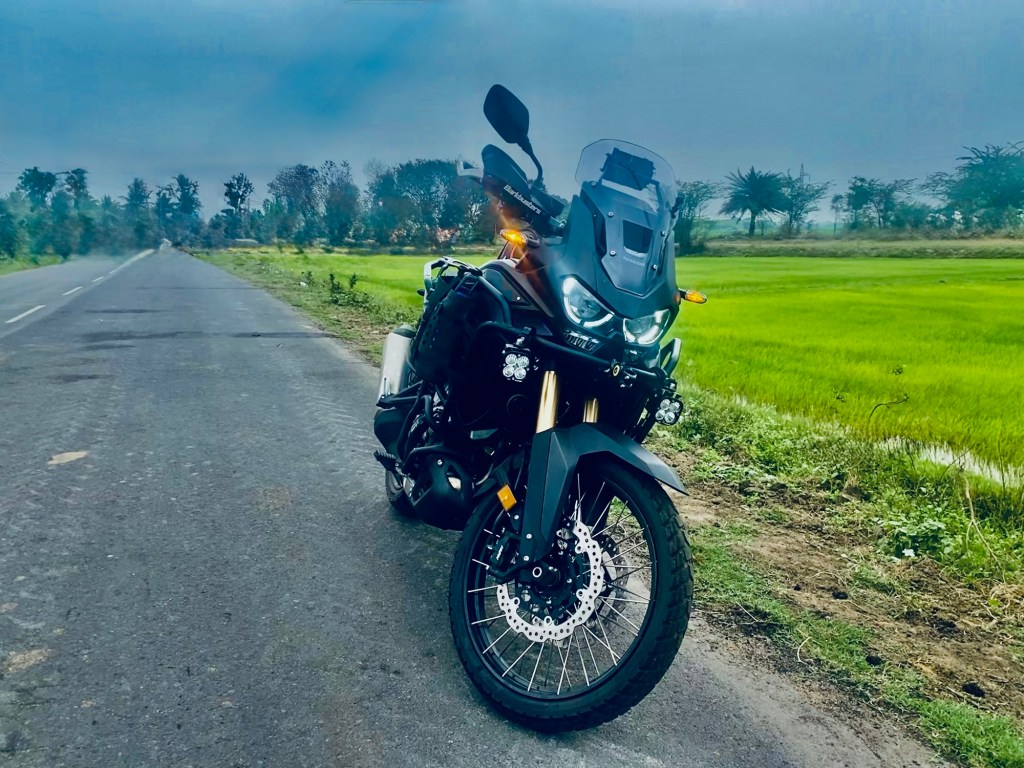
After a long gap, I dusted off my Honda Africa Twin.
There was nowhere I needed to be.
That was precisely the point.
I thumbed the starter, listened to the engine settle into its familiar rhythm, and simply rode.
Almost instinctively, the wheels found the East Coast Road.
The Bay of Bengal was wearing a soft golden glow. Chennai had finally exhaled. Days after an unforgiving July heat, unexpected thunderstorms had washed the city clean. The morning breeze carried the scent of wet earth and salt. The road looked as though it had been waiting.
I wasn’t chasing a destination.
I was enjoying the privilege of having none.
Then the motorcycle’s display lit up.
“Start navigation?”
The Maps app appeared.
I dismissed it.
A few minutes later, it returned.
Patiently waiting for me to choose a destination.
I smiled.
The machine couldn’t understand that I didn’t want directions.
For the first time in a long while, I wanted the road to decide.
That tiny notification made me realize how deeply technology has changed the way I travel.
Once upon a time, I couldn’t begin a journey without unfolding a road atlas.
Today, my motorcycle assumes every ride must have a destination.
Every road has two destinations: one printed on the map, and the other quietly unfolding within us.
My journey with maps began long before satellites, smartphones, or AI mapped our daily routines. It began in 1994 during my NCC days, standing beneath a blistering sun with a paper map, a magnetic compass, and a plastic protractor in my hands. Map reading wasn’t simply about reaching a place; it was about understanding the terrain. Beneath my gaze, flat contour lines swelled into mountains. Grid references became anchors of certainty, and bearings became decisions. The paper map never whispered instructions. It simply revealed possibilities.
That discipline helped me top the map-reading section of my NCC C Certificate examination. It taught me the first, most enduring lesson of navigation: the map never walks for you.
Then, life accelerated.
In 2002, I landed in the United States carrying a Palm VII. It felt like stepping into tomorrow. Travel updates arrived wirelessly, and roads became dynamic. Information was no longer static ink printed on folded paper; it flowed. The map had started moving.
Years later, Google Maps arrived, and the glowing blue dot became my silent companion. Through every commute, every road trip, every airport, and every unfamiliar city, the map no longer waited for my questions. It anticipated them. Today, it knows where I live and where I work. It knows the cafés where I pause, the temples I visit, the highways I prefer, and the exact time I usually leave home. Sometimes, it knows where I’m going before I’ve even decided.
Somewhere along the journey, something curious happened: the map began to know me better than I knew the map.
Then came another quiet miracle. Maps learned to remember.
With Google Earth’s historical imagery, I can travel through time as easily as I travel through space. I watch neighborhoods emerge from dirt, lakes shrink into puddles, highways stretch across empty land, and cities slowly rewrite their own geography. Sometimes I revisit the fading streets of my childhood. Sometimes I zoom into the exact coordinates of places that changed my life. The satellite remembers what human memory quietly lets go.
Maps stopped asking, “Where are you?” They began asking, “Where have you been?”
People often ask why I spend so much time exploring maps. For some, music quiets the mind. For me, maps do. Some people replay their favorite songs; I replay journeys. A winding mountain road. A coastline hugging the restless sea. A forgotten village hidden behind a canopy of forests.
Watching maps is meditation with a satellite view. Every landscape has a rhythm, every river has a melody, and every highway tells a story.
But every gift asks for something in return.
The road atlas that once lived heavy in my hands has become a sleek phone mounted on my dashboard. The glowing blue line has overridden my instinct. I no longer memorize routes. I notice fewer landmarks. I trust algorithms more than I trust my own sense of direction. Technology didn’t weaken my ability to navigate; it simply made navigation effortless enough that I stopped practicing it.
That realization has planted a dream.
One day, I want to ride without the blue line. I want to carry a folded paper map again. I want to miss a turn without the sudden spike of panic, and ask a stranger for directions. I want to discover a roadside tea stall devoid of online reviews, and find a village that doesn’t appear on anyone’s travel reel.
I want this not because technology is wrong, but because every traveller deserves moments when curiosity overpowers convenience. Perhaps getting lost is not losing the way. Perhaps it is finding the parts of ourselves that algorithms cannot predict.
Looking back, my life has quietly followed the evolution of maps. From paper maps, to connected devices, to GPS, to AI companions, to maps that remember my past and predict my future. The technology has changed beyond imagination.
The road has not.
It still waits patiently for the traveller willing to begin. Because luck has always lived just beyond the next bend, and the greatest journeys are never measured only in kilometres. They are measured in the person who arrives.
The road favours a traveller—not because roads create luck, but because every mile gives life another chance to surprise you.
 Arambhin
Leave a comment