
Algorithm. Truth. Mind.
There was a time when Homo sapiens gathered around the same fire.
We hunted together, celebrated together, mourned together, and passed stories from one generation to the next. Tribes were separated by mountains and oceans, but within each tribe there was a shared rhythm. The same sunrise woke everyone. The same stars guided everyone home.
We were divided by geography.
Today, we are divided by algorithms.
The world’s tallest walls are no longer built with stone. They are built with personalized recommendations.
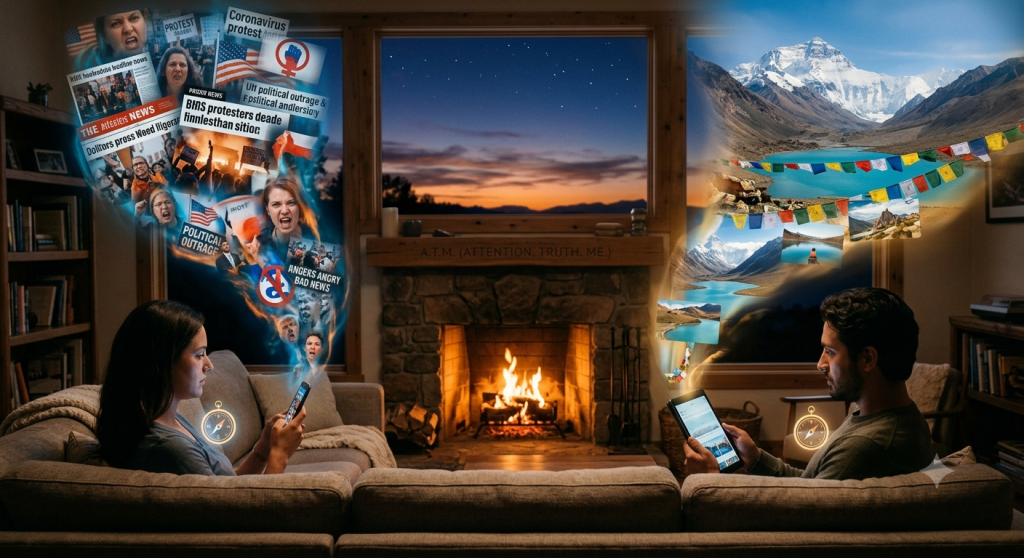
Two people sitting on the same couch can inhabit entirely different realities. One sees political outrage. Another sees travel reels. One is persuaded to buy a new gadget. Another suddenly dreams of hiking the Himalayas. One develops anxiety from endless bad news. Another believes the world has never been better.
None of them is lying.
Each is simply living inside a different algorithm.
For the first time in history, humanity is no longer just geographically scattered. We are digitally stratified, living in invisible layers created by prediction engines that know what will keep us looking just a little longer.
Algorithms influence what we watch.
Then what we read.
Then what we eat.
Then where we travel.
Then what we believe.
Eventually, they begin influencing who we think we are.
This is not because algorithms are evil.
They are extraordinarily good at one thing.
They amplify attention.
Every click, pause, swipe, purchase, and search becomes another vote in a silent election. The winner is the next version of your digital world.
Slowly, the feed stops reflecting your interests.
It starts shaping them.
That leads to an uncomfortable question.
How much of me is truly me?
Did I choose this opinion?
Did I choose this hobby?
Did I choose this ambition?
Or was it gently cultivated by thousands of invisible recommendations?
The challenge of the twenty first century is not escaping algorithms.
It is learning to see through them.
Ancient traditions called this viveka, the power of discernment. The ability to distinguish the real from the merely attractive.
Perhaps viveka has found a new purpose.
Not only to question our thoughts.
But to question what produced them.
A healthy relationship with technology is not rejecting algorithms. They are remarkable tools. They help us discover music, books, ideas, and people we might never have encountered otherwise.
The danger begins when convenience quietly replaces curiosity.
Freedom is not the absence of algorithms.
Freedom is having an inner compass strong enough that algorithms become assistants instead of authors.
Our ancestors explored forests, deserts, and oceans to discover the world.
We must now explore our own attention to rediscover ourselves.
Because in the age of AI, the rarest intelligence may not be artificial.
It may be intentional.
The future belongs not to those with the smartest algorithms, but to those who remember that behind every recommendation is still a human being capable of asking the oldest question of all:
Who am I, when no algorithm is answering for me?
 Arambhin
Leave a comment