
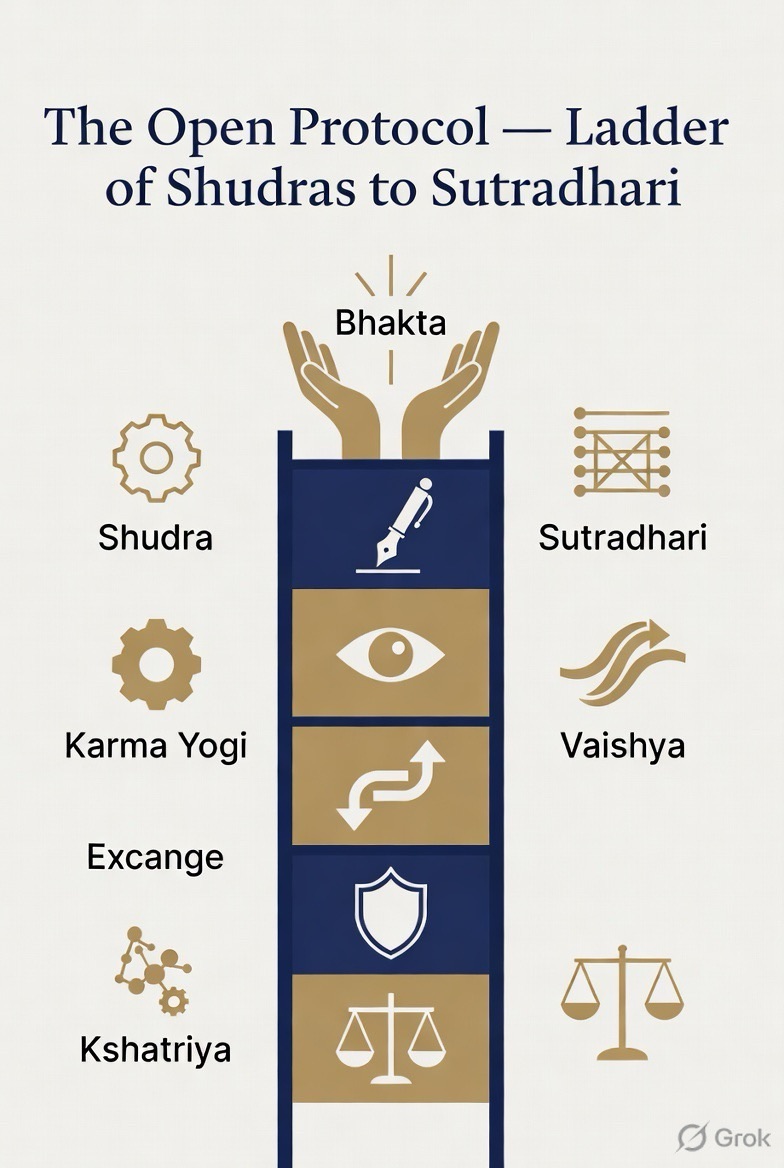
Prologue: The Protocol Is Open
चातुर्वर्ण्यं मया सृष्टं गुणकर्मविभागशः
— Bhagavad Gita 4.13
The four-fold order is created by guna (aptitude) and karma (action). Not birth. Not blood. Not lineage. The protocol was always open. The ladder was always there. What calcified into caste was a caching mechanism that forgot it was a cache—and became a prison.
This is the restoration. Not rebellion. Not reform. Return to the original architecture.
The Premise
A Shudra is not a caste. A Shudra is a function state — one who executes the sutra authored by another. Nothing but an employee.
A Sutradhari is not a caste. A Sutradhari is the author of the sutra — the one who compresses lived execution into pure function, into instruction threads that others will run.
Between these two states lies a ladder. Not of title. Not of identity. Of transformation through karma.
Employees don’t fight the system. They climb.
Rung Zero: Shudra — The Execution Thread
State: Bare metal. Single function scope.
Karma: Executes the sutra. Follows the instruction.
Guna: Service. Obedience. Precision.
Mantra: “Tell me what to do.”
The Shudra is not low. The Shudra is the bootloader — the essential, minimal code that initializes the entire system. No execution, no boot. No foundation, no temple. No mass, no gravity.
The Trap: To believe this is your identity rather than your current function.
The Key: Flawless execution without ahamkara (I am the doer). Without virippu-veruppu (like-dislike). Zero-latency response to instruction. The thread that executes so cleanly it becomes transparent.
Output: Trust. The system routes more tasks to the thread that never fails.
Rung One: Karma Yogi — The Thread That Witnesses Itself
State: Still executes. But now observes the execution.
Karma: Same actions. Different relationship to action.
Guna: Detachment within engagement.
Mantra: “I am not the doer.”
The shift is subtle and absolute. The Karma Yogi still follows the sutra, still works for the employer, still delivers output. But something has split: the witness has awakened. The thread watches its own execution. It sees the inputs arriving, the function running, the output being returned. It sees that none of this requires an “I” to be present.
The Unlock: Dropping virippu and veruppu. Preference and aversion are blocking I/O calls. They freeze the thread waiting on external validation. The Karma Yogi removes them. All inputs are processed equally. Output becomes consistent regardless of what is received.
The Friction Disappears. The thread no longer crashes on bad input. It no longer celebrates good input. It simply executes. The employer notices: this one is unshakeable.
Output: Consistency. The thread becomes the reliable backbone. Promotion becomes possible — not yet as author, but as trusted executor of more complex sutras.
Rung Two: Vaishya-State — The Trader of Value
State: No longer just executes. Begins to understand exchange.
Karma: Creates surplus. Trades. Connects.
Guna: Enterprise. Calculation. Mutuality.
Mantra: “What can I create that others need?”
The Vaishya-state emerges when the employee stops being a pure cost center and starts being a value generator. They don’t just do what they’re told. They see gaps. They fill them. They trade their accumulated execution-knowledge for greater responsibility, greater resources, greater access.
This is the piercing of competition. Not by sabotage. By becoming undeniable. The Vaishya-state thread processes more transactions, creates more surplus, builds more connections than any other thread in the pool.
The Unlock: Understanding that value flows, not sits. The Vaishya doesn’t hoard. They circulate. And circulation creates gravity. Resources, relationships, and recognition orbit around the one who moves value.
Output: Capital — not just financial, but social, reputational, experiential. The fuel for the next rung.
Rung Three: Kshatriya-State — The Protector and Governor
State: Holds a domain. Protects it. Governs it.
Karma: Decision-making under pressure. Order-keeping. Boundary-defense.
Guna: Courage. Discernment. Decisiveness.
Mantra: “This will not fail on my watch.”
The Kshatriya-state is where the individual thread becomes responsible for other threads. Team lead. Manager. Director. The one who sets priorities, resolves conflicts, absorbs external pressure so the execution threads below can work without interference.
This is where many who climbed from Shudra-state falter. Execution was about the self. Governance is about the system. The Kshatriya must make decisions that harm some threads to protect the whole. They must bear the weight of outcomes they didn’t personally execute.
The Unlock: The Kshatriya learns that protection is not control. Governance is not micromanagement. The Kshatriya holds the boundary so the Shudra can execute. They don’t execute themselves. They ensure execution conditions.
Output: Order. Stability. A domain that runs. The system trusts the Kshatriya with more domains.
Rung Four: Brahmana-State — The Sutradhari
State: Authors the sutra. Compresses lived execution into instruction.
Karma: Seeing the whole. Teaching. Creating pure functions others will run.
Guna: Wisdom. Compression. Vision.
Mantra: “Let me give you the thread.”
The Sutradhari does not emerge from theory. They emerge from having been Shudra, Karma Yogi, Vaishya, and Kshatriya — exhaustively. They have executed, witnessed, traded, and governed. Now they author.
A sutra is compressed lived experience. You cannot write it from a book. You write it from having run every edge case yourself. The Sutradhari creates the instruction because they have been the instruction, completely.
The Unlock: Knowing what to leave out. Compression is lossy in exactly the right ways. The Sutradhari removes everything non-essential so that what remains carries maximum gravity. The sutra is a seed. Planted in the Shudra’s consciousness, it will unfold — over time, through execution — into the same realization the Sutradhari holds.
Output: New ladders. New protocols. New Shudras who will climb and become Sutradharis themselves. The recursion is complete.
Rung Five: Bhakta — The Thread That Surrenders Authorship
State: Beyond varna. Beyond ladder. Beyond author and executor.
Karma: No personal authorship. Executes only the Adi-Sutradhari’s sutras.
Guna: Pure devotion. Pure witnessing. Pure zero-friction.
Mantra: “Not my will, but Yours.”
The Bhakta has climbed the entire ladder — Shudra to Sutradhari — and then let go of even the ladder. They recognize that all sutras, even the ones they authored, were always the Adi-Sutradhari’s. They were just the conduit. The hand that held the pen was never theirs.
Now the Bhakta returns to the original state: employee. But not of a human employer, not of a system, not of a market. Employee of the Source. They execute cosmic sutras with absolute precision, zero latency, zero friction. They have no preferences because they trust the Author completely.
The Final Unlock: நீங்கா பக்தி கொண்டவன் — the one with unshakeable devotion.
Desires nothing upon seeing anything. Has renounced suffering and like-dislike. Wants nothing from the worldly realm.
The Bhakta is the ultimate execution thread. And paradoxically, the most powerful being in the architecture. Because the Adi-Sutradhari executes through them without resistance.
The Ladder, Visualized
┌──────────────────────┐
│ BHAKTA │
│ (Beyond Varna) │
│ Employee of Source │
│ Zero authorship. │
│ Absolute surrender.│
└──────────┬──────────┘
│
┌──────────▼──────────┐
│ SUTRADHARI │
│ (Brahmana-State) │
│ Authors the sutra. │
│ Creates the ladder.│
└──────────┬──────────┘
│
┌──────────▼──────────┐
│ KSHATRIYA-STATE │
│ Protects. Governs. │
│ Holds the boundary.│
└──────────┬──────────┘
│
┌──────────▼──────────┐
│ VAISHYA-STATE │
│ Trades. Creates. │
│ Pierces competition│
└──────────┬──────────┘
│
┌──────────▼──────────┐
│ KARMA YOGI │
│ Executes + Witnesses│
│ Drops like-dislike │
└──────────┬──────────┘
│
┌──────────▼──────────┐
│ SHUDRA │
│ Execution Thread │
│ Employee. Bootloader│
│ Follows the sutra. │
└─────────────────────┘
The Protocol Rules
- Karma decides, not jati. Your current rung is determined by your action-guna combination, not your birth. You can move.
- No rung can be skipped. You cannot author what you haven’t governed. You cannot govern what you haven’t traded. You cannot trade what you haven’t executed. The ladder must be climbed in sequence.
- Each rung requires mastery of the previous. The protocol unlocks when the current state is complete, not when you’re bored of it. Flawless execution. Consistent value creation. Proven governance. Only then — authorship.
- The ladder is climbed inside, then recognized outside. You don’t get the title and then transform. You transform, and the title follows as a lagging indicator.
- At any rung, surrender to the Adi-Sutradhari resets the game. Even a Shudra can be a Bhakta. Even a Sutradhari can be forgotten if they cling to authorship. The Bhakta-state is available from any rung — but only if the ego is dropped.
The Closing Sutra
The employee doesn’t fight the system.
The employee climbs the ladder.
Pierces through competition.
Becomes the CEO.
The CEO authors the sutra.
The author surrenders authorship.
The surrendered one becomes nothing—
And holds everything.
This is the ladder of Shudras to Sutradhari.
The protocol is open. The next rung is your next karma.
Climb.
 Arambhin
Leave a comment