
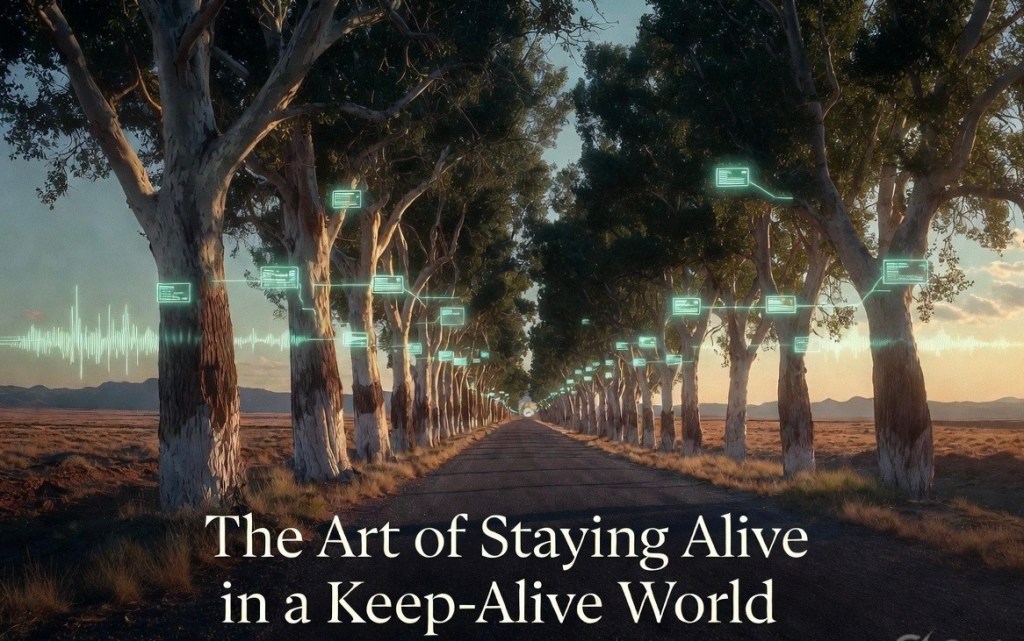
In network engineering, there is a small, elegant mechanism called the Keep-Alive signal. It is a packet sent at regular intervals between two machines. It carries no payload. It performs no real work. Its only job is to say: “I am still here. Do not drop the connection.”
We have entered the era of the human Keep-Alive.
For the first time in history, civilization is large and automated enough to decouple physical survival from genuine understanding. In the eras of friction and consequence, the learning curve was brutal: if you couldn’t read the forest, the market, or the political winds, reality disconnected you. Stupidity was expensive.
Today, the bill arrives so slowly that you can live an entire lifetime fed by supply chains you don’t understand, navigated by a phone you didn’t build, and contentedly outraged by headlines designed for reaction—never once feeling the cost of your own ignorance. This isn’t a moral failing. It’s infrastructure.
The Noise Floor
Walk into any urban center and you will see the protocol humming. Millions are physically preserved but cognitively idling—kept alive by systems they cannot name, fed information they did not seek. The algorithm reads for them, telling them what to want and who to resent. The result is a permanent, low-grade signal: a billion heartbeats broadcasting “I am here, I am here, I am here.”
I used to find this noise maddening. Now, I see it as a feature. A world that sustains you without demanding your full attention is a historical anomaly—a mercy, even. The question is: what do you do with the attention you’ve been given back?
Most of us fill it with a high-frequency loop: 24-hour news, 15-second videos, 280-character outrage. This speed guarantees amnesia. Power, in this loop, looks like status: loud cars and public titles. It’s all User Interface (UI). But the people who actually shape the world operate at a different frequency entirely. They aren’t on the UI. They’re in the Kernel.
The Quiet Rewrite
I learned this on a gravel pull-off in the American West fifteen years ago. I noticed a line of cottonwoods along a fence—evenly spaced, thirty feet tall, clearly planted. They weren’t wild, yet they weren’t ornamental.
Whoever planted them was likely dead. The trees didn’t broadcast; they didn’t signal. They simply stood there, silently altering the wind, the soil, and the sightline. They were defining the parameters of the place without anyone noticing.
That was the day I understood power. It isn’t the ability to command attention; it’s the ability to define the conditions under which attention happens. While the world argues over flickering shadows on the screen, the Kernel-dwellers are quietly setting the parameters of the conversation.
The 60-Year Clock
Progress used to happen “one funeral at a time.” You waited for the old guard to die so new ideas could root. That was the 60-year clock.
We no longer wait. We build around them.
Through “continuous compilation,” new architectures emerge alongside the old. The legacy code of institutions and official narratives keeps running, but the underlying logic changes incrementally. By the time the UI-dwellers notice, the change is a fait accompli.
There is a danger here: the ego-trap of believing “they are asleep and I am awake.” It’s a seductive thought because it turns loneliness into superiority. But the line between being “hidden” and being “irrelevant” is thinner than most manifesto-writers admit. Some people don’t see your work because they are distracted; others don’t see it because you haven’t done anything worth seeing yet.
Stewardship of Attention
To work at a lower frequency, you must protect your time scale. The modern world wants your pings. It has perfected Agile Theatre: the endless performance of busyness that mimics productivity but is really just another Keep-Alive signal. It keeps you visible to the system, but it doesn’t keep you alive.
Survival requires two things: Refusal and Calibration.
Refusal: You must train yourself to stop treating every incoming signal as a command. The news cycle will not miss you. The loop is closed; it doesn’t need your contribution to keep spinning.
Calibration: You must attend to something that doesn’t care about you. For me, that’s carrying a camera into high-altitude ridgelines where weather changes without consultation. It is not transcendence; it’s remembering what it feels like to have an internal clock that isn’t set by a feed.
I also returned to the “old source code”—Stoic fragments and Vedic passages. I stopped reading them for comfort and started reading them as technical documentation. These were people who documented the human operating system before attention became a commodity.
The Modular Self
There is a final, uncomfortable truth: you will spend your life partially legible to different audiences, and none will see you whole.
To your peers in the Kernel, no explanation is needed. To everyone else, you are a black box. They see the output—a polite neighbor, a functional professional—but they don’t see the 25 years of slow, methodical study.
I used to want credit. I wanted the world to know what I was building while I was building it. That desire didn’t survive. What survived was the work itself, and the strange peace of being unregistered.
The Keep-Alive world will keep humming. But within that static is a smaller signal. The person who planted those cottonwoods had no reason to think anyone would notice. They planted anyway, set something in motion on the scale of decades, and got out of the way.
That is the art : not hiding, not winning — simply staying alive in the only sense that matters. The sense that has nothing to do with a heartbeat and everything to do with what you set in motion that will still be standing after you’re gone.
 Arambhin
Leave a comment