

Beyond All Colors: Kabir’s Vision of the Unstained Divine Ram
What if everything you consider sacred—your gods, your scriptures, your devotions—were only color applied to a surface?
Don’t be proud of your color, your creed —Just Read, one day it will all fade. It’s all a dye that will die before you. — RuRu
This unsettling question lies at the heart of Kabir’s bhajan “Ram Niranjan Nyara Re.” The 15th-century weaver-poet employs the simple yet subversive metaphor of dye (anjan) to reframe the entire universe of names, forms, rituals, and even deities as appearances within Maya. Against this vast spectrum of coloring, Kabir places Niranjan Ram—the unstained, formless Absolute—as the only true Reality.
This essay argues that Kabir’s song is not a rejection of the world, but a radical invitation: to see through all colors and awaken to the uncolored Infinite.
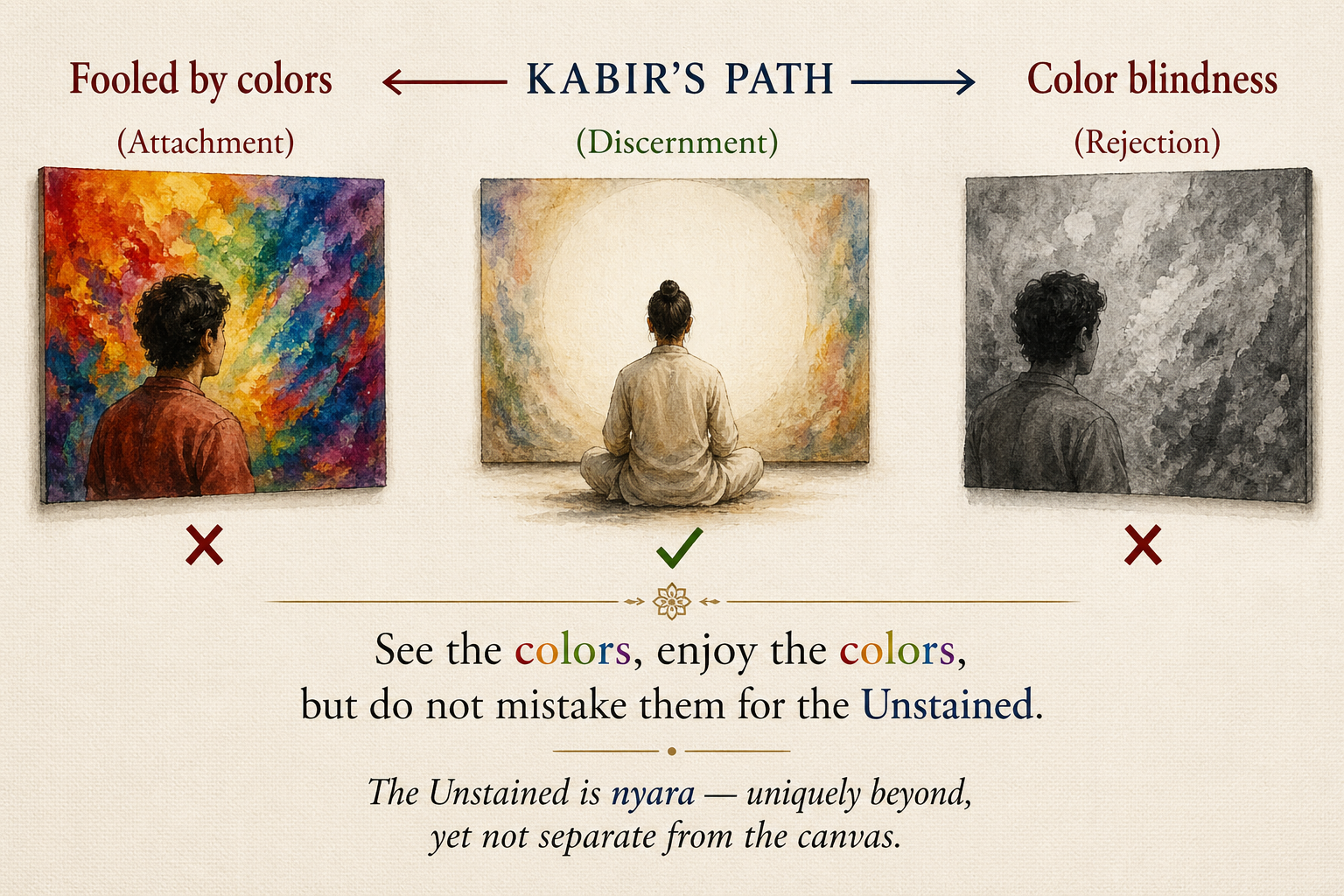
Kabir dismantles the assumed absoluteness of the sacred by declaring that even the highest deities and scriptures are “colored.” He sings, “Anjan Brahma Shankar Indra”—Brahma, Shiva, and Indra are all within the realm of dye. More strikingly, “Anjan Gopisange Govinda”—even Krishna, along with the Gopis, belongs to this colored field.
Nothing escapes this classification: speech, Vedas, knowledge, Puranas, austerity, charity, pilgrimage. Kabir’s intent is not irreverence, but recontextualization. These are not false; they are functional. They belong to the domain of duality—of cause and effect, name and form—but they are not the final Truth.
What, then, is untouched?
“Ram Niranjan Nyara Re”—Ram, the Unstained, stands uniquely apart.
The term Niranjan literally means “without collyrium,” the black pigment applied to the eyes. Just as collyrium alters vision, anjan (Maya) conditions perception, causing the One to appear as many. Niranjan is that which cannot be colored, modified, or perceived as an object. It is formless, attribute-less, pure awareness.
Kabir calls it Nyara—separate, not in distance, but in nature. It is not another entity within the universe; it is the ground upon which the entire universe appears.
The path Kabir points to is equally uncompromising.
“Koi birla jage”—only a rare one awakens.
Why rare? Because even seekers cling to refinement within the colored world. They seek liberation through more practices, more knowledge, more virtue—more subtle layers of dye.
The awakened one does something radically simple:
“Chhadi anjan”—abandons the coloring.
“Anant hi dhake”—moves directly toward the Infinite.
This is not gradual evolution. It is a decisive shift in identity—from the painted to the unpainted.
Here is my Translation of Kabir’s Verses in Tamil
🌈 Beyond All Colors / கரு நீல வண்ணன்
Kabir’s Niranjan Ram through a Tamil Lens
ராமனே தூய்மையான வண்ணமடா
மற்றவை எல்லாம் சாயமடா
சாயமே உன் ஆதியும் உன் நாதமும்
சாயமே உன் ஆசையும் உன் வீசையும்
சாயமே அந்த பரமனும் சிவனும் இந்திரனும்
சாயமே அந்த கோபியரும் கோபாலனும்
சாயமே உன் வாதமும் அந்த வேதமும்
சாயமே உன் விருப்ப வெறுப்பும் இந்த பேதமும்
சாயமே இந்த அறிவு வழியும் புராணமும்
சாயமே இந்த வாழ்க்கையும் பக்தி ஞானமும்
சாயமே இந்த பகத்தனும் அந்த கடவுளும்
சாயமே உன் தேவையும் உன் சேவையும்
சாயமே உன் வேடமும் முடிவிலா ரூபமும்
எங்கும் எதிலும் சாயமே
தான தவம் புண்ணிய மீதியும் சாயமே
சொன்னாரே ரூரூ அன்று அவரோ தனிரூபம்
சாயத்தை விட்டு விடடா
அழிவில்லா ஆனந்தம் சேர்ந்துவிடடா
Conclusion
Kabir’s bhajan is a quiet act of spiritual demolition. By placing everything—Omkar, Vedas, deities, devotion—within anjan, he clears the entire field for Niranjan, the Unstained.
He does not ask us to reject the world, but to see it clearly: as color, not essence. Names, forms, rituals, and gods are the vast and beautiful pasara—the spread of dye. But the Unstained Ram remains nyara—utterly beyond.
Only the rare one recognizes this, loosens their grip on all coloring, and turns toward the infinite, waveless stillness.
And Kabir leaves us with a question that refuses to fade:
Will you remain enchanted by the colors…
or turn toward the One who needs none?
Don’t be proud of your color, your creed
Ruru
Just read — one day it will all fade
 Arambhin
Leave a comment