
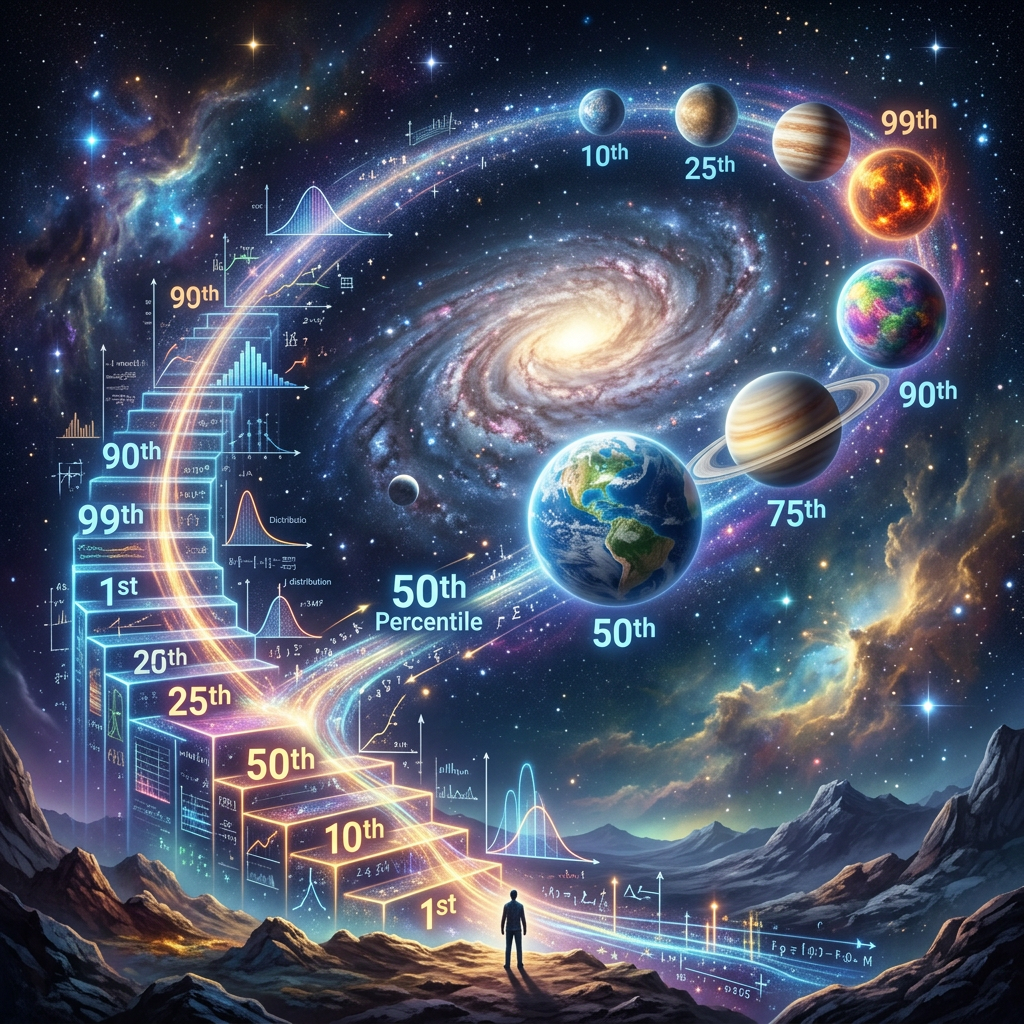
The Geometry of Three Maps
It started with a single day that refused to remain simple.
At 11:00 AM, in a glass-walled conference room in Chennai’s IT corridor, a facilitator slid a 28-page leadership assessment across the table. I had just spent two hours answering 187 questions designed to strip my psyche down to its gears—how I handle conflict, how I breathe under pressure, how I navigate the fog of ambiguity.
“High Conscientiousness. Strong Strategic Thinking. Moderate Emotional Expressiveness.”
My personality was distilled into sleek bar graphs and radar charts—a performance review from the universe, rendered in Helvetica.
By 8:00 PM, the glass walls were gone, replaced by the humid embrace of home and the scent of sambar and tempering mustard seeds. Amma handed me a xeroxed page, still warm from the shop. “Your horoscope,” she said, her voice dropping into the tone she used for holy things. “Saturn is entering your tenth house. The obstacles are shifting. We must start looking for marriage alliances.”
From the hall, Appa didn’t look up from his phone, his face bathed in the blue light of a chat interface. “Two families called today. Both good backgrounds. I even checked with Gemini—the timing is right. We need to reply by the weekend.”
“Appa, don’t check everything in AI chats. How many times have I told you?” I muttered, half-amused, half-exasperated.
I sat with my hand paused between plate and mouth, a morsel of rice suspended in the air. I was caught between two maps of my future—two ancient languages claiming to translate the same silent heart—now with a third voice chiming in from a silicon oracle.
The Trinity of Patterns
In twelve hours, I had received three blueprints of my soul. One was built on personality profiling: statistical validation and decades of Western psychological data. The second was Jyotisha: planetary positions and centuries of celestial observation etched into the collective memory of the East.
The third was the emerging map: Artificial Intelligence. Trained on millions of performance reviews, LinkedIn trajectories, and behavioral data points, AI was learning to predict promotions, burnout, and leadership fit with unsettling precision. And now, apparently, it was being consulted for marriage.
Ironically, my current project at work is preparing my team to create the high-quality training data for these very systems. Day after day, I guide engineers on how to label and curate human behavior so machines can better “understand” us. What fascinates me is that the old is not fading; it is being reincarnated. Ancient pattern languages of timing and human cycles are being fed into models that can simulate Jyotisha-like predictions at population scale.
At their core, all three are pattern engines. One compresses whims into traits; one compresses lifetimes into symbols; the last compresses the aggregated lives of millions into probabilities. All three attempt the same desperate feat: reducing the terrifying uncertainty of being human into something manageable.
The Seasonal Shift
Personality profiling offers probabilities, but Jyotisha offers a “cosmic grammar.” Modern psychology is only now begrudgingly accepting that we are different people at twenty-eight than we are at thirty-eight. Jyotisha has always spoken in seasons. It doesn’t just say, “You are ambitious.” It says, “Your ambition will peak between 2026 and 2032, but prepare for the dry well of delays in 2028.” It gives narrative weight to the struggle. It turns a “bad year” into a “necessary winter.”
However, the corporate report has a survival advantage: it measures itself. It discards the variables that fail the test of replicability. Popular Jyotisha often lacks this feedback loop. When a prediction misses the mark, the language shifts from “this will happen” to “this is the lesson.” In 2026, in a world of data points and rapid pivots, that lack of self-correction is a jagged pill to swallow.
The Interior Negotiation
I’ve stopped asking which system is “correct” and started asking what each is good for.
Personality profiling helps me navigate the boardroom. Jyotisha helps me sit with the silence of my ancestors. And AI? It appears to be the bridge—taking the depth of the old and giving it the speed and scale of the new.
Last month, my corporate report urged me toward leadership. Simultaneously, my dasha warned of “tests through delays.” One system told me to run; the other told me to wait. Part of me wanted to choose a side—to be the purely rational technocrat or the purely rooted devotee.
Instead, I did both. I updated my LinkedIn and applied for “stretch” roles, honoring the data. I also visited the temple Amma suggested and began waking up earlier—not because Saturn demanded a sacrifice, but because I realized the “season” called for a specific kind of discipline.
The Truest Report
The results? A new project offer and a quietness in my chest I can’t quite explain.
I still don’t know which system holds the “truth.” I am simply learning to read all three: one for direction, one for depth, and one for scale. Life isn’t found in a profiling score, a planetary transit, or an AI prediction. It is the uneasy, living space between them—the friction where a man tries to belong to three worlds at once without losing himself in the shadows of any.
I told Amma about the profiling report. She listened carefully, nodded, and said, “Very good. But does it say anything about marriage timing?”
Some systems, it seems, are more universal than others. We were once the patrons of these systems; now, we are the patterns they feed on.
 Arambhin
Leave a comment