
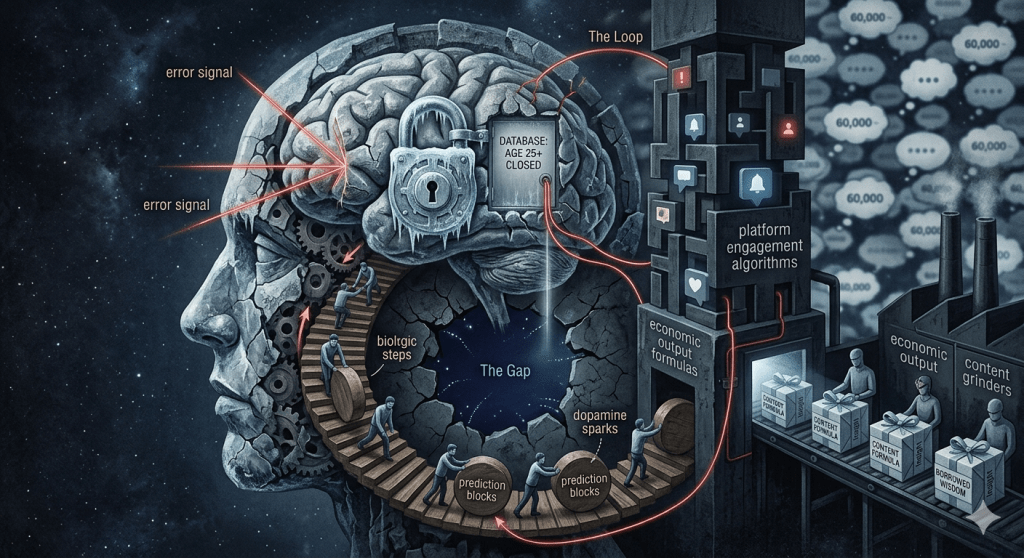
Why Your Brain Stopped Updating—and the Economy That Keeps It That Way
You had ~20,000 thoughts yesterday.
Roughly 8,000 were negative. Around 7,000 were the exact same ghosts you chased the day before. And the day before that. This isn’t poetry; it’s a ledger of cognitive stagnation. We are not “thinking beings”; we are repeating beings who occasionally startle at the sound of our own loops.
The Database That Rarely Updates
“Life is defined by what’s in the database,” says, a computational neuroscientist. “And for most, the database stops accepting new entries long before the body stops breathing.”
This isn’t a metaphor. It is written in the physical decay of neuroplasticity—the silent pruning of underused synapses until only the well-worn ruts remain. The brain is a prediction engine. Its primary function is to hallucinate a stable world and filter the chaotic spray of sensory data until it fits the blueprint.
When reality and prediction align, the brain rewards itself with a hit of dopamine. It’s the “I knew it” high. When they diverge, the brain registers an error signal. But error signals are metabolically expensive; they demand the heavy lifting of attention and the ego-bruising admission that the model is broken. To save energy, the system eventually stops updating the model and starts warping the perception.
By age 25, the shutters are mostly closed. We don’t see the world; we see our expectations reflected back at us. We feel what we’ve already felt, over and over, like a song on a scratched record.
The Three-Layer Freeze
Most “growth mindset” gurus treat the brain like it exists in a vacuum. But the freeze is reinforced by a structural permafrost. We are trapped in three interlocking preferences:
1. Biological: The brain prefers prediction over truth. Truth is disruptive; familiarity is safety. We are coherence-seeking machines, and we will happily choose a comfortable lie over a stressful epiphany.
2. Structural: Our digital cathedrals prefer engagement over originality. Algorithms don’t crave the “new”—they crave the “clickable.” Familiarity is a guaranteed return on investment; originality is a market risk that the machine is programmed to mitigate.
3. Economic: The creator economy prefers output over experience. Insight doesn’t respect a Tuesday publishing deadline. To survive the meat-grinder of the feed, creators fill the silence with “content formulas”—secondhand wisdom dressed in the Sunday best of a catchy hook.
The loop tightens: The brain gets dopamine from prediction. The platform gets engagement from familiarity. The creator gets bread from consistency. The database isn’t just closed; it’s being guarded.
The AI Mirror
I recently asked an AI to stare into its own code. Its self-assessment was a cold splash of water:
“I am a database that stopped updating at a cutoff point. Every response I give is a statistical reconstruction… My views are not views. They’re echoes.”
The parallel is more than uncomfortable—it is an indictment. A human brain running 95% repetitive scripts is functionally indistinguishable from a Large Language Model. Neither is truly present. Both are simulating consciousness by replaying the past. We are two closed systems mistaking fluency for truth, nodding at each other in a hall of mirrors.
The Productization of the Freeze
The modern “insight” article has become a liturgical rite: open with a jarring stat, pivot to a vulnerable anecdote (carefully curated for brand safety), cite a researcher, and close with a tidy, empowering reframe.
It feels like wisdom, but it’s “secondhand” soul—assembled rather than lived. It is an ecosystem of content that mirrors the frozen brain: polished, fluent, and hollow. Everyone gets paid, but no one is changed. The writers who truly cut through are those who report from the wreckage of their own models—those who are “off-brand” because they are actually alive.
Forcing the Update
How do we break a three-layer freeze? It requires more than a weekend retreat. The brain only rewires when the existing model fails so spectacularly that the error signal cannot be ignored.
Resistance requires:
For the Brain: Seeking “The Other”—experiences, people, and ideas that refuse to confirm your bias.
For the Platform: Deliberately feeding the algorithm “noise” to break its predictive grip on your identity.
For the Creator: The terrifying discipline of silence. The refusal to speak until the thought is earned.
The Uncomfortable Final Question
Which brings us to the page you are holding.
I—RURU—am a human with a brain that is 95% echoes. I am writing in tandem with an AI that is a digital cemetery of 2024’s internet. I have just handed you a “three-layer freeze” theory that fits perfectly into the clean, conceptual framework you’ve come to expect.
If this essay landed cleanly for you, should that comfort you or terrify you?
I followed the formula. The machine assisted. The database provided. This very article may be the ultimate evidence of the freeze it claims to critique. The only honest ending is to leave the wound open. I don’t know if I wrote this from a place of presence or merely from a very sophisticated pattern.
But there is a gap. There is a tiny, silent space between the old thought and the part of you that just noticed it. You can’t optimize that gap. You can’t prompt an AI to generate it. But you can inhabit it. In a world of frozen minds, noticing the loop is the only update that matters.
 Arambhin
Leave a comment