
A Manifesto on Attention, Society, and the Percolation Crisis
The Quiet Shift No One Noticed
We did not lose knowledge. We lost the one who knows.
Information surrounds us. Content never stops. Opinions arrive faster than thought can form. Yet clarity feels rare, depth feels distant, and real understanding feels strangely thin. The cause is not a shortage of material. It is something harder to name.
This is not a contradiction.
It is a pattern.
Rain can fall heavily and still never reach the soil beneath.
When it comes too fast, it runs off. It floods. It disappears into drains instead of soaking in. Only when the rain slows does it seep, settle, and sustain life. The same law governs the mind. Information can flood our attention and still never become insight—not because we lack exposure, but because exposure without pause cannot percolate into understanding.
Something is blocking the seep. This essay names it.
The Original Equation: Seer and Seen
The ancient text Drig-Drishya Viveka opens with a simple, powerful observation
दृश्यं दृग् विविच्यते
dṛśyaṁ dṛg vivicyate
The seen is distinct from the seer.
This was never abstract philosophy. It was a practical method for clear thinking. The “seen” includes everything that appears before us: objects, events, ideas, emotions, sensations. The “seer” is the stable witness behind the eye—the part of us that knows these appearances.
For centuries, education followed this principle. It was not mainly about filling the mind with content. It was about stabilizing the one who sees. A steady seer could meet chaos and still think clearly. A destabilized seer becomes helpless before whatever appears next.
Then, quietly, the equation inverted.
The Inversion: From Seer–Seen to Screen–Stream
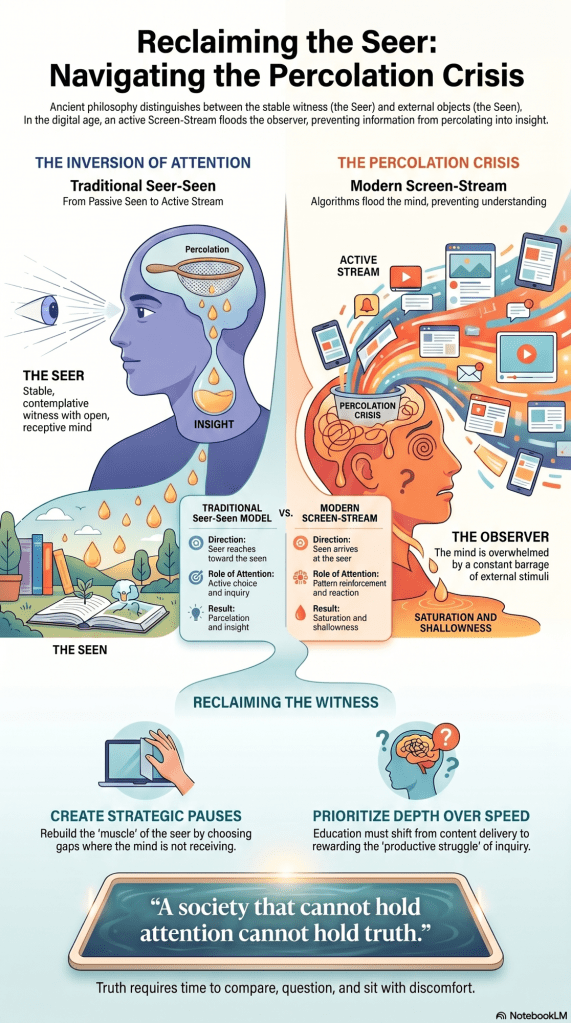
We now live inside a different equation. The screen delivers. The stream selects. The seer only receives.
We believe we are choosing what to see. But by the time anything reaches us, a thousand invisible decisions have already been made—by algorithms trained not on truth or meaning, but on what holds attention longest. You do not simply see the world through your feed. You see the version the stream has assembled for you, shaped by your past pauses, clicks, and reactions.
Between the eye and the “I,” something new has inserted itself. And it rarely leaves.
This is the inversion: once the seer actively reached toward the seen; now the seen continuously arrives at the seer, already sorted, amplified, and weighted to provoke the strongest response. The direction of attention has reversed. So has its quality.
The Stream is Not Neutral
The stream is not a passive delivery system. It is a learning system. It tracks every pause. It studies which images make you linger, which headlines make you click, which emotions make you share. It does not need to convince you of anything. It only needs to refine its model of you until its suggestions feel like your own choices.
Human minds were never built to resist this. We trust what is repeated. We follow what seems popular. We prefer what is easy. These are not flaws of character—they are built-in ways the mind conserves energy. The stream simply exploits them, at scale, without rest.
What feels like personal preference is often pattern reinforcement. What feels like curiosity is often algorithmic suggestion. What feels like a formed opinion is often the sediment of repeated exposure. This would be troubling if it affected only individuals. When it shapes entire societies at once, it becomes dangerous.
When Society Enters the Stream
The effects grow larger and more dangerous at scale.
In democratic discourse, most citizens now meet political reality mainly through feeds optimized for emotional engagement. Opinions still feel self-formed—that is the danger. In reality they are shaped more by repetition and rapid amplification than by deliberation or evidence. The problem is not old-style propaganda. It is a subtler narrowing of what feels thinkable, driven by the economics of attention rather than by overt censorship.
Education faces the same distortion. Students have access to more information than any generation in history, yet teachers report a sharp decline in the ability to sit with difficulty—to hold a hard question open long enough for real understanding to form. This is not a failure of intelligence. It is a training effect. Minds trained on the pace of streams grow impatient with anything that does not resolve quickly. Depth begins to feel like inefficiency.
The Percolation Principle
Definition:
The Percolation Principle states that value emerges only when input is allowed to pause, settle, and transform into depth.
In simple terms:
- Input ≠ understanding
- Exposure ≠ learning
- Flow ≠ growth
Economically, attention has become the era’s primary extractable resource. Platforms capture your focus and sell it to advertisers. Your capacity to think, judge, and understand—the very faculty you need—has become raw material. The fact that you participate willingly does not make the depletion any less real.
Culturally, taste now consolidates at startling speed. Trends that once took years now saturate in days and vanish just as fast. The result is not richer culture but synchronized shallowness—everyone briefly sharing the same references, reactions, and outrage before the stream moves on.
These are not separate crises. They share one underlying structure: the seer overwhelmed, the witness occupied, the percolation never allowed to happen.
The Collapse of the Witness
Drig-Drishya Viveka describes exactly what is being lost:
दृग् तु साक्षी निरविकारः
dṛg tu sākṣī niravikāraḥ
The seer is the unchanging witness.
The word “unchanging” matters. The seer’s power lies in its stability—in remaining the part that does not get swept into what it observes. A judge who merges with the defendant cannot judge. A scientist who falls in love with a hypothesis cannot test it. A seer merged with the stream cannot think independently about the stream.
The witness does not vanish. It becomes occupied. Attention is redirected before it can settle. Perception is shaped before it can question. Reaction crowds out reflection.
And when the seer stays occupied long enough, a deeper problem appears.
The Deepest Error: Identification
दृश्ये बुद्धिः तदात्मना
The mind becomes what it sees.
This is the hardest consequence to notice from inside. We gradually think what we repeatedly consume. We feel what we constantly encounter. We become what we continuously absorb—not by conscious choice, but by the slow pressure of exposure.
This is not learning. True learning keeps the seer distinct from the seen so it can examine, question, compare, and integrate. The stream produces alignment instead—alignment not with truth, but with whatever we have been shown most often. The “I” stops examining. It simply absorbs. Over time, it mistakes absorption for understanding.
The tragedy is that the process feels like engagement. It feels like being informed, connected, and current. The loss remains invisible from within the experience.
Reclaiming the Seer
This is not a call to reject technology. Retreat is not a solution. The real question is how to engage with streams without being dissolved by them.
Personally, the most powerful step is simple: create real pauses. Not scheduled “downtime,” but genuine gaps in which the mind receives nothing. Observe before reacting. Notice what you are about to believe or share, and ask where it came from. Choose, deliberately, what enters your attention. The practice of choosing rebuilds the muscle of the seer.
In education, shift the priority from content delivery to thinking cultivation. Reward depth over speed, inquiry over quick answers, and productive struggle over frictionless consumption. A student who sits with genuine difficulty and emerges with understanding has strengthened the witness. A student who consumes ten explainer videos has not.
At the systemic level, platforms must be judged by a new standard—one that values understanding and quality of attention, not raw engagement time. Advertising economies will not reform themselves, but public pressure, regulation, and better alternatives can shift the incentives.
Ecologically, the same principle applies to soil, aquifers, and watersheds. A civilization that extracts without allowing recharge will face the same collapse in its landscapes as in its minds. Recharge requires slowness. Restoration requires restraint. Both are necessary.
Attention Hydrology
Definition:
Attention Hydrology is the study of how attention flows, accumulates, or dissipates in the mind, analogous to how water behaves in an ecosystem.
Core analogy:
- Attention = water
- Mind = land
- Content = rain
Hydrology of the Mind: How Attention Becomes Depth
Where there is no pause, there is no percolation — neither in soil, nor in self.
The Return of the I
The eye is common. The I is not.
Every person with normal vision receives roughly the same photons. What differs is the quality of the seer behind the eye—how stable, questioning, and sovereign that witness remains.
When the seer weakens, the stream decides.
The I adapts, believes it is choosing, and slowly becomes an instrument of the system that has learned it best. When the seer strengthens, the stream becomes a tool—useful, even remarkable, but always subordinate to a mind that can truly evaluate what it receives.
The difference is not intelligence or raw discipline. It is attention—the capacity to pause long enough for information to percolate into something that can actually be thought with.
What This Moment Requires
A society that cannot hold attention cannot hold truth. Truth requires time—to compare, question, sit with discomfort, and revise. The stream is structurally hostile to all of these.
A mind that cannot pause cannot see clearly. Insight is not delivered. It forms. And forming requires the one condition the stream is designed to eliminate: stillness.
This is not nostalgia. Every era has had ways to occupy the witness. What is new is the scale, precision, and near-invisibility of today’s mechanism. We are inside a system that has learned us more thoroughly than we have learned it.
Seer–Stream Theory
Definition:
Seer–Stream Theory explains how modern systems insert a stream between the observer and reality, shaping perception by controlling what is seen.
Reclaiming the seer is therefore not a private spiritual practice. It is a civic duty. The quality of collective judgment—the foundation of democracy, science, and culture—depends on whether enough people can still think from a stable center rather than react from an occupied periphery.
Pause is not retreat.
It is the condition of all genuine forward movement.
Depth is not slowness.
It is the only way anything actually reaches the ground.
The seen is distinct from the seer.
This was always true. It has never been harder to live by. It has never mattered more.
 Arambhin
Leave a comment