
நான் யார்? — Who am I?
We answer this question quickly.
“My school.”
“My job.”
“My title.”
We build identities from what we have done or what we plan to become.
But before any of that, much was already chosen:
Our country Our parents Our culture and religion Our language, rituals, and inheritance
None of these were selected by us.
Yet they shape us deeply.
We either carry them unconsciously or reject them casually. Rarely do we examine them.
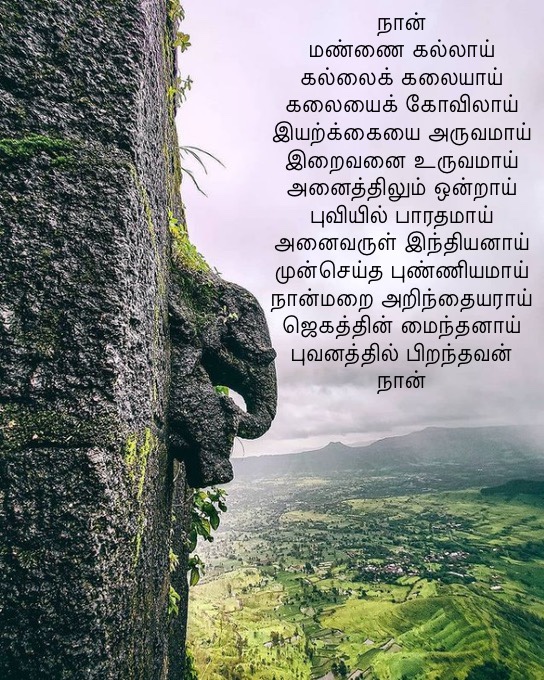
நான்
மண்ணைக் கல்லாய்
கல்லைக் கலையாய்
கலையைக் கோவிலாய்
இயற்கையை அருவமாய்
இறைவனை உருவமாய்
அனைத்திலும் ஒன்றாய்
புவியில் பாரதமாய்
அனைவருள் இந்தியனாய்
முன்செய்த புண்ணியமாய்
நான்மறை நெறியோராய்
ஜெகத்தின் மைந்தனாய்
புவனத்தில் பிறந்தவன்
நான்
In the heart of an ancient land, where the river hums forgotten hymns and the wind whispers through temple corridors, I trace my origins—not in dust, but in stone.
There was a time when men shaped the earth, not with machines, but with devotion. Mud rose into stone, stone became art, and art transformed into temples—each chisel stroke an echo of faith, each carving a silent prayer frozen in time. But what were they really building? A shrine for the divine? Or a mirror to see themselves more clearly?
I come from that lineage.
A civilization that saw the formless in form, the infinite in idols, the divine in everything. They sculpted gods, not to contain them, but to remind themselves that divinity had never left. And yet, across centuries, something was lost. We began worshiping stone, forgetting the fire that once shaped it.
I am the son of Jagannathan, born of Bhuvaneshwari’s breath. Their names may not be known beyond my home, but in them lives the weight of generations—the silent strength of those who carried the wisdom of the Vedas, who walked between devotion and doubt, who sought truth not in what is built, but in what is understood.
Like them, I am a seeker.
I have walked through temples where time lingers in cracks, where stone idols wear the weight of a million prayers. I have seen faith carved into pillars and gods adorned in silk, yet I have also seen silence speak louder than ritual. And I wonder—did those who built these temples truly seek gods, or were they simply reaching for something greater than themselves?
I carry this question within me.
Perhaps the real temple is not built of stone, but of longing. Perhaps the divine is not waiting in an altar, but in the act of searching itself. I am no sculptor, yet I am shaping my own path. I am no priest, yet I carry the same fire in my soul.
And though the temples will stand long after I am gone, though the stone will endure while I turn to dust, it is not the temple that matters—it is the hands that built it, the prayers whispered into its walls, the search that never ends.
That is me.
That is us.
That is the story of every seeker who ever lived.
I come from a land where
Mud became stone,
Stone became art,
Art became temples,
And faith was carved into eternity.

We worship the formless in all forms,
Seeing the infinite in the finite,
The divine in the dust,
The cosmos in a grain of sand.

This is Bharat, this is India,
Where wisdom flows like the Ganges,
Where seekers walk the path of truth.

Blessed by the past,
Guided by the Vedas,
I stand—
Son of Jagannathan,
Born to Bhuvaneshwari,
A whisper of my ancestors,
A flame that never fades.
That is Me.
 Arambhin
Leave a comment