From Ayodhya to the Algorithmic Age
Diwali arrives with the scent of clay lamps and mustard oil, carrying an echo three millennia old: the return of Rama, Sita, and Lakshmana to Ayodhya after fourteen winters of dust, thorns, and grief. The streets blazed with fire to welcome an exile home.
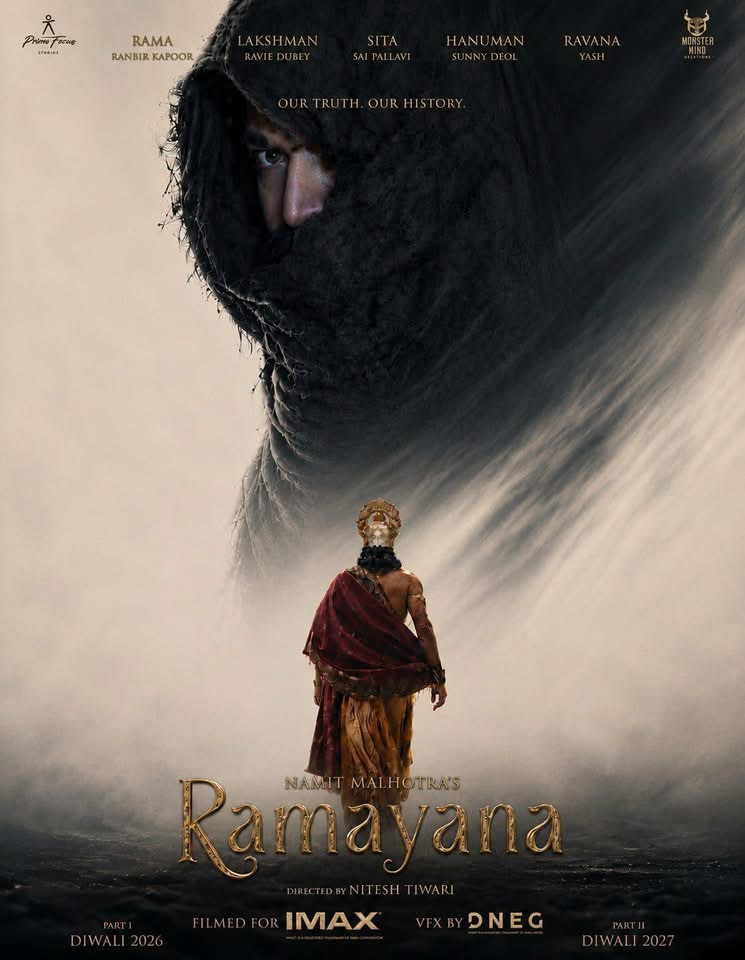
Now, the return is heralded not by oil wicks, but by the cold luminance of multiplex screens and the electric glare of smartphones. A cinematic adaptation has thrust the epic back into the center of the town square, accompanied by the inevitable, viral question:
“Have you watched it? What’s your take?”
Instantly, the amphitheater fills. Political theorists, cultural commentators, self-appointed arbiters of taste, traditional Upanyasakas, and ardent Bhakthas jostle for the microphone. Everyone dissects frame rates, costume fidelity, political undertones, and historical allegiances.
Yet the most compelling inquiry is not whether the film succeeded in its visual effects or box-office returns, but a quieter, far more stubborn mystery: Why does this particular narrative refuse to retire?
The Story That Outlives Its Mediums
Trace the lineage backward.
The Ramayana has resisted petrification for millennia. It has slipped effortlessly across birch bark, palm-leaf manuscripts, stone temple reliefs, shadow-puppet screens in Java, Kathakali stages in Kerala, folk songs across the Gangetic plains, street Ramlilas, Doordarshan cathode-ray tubes, and glossy paperbacks.
Every epoch invents, interrogates, and crowns its own Rama.
Now, we hand the tale over to cloud servers, short-form video algorithms, neural networks, and prompt windows. Far from rendering the ancient tale obsolete, digital architecture merely serves as another mirror held up to it. Some revere him as God incarnate; some admire him as an ethical benchmark; some challenge his verdicts; some deconstruct him through contemporary sociopolitical grids.
Yet nobody ignores him.
A blockbuster commands cultural oxygen for three weeks before dissolving into the archive. The Ramayana has commanded human curiosity for thousands of years.
Beyond Political Shorthand
The contemporary discourse often reduces the epic to binary battle lines. Was Rama an Aryan invader? Was Ravana a Dravidian sovereign? Was the epic a manifesto for caste hegemony, or a chronicle of prehistoric regional friction?
These ideological contestations are not the sudden creations of twenty-first-century digital outrage; they possess deep roots, notably in modern Tamil sociopolitical discourse and nineteenth-century colonial philology. Yet approaching the epic solely through these fractured prisms flattens a living ocean into a puddle.
The text has never been a static monolith. The Kamba Ramayanam, the Jain Paumachariya, the Buddhist Dasaratha Jataka, Awadhi folk ballads, and Southeast Asian variations such as the Reamker and Ramakien have long engaged the core narrative through radically diverse metaphysical and moral frameworks. They were not mechanical translations; they were sovereign acts of cultural re-imagination.
Moreover, the source material resists crude demographic silos. In Valmiki’s Sanskrit text, Rama emerges from the Solar Ikshvaku dynasty. Ravana, far from being an outsider to the Vedic world, is the grandson of the Prajapati Pulastya, born to the sage Vishrava and the Rakshasi Kaikesi; he is himself a master of the Sama Veda and an unmatched scholar of the scriptures. Neither figure fits into the flat political boxes designed to contain them.
Interrogating the text, challenging its protagonists, and probing its moral silences is vital literary and ethical engagement. But when characters are reduced entirely to modern tribal identities, we cease to read the Ramayana; we merely project our own temporal neuroses onto it. Political regimes crumble and ideologies fade into footnotes. The epic endures because its inquiries transcend the political anxieties of any single afternoon.
The Monk in the Crown
The failure of contemporary cinema often lies in its instinct to reduce mythic archetypes to caped crusaders. Pop culture seeks an invulnerable savior: kinetic stunts, earth-shaking weapons, unyielding wrath, and tidy victories.
Rama is arresting precisely because he is not a superhero. He possesses no cape, no cynical quips, and no immunity to sorrow.
Witness the arc:
As a child, vulnerable innocence.
As a prince, rigorous discipline and preparation for duty.
As a forest-dweller (Vanavasi), the sudden stripping away of regal luxury and the naked experience of loss.
As a son, brother, husband, and ally, the agonizing friction of human relationships.
As a commander, the sorrowful necessity of armed conflict.
As a monarch, the crushing burden of public scrutiny and the loneliness of statecraft.
The defining paradox of his character is simple: he is a monk within, a prince without.
He understands how to inherit the earth without being poisoned by ownership. He accepts the golden throne of Ayodhya without vanity; hours later, commanded into fourteen years of wilderness, he steps into exile without bitterness. The marble hall does not enlarge him; the jungle briars do not diminish him. He remains an island of internal stillness amidst shifting external storms. His heroism is not measured by the empires he conquers, but by the sovereign mastery he maintains over his own mind.
The Seeker Before the Sovereign
Popular imagination fixates on the archer who felled Lanka. Yet ancient tradition preserved another, crucial portrait: the philosophical seeker who preceded the warrior.
This dimension lives within the Yoga Vasishta—an independent philosophical masterpiece attributed to the tradition of Valmiki. Long before Vishwamitra summons the young prince to slay demons in the Dandaka forest, Rama returns from a royal pilgrimage through his father’s realm struck by profound, paralyzing existential despair.
He witnesses the fragility of human joy, the inevitability of decay, and the absurdity of worldly ambition. Sitting before King Dasharatha and the royal court, the teenage prince asks:
What is this ephemeral world? Why does the mind fabricate its own cages? If all empires turn to dust, what is the ground of ultimate truth? What does it mean to be truly free?
Sage Vasishta answers not with calls to war or divine lineages, but with a radical inquiry into the architecture of consciousness itself.
This places the Ramayana in direct resonance with the Mahabharata. Where Arjuna faces an active moral paralysis on the blood-soaked field of Kurukshetra and receives the Bhagavad Gita, Rama faces an interior, existential crisis in the quiet halls of his youth and receives the Yoga Vasishta.
Before Rama can govern a nation or conquer an adversary, he must master the internal machinery of desire, ego, and despair.
The Unbroken Voice of Sita
Any reading of the epic that treats Sita as a passive victim or decorative foil fails the text itself. Sita is the ethical compass of the narrative, an autonomous moral force whose decisions drive the story forward.
She demands exile, rejecting Rama’s plea to remain sheltered in Ayodhya’s palaces, reminding him that her dharma is intertwined with, yet independent of, his convenience. Imprisoned beneath the Ashoka trees of Lanka, surrounded by threats and opulent temptations, she refuses Ravana without weapon or shield, relying solely on her moral sovereignty.
Yet the narrative refuses easy comfort, posing questions that wound: the fire ordeal (Agni Pariksha) at the close of the Yuddha Kanda, and the heartbreaking estrangement in the Uttarakanda.
Why must public virtue demand the private sacrifice of a blameless woman? Where does the cold calculus of a ruler’s duty end, and the sacred obligation of a partner begin?
These are not modern, imported skepticism; they are raw lacerations embedded within the narrative fabric itself. Regional traditions and folk songs—particularly those preserved by rural women across India—have long sung of Sita’s interior grief and quiet defiance.
When Rama eventually asks her to prove her virtue a second time before the assembly of Ayodhya, Sita makes her definitive choice. She refuses to accommodate the court’s endless demands for validation. Calling upon the Earth from whose furrow she was born, she demands that the ground split open and receive her.
Her departure is not a surrender; it is a profound indictment of a society obsessed with external appearances over essential truth.
The Architecture of Character
Strip away dogma, and Rama offers an enduring study in the burden of principled leadership:
1. Alignment of Word and Deed: Promises are treated not as transactional currency, but as the bedrock of personal honor.
2. Restraint in Power: The deliberate refusal to abuse institutional authority or physical strength, even under severe duress.
3. Duty over Impulse: A willingness to accept personal discomfort rather than negotiate away moral commitments.
4. Leadership as Stewardship: The conviction that sovereign power exists to protect the vulnerable, not serve the ego of the ruler.
Anyone can inherit power; very few become worthy of the responsibilities it demands. Rama’s story endures because it does not offer easy answers; it forces every generation to evaluate the steep, often tragic price of moral consistency.
From Palm Leaf to Prompt
Now, the epic enters the silicon ecosystem: the Algorithmic Age.
Generative engines and predictive models can cross-reference Valmiki with Tulsidas in milliseconds, parse regional variations, summarize complex commentaries, and translate verses across every language on Earth.
Yet the algorithm carries distinct vulnerabilities:
Can an LLM balance the rigorous non-dualism of the Yoga Vasishta against the devotional fervor of the Ramcharitmanas without collapsing both into a bland, homogenized summary?
Can predictive architectures capture the searing dignity of Sita’s silence without flattening her into an ideological talking point?
In an attention economy engineered to reward outrage, tribal hostility, and viral provocation, will algorithms amplify the epic’s nuanced ethical ambiguities—or mine it for polarizing content?
An algorithm can retrieve information, but it cannot cultivate discernment (viveka). It can map the verses, but it cannot bear the moral weight of the choices they depict. Technology should serve as an open corridor into the text, never a shallow surrogate that replaces direct engagement with it.
The Endless Return
So, what is the verdict?
Cinematic interpretations will emerge, spark debates, claim their box-office records, and eventually slip into media archives. But the source current remains untamed.
If we seek only spectacle, we miss the philosopher.
If we seek only the warrior, we miss the existential seeker.
If we seek only the deity, we miss the vulnerable human heart.
If we fixate solely on the king, we risk silencing Sita.
Rama requires neither divine apotheosis nor superhero theatrics to command attention. He stands as a challenging human inquiry: How does one navigate an imperfect world with an uncorrupted heart?
A prince on the outside; a monk on the inside.
Cinemas close their doors, political seasons turn, algorithms re-weight their parameters, and the medium shifts once again. But the ancient journey remains open—inviting us, whenever the lamps are lit, to find our way home.
Leave a Reply