A strange little egg appeared on my timeline recently. At a time when an algorithmic agent can answer a student’s question before a teacher has finished writing it on the board — when machines can write the essay, solve the equation, and synthesise the philosophy in seconds — an old poem by the late Tamil poet Na. Muthukumar felt suddenly contemporary.
ஆசிரியர் சிலேட்டில் முட்டை போட்டார்…
மாணவனின் எதிர்காலம் அழிந்தது!
அதையே தட்டில் போட்டார்…
மாணவனே அழிந்தான்!
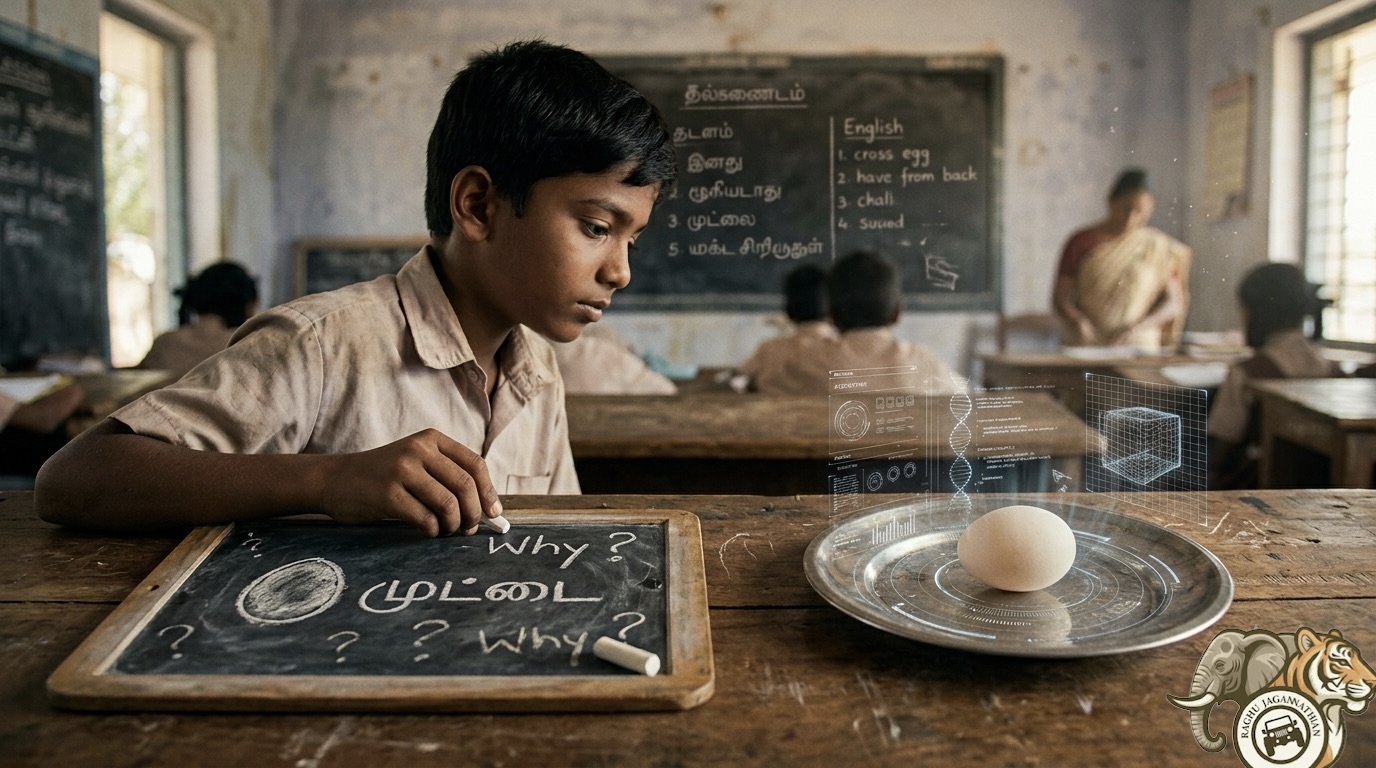
The teacher drew an egg on the slate. The student’s future was ruined. He set the same egg on a plate. The student was ruined.
Read one way, it is a wry comment on poverty and the classroom. The egg on the slate is the zero, the mark that closes a child’s academic future. The egg on the plate is the free midday meal, the charity that keeps the child fed and quietly reduces him to someone who is fed. I do not know if that was the poet’s intention. It is a fair reading of the lines. It is also, the longer I sit with them, not the reading that matters.
The poem is not about the egg. It is about what the egg does to the child. And that opens a larger question. What happens to education when intelligence becomes abundant, and free?
For centuries the arrangement was simple. The teacher held the knowledge. The student needed it. The slate was where you showed that it had taken root. The teacher asked. The student wrestled. The student wrote. The teacher judged. The friction was the education. A wrong answer, slowly corrected, was worth more than a right one handed over.
Then a fourth person entered the room. The student can ask the machine, and the machine will answer. Ask for the essay, and it will write it. Ask for the solution, and it will solve it. The old three — teacher, student, slate — have to be thought again, because the fourth does not struggle. It serves.
The egg has two lives. On the slate it is raw, unfinished, costly: the mind paying for its own answer in time and error. On the plate it is complete, subsidised, ready to be eaten. AI is extraordinarily good at moving things from the slate to the plate. That is its power, and it is the dilemma. A subsidy changes behaviour. When the finished answer costs nothing, the unfinished one begins to look like a waste. Dependence is the price. Not inability — unwillingness. The child who can still produce an answer, and no longer sees why he should.
The crisis is no longer the state of the egg. It is the state of the mind that will not pick up the chalk.
My father was a schoolteacher in the villages. There was a slate, and chalk, and a child who had no choice but to think. He taught me something I understood only later. Grow yourself to a position where you can say no. No to free. No to the unnecessary discount. No to dependence. He called that real freedom.
The child who can refuse the plate is the child still willing to sit with an empty slate. That is the lesson, carried into a room where the plate is infinite. Do not teach the child only to consume the answer. Teach the child to refuse one, and then to build the question that makes an answer necessary.
The egg can stay on the plate. The future of the mind depends on what we still compel the child to forge on the slate.
We need the egg but it’s high time to break its free shell. 🤔.
Leave a Reply