
The October sun had barely threaded the canopy when Sundaram stepped onto the veranda. Today was the second. His hundredth birthday.
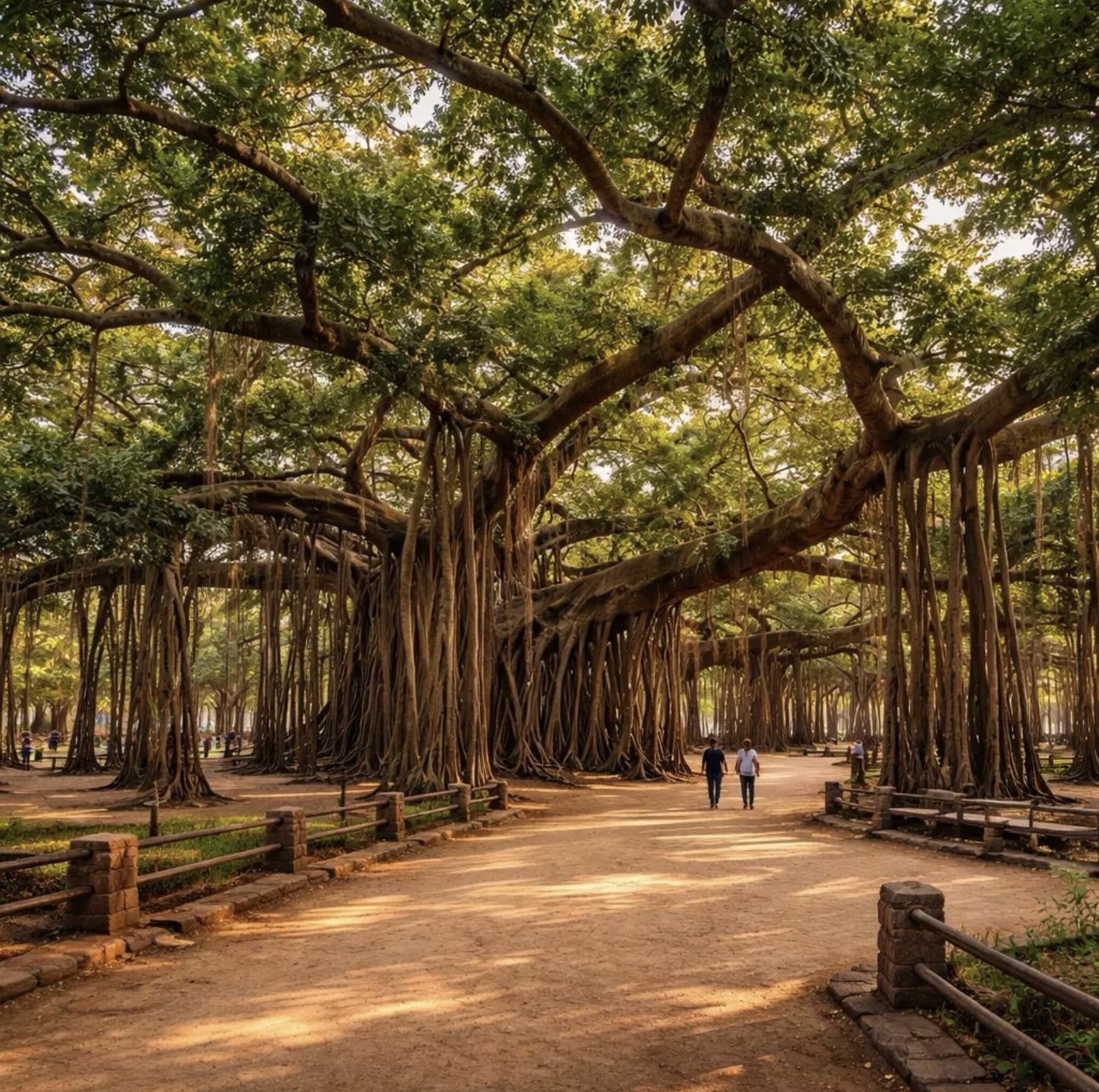
The red earth was still dark with dew. Cataracts had milked the edges of things, but the garden did not require sharp sight. Sixty years ago the plot had been a bare field. Now banyans stood over it, hanging roots drifting like the beards of old sages, and ebony trees held the mist along the eastern wall. Mynahs and koels were already loud.
At the wrought-iron gate, twelve-year-old Aarav shifted from foot to foot, a crumpled envelope in one hand.
“Happy birthday, Thatha. A hundred years. Do you feel like a century?”
Sundaram leaned on his teakwood stick. “I feel much as I did yesterday. Louder knees. And everyone determined to treat me like porcelain.”
Aarav laughed and fell in beside him. The old man shuffled. The boy shortened his stride without seeming to notice.
“You’ve seen all of it,” Aarav said, slipping the envelope into his pocket. “Carts to electric cars. Telegrams to phones. If you could have one wish today, what would it be?”
Sundaram stopped under the oldest banyan. “Before the wish. What makes a man rich?”
“Money. A house in the city, fast cars, stocks. Rohan says if you’re really rich you have a jet, so you never wait at an airport.”
“A jet.” The cataracts crinkled. “How rich, then, should your Thatha be?”
“Rich enough to buy anything he wants.”
“When I was forty, a banker asked me that. I told him I wanted a garden with two or three banyans, and five or ten ebony trees.”
Aarav looked at the green around them. “That’s all? You could have asked for a palace.”
Sundaram set his knotted hand on the trunk. “A palace needs servants and guards. A garden asks to be loved.”
Aarav tugged a hanging root. “Why these? They don’t even give mangoes.”
“Look up.”
“Branches. Leaves. A squirrel’s nest.”
“A grown banyan wants an acre. Sometimes two. Not for apartments, not for parking, not for timber. Just to stand as it stands. Your father will tell you what an acre costs in this city. That is why the tree is the luxury. A house walls space for one family. This feeds hornbills and bats, shelters frogs, and cools the ground for anyone who walks under it.”
Aarav pointed at the dark trunks by the wall. “And those?”
“Ebony grows so slowly you think it has stopped. Men want the black heartwood for carvings and piano keys. You get it by killing the tree. I wanted to be rich enough to look at it and leave it in the sun.”
The boy chewed his lip. “So you wanted your own forest.”
“You don’t own land. You hold it. I wanted the earth itself to come up richer than I found it.”
They had reached the crumbling wall. A compost pit steamed in the cool air.
“When your father buys shares, what does he wait for?”
“Returns. The numbers go up.”
“And a sapling?”
“It gets taller.”
“Say it grows two hundred years. Roots hold the soil when the monsoon comes. Leaves rot and feed the worms. Fifty summers on, children neither of us will meet stand in the shade. The return doesn’t come back only to the man who planted it.”
Sundaram bent, stiffly. Aarav caught his elbow. The old man lifted a brittle banyan leaf, crumbled it, and let the flakes fall.
“We were taught that land was lazy unless it paid someone. Factories, crops, rent. We had the accounting backwards. That leaf isn’t a loss. It’s next spring. We are the only creature that can turn a living place into concrete and call the concrete progress.”
Aarav laughed once. “If you tell my father the tree is a better investment than his funds, he’ll say you’ve gone senile.”
“Tell him the banyan doesn’t fall when the market panics, and never asks for a bonus.”
A breeze took the small khadi flag on its bamboo pole by the cottage. Saffron, white, green.
“We had a holiday for Gandhi Jayanti,” Aarav said. “Was it strange, sharing his birthday?”
“I was born in 1926. He was still walking the roads. My father marched with him once. Sharing the day kept reminding me that freedom is harder than the holiday makes it.”
“The British left.”
“And yet we stay chained to wanting more than the neighbor, and to buying what we don’t need with money we haven’t earned.”
Aarav glanced at his new sneakers and said nothing.
“Planting a tree doesn’t free you,” Sundaram said. “But you plant an ebony knowing you will never sit in its full shade. The oxygen isn’t yours. The koel in the crown isn’t yours. The deed is. When the best of what you have can’t be locked away, the appetite loosens.”
They walked the last yards without talking. Stick on gravel. A kingfisher hit the pond and came up.
Beside the lilies stood a young banyan, no taller than the boy, its first aerial roots dangling, still short of the earth.
“You haven’t told me the wish.”
Sundaram rested both hands on the stick, chin near his knuckles. “Men write wills to divide gold and flats and shares. My wish is simpler, and harder. I do not merely wish to leave generations of wealth behind to my family. I wish to leave Mother Earth wealthy enough to nurture every generation that follows.”
The envelope felt small in Aarav’s pocket. He held it out. “I made this last night. Before we walked. Now it seems like a waste of paper.”
Sundaram drew the card out with trembling fingers. A banyan in colored pencil, a tire swing on the lowest limb. Inside, crooked letters: To Thatha at 100 — the richest man I know, because he never needs anything.
He looked at the drawing a long time. A drop gathered at the corner of his eye, caught the sun, and lost itself in the wrinkles.
He folded the card into the breast pocket of his kurta. “It gives me the nerve to ask for a second gift.”
“Tell me.”
“Next October, no card, no sweets. Bring a spade and plant a tree with me. Every second of October after that — if I am on this path, or if I am under it — plant another. Not a twig for a photograph. Choose the ground. Water it through May. Keep the goats off it until the roots find the deep water.”
Aarav straightened. “Can the first one be a banyan?”
“If you can find room for it to be free.”
The boy grinned. “Then I’d better save my pocket money. I’ll need an acre by next year.”
Sundaram laughed, and two parakeets left the canopy. “Don’t buy the acre yet. First learn how to make one live.”
By the time they climbed to the house, the mist had burned off. The sky was a hard blue. They sat on the stone bench. Sundaram’s breath was shallow. He leaned back and closed his eyes to the warmth.
Aarav set his head against the bony shoulder. Sandalwood soap, old cotton, damp earth.
“What should I be?”
The papery hand covered the boy’s knuckles. “Earn, if you can. There is no virtue in being poor when you have the talent to make abundance. Only ask the wealth, every day, what life it is making possible. If you can afford a forest, plant one. If you can afford a pot, grow jasmine for the bees. If you have nothing, don’t destroy what others spent their lives keeping alive.”
His breathing slowed.

Aarav did not move. Beyond the railing the young banyan’s roots swayed, reaching, not yet touching. Years before they would take hold. Decades before they could hold up anything like a sky.
He saw himself at a hundred, on this path, with a stick. The year would be 2114. A boy not yet born might walk under the vault those roots had become, and ask what it meant to be rich.
Aarav smiled. Even if that boy never knew Sundaram’s name, the shade would answer for him.
Leave a Reply