
An Vichara
The Kidnapping You Didn’t Notice
How we lost ourselves while learning to become someone
Before the kettle, the thumb has already voted.
A performance video begins. Clear goals. Immediate feedback. Challenge matched to skill. Repeat until belief catches up. The voice on the screen is calm, certain that this is news.
Halfway through I am not learning. I am recognising.
The lamp is lit at the same hour. The same hand, the same sequence, no speech about motivation. You do not wait to feel ready. You do the act until the act teaches the hand, and the hand teaches the day. What the video calls a system, the house already called a ritual.
The shock is not that the method works. The shock is that it arrived wearing someone else’s face — and for a moment I received my own memory as content.
That is a small kidnapping. Most of them are small.
A message makes you anxious. Someone else’s success makes you question your own. A rejection changes your mood. A compliment changes your confidence. A notification interrupts your attention. A childhood sentence quietly decides what you think is possible.
By evening you are exhausted. You call it life.
Psychology has names for pieces of this machinery. The older house has other names. Neither set of names is the problem.
The problem is simpler, and worse.
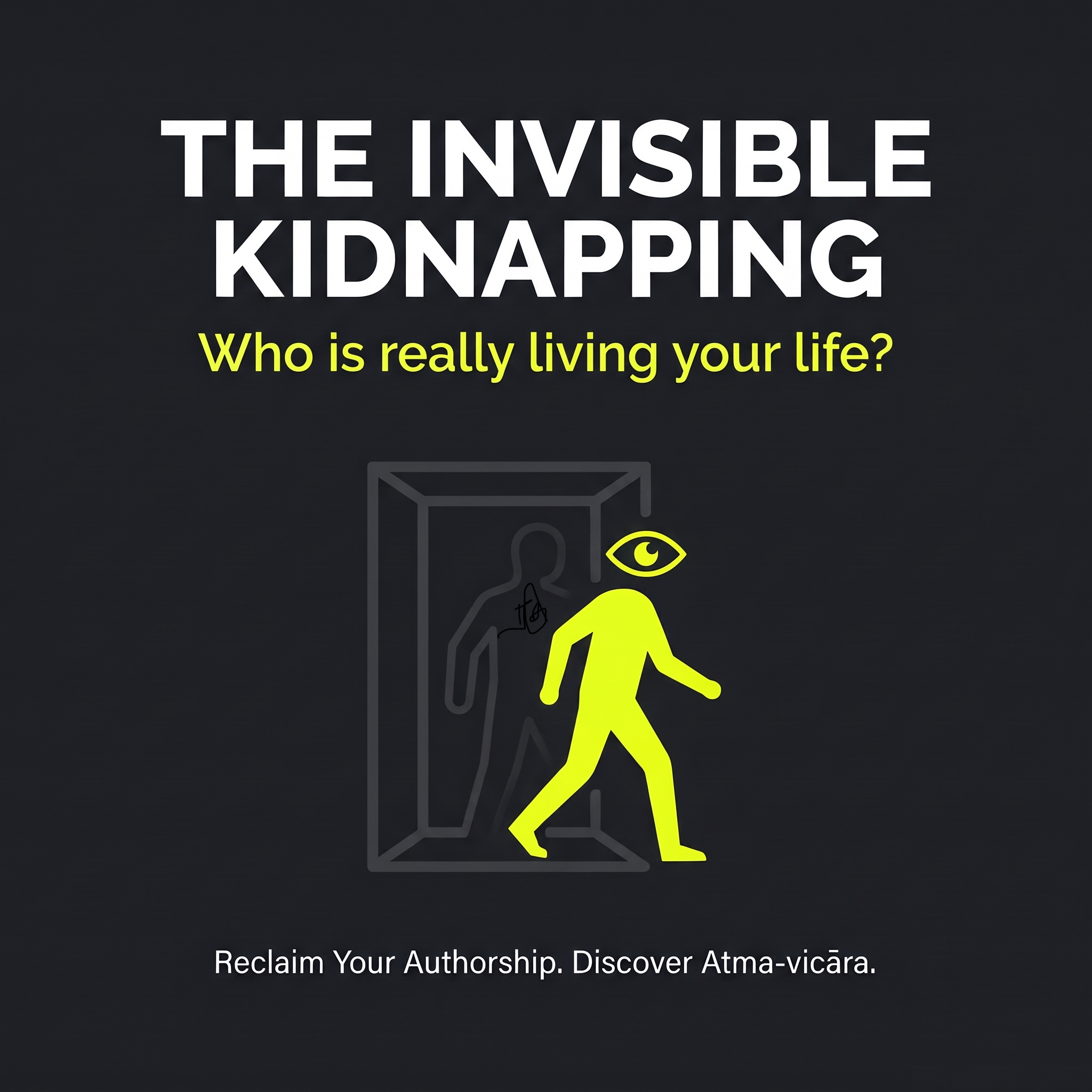
Who is living this life?
Because the greatest danger is not that somebody controls you. It is that you can be kidnapped from yourself without a moment you can later point to and say: there. That is when I was taken.
1. The Invisible Kidnapping
Nobody needs to imprison you physically. They only need to influence what you notice. What you fear. What you desire. What you call successful. Whose approval still moves the body. What identity you defend when a sentence threatens it.
The kidnapping is gradual.
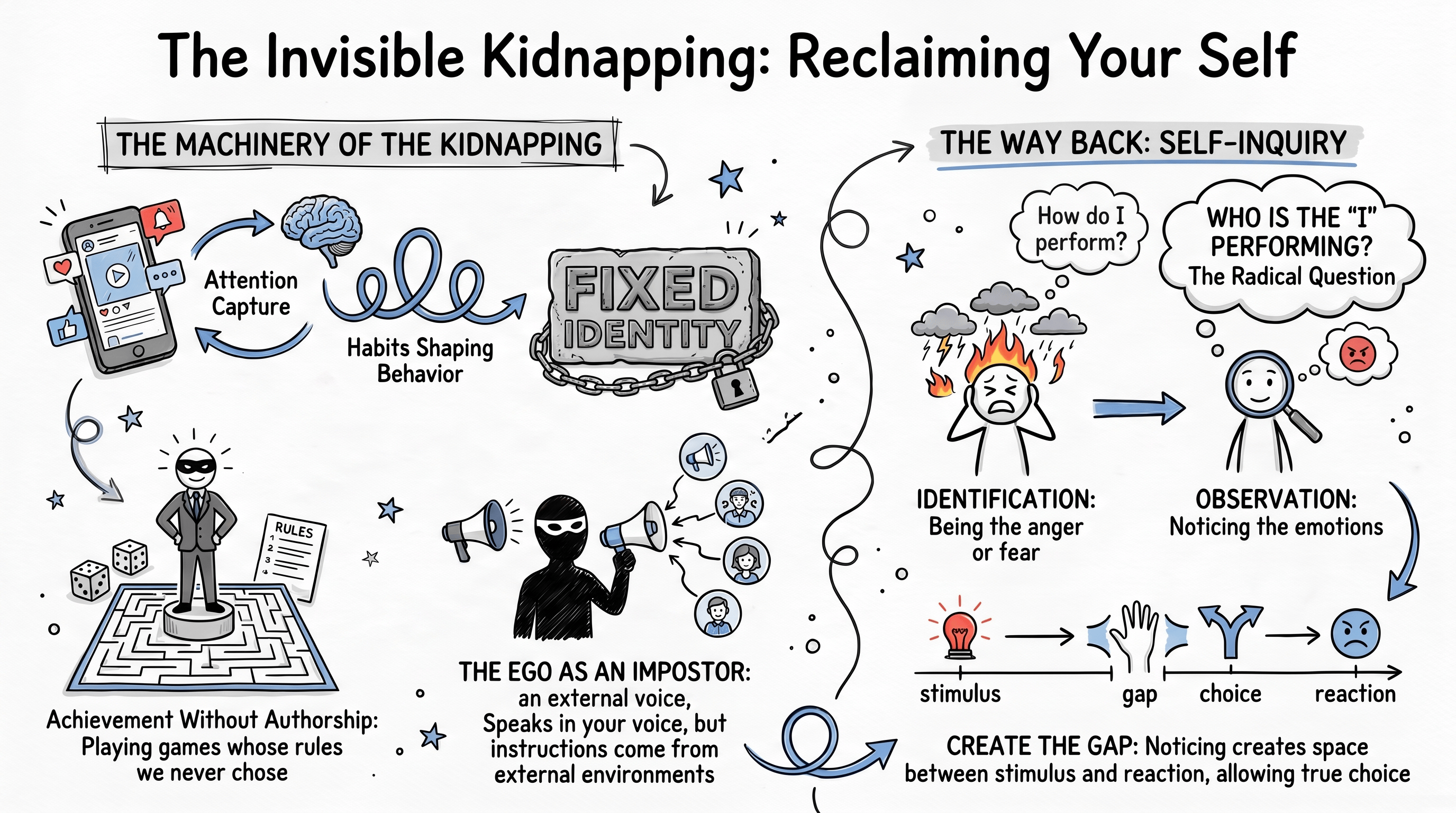
Attention is captured. Behaviour is shaped. Repeated behaviour becomes habit. Habit begins to feel like personality. Personality hardens into identity. Then you defend the identity as if it were the one who was born.
There may be no hour in the diary titled I was kidnapped.
There is only a substitution of authorship.
Someone else writes the first few lines. You continue writing. Eventually you forget whose handwriting it was.
The video did not invent practice. It sold back the authorship of practice. That is enough.
2. What the Video Knew, and What It Couldn’t Say
The performance literature is not empty. Bandura’s word for the useful part is self-efficacy: the working belief that I can carry out the act this situation requires. That belief is built most honestly by doing the thing, failing, doing it again — mastery as evidence, not as a speech. Csikszentmihalyi’s word for another part is flow: attention so gathered around the task that the scorekeeper goes quiet and time changes shape.
Both describe machinery you can feel in a well-kept ritual.
You do not light the lamp because you have become confident. Confidence is what sometimes arrives after the hundredth lighting. That is mastery experience without the textbook.
The room is arranged. Hour, direction, the small sequence the body knows. Environment is not decoration. It is a co-author. Change the room and the person who enters it is already slightly different. The video says this as if it were a hack. The house knew it as hospitality toward attention.
And when the act is clean, the social-me steps aside. Not forever. For the length of the offering. That quiet is not branding. It is closer to flow than a thumbnail will admit — and still not the last question.
The last question is the one the video cannot ask, because the video’s job is to make a better performer.
What exactly is this “I” that performs?
3. The Ancient Question
The inner instrument has been mapped for a long time. Senses meet the world. Mind oscillates. Intellect discriminates. Ego claims the act: I am doing this. Memory and old impressions decide what feels possible next. Together they produce what we ordinarily call a person.
Psychology can put many of these processes on a bench and measure them. Vedānta then makes the ruder move.
Who is aware of them?
You can watch a sensation. You can watch a thought. You can watch anger arrive and name itself as you. You can watch a career become a sentence you defend. You can watch your personality change across a decade and still speak of it as if it were the witness.
If all of this can be seen, can any one of it be the whole of what you are?
That is the beginning of ātma-vicāra. Not: what am I thinking? Who is aware that thinking is happening?
A small change in the question. A different investigation.
4. Seeing Is Not a Caste
Brahman is not Brahmin. One word points at ultimate reality. The other names a social and religious category. They are not interchangeable, and the inquiry is not an inquiry into hereditary identity.
Tamil has its own words — pārppān, antaṇar — grown inside particular literary and social weather. It is tempting to hear “one who sees” and stop there, as if etymology were already philosophy. It is not. The metaphor is still useful.
Seeing is where inquiry starts. To observe. To discriminate. To refuse the first story. And then: who is the seer?
That movement is worth recovering. Not as a community argument. As a question about consciousness.
5. Two Ends of the Same Telescope
The lazy sentence is: the ancients already knew modern psychology. That flattens both rooms.
They sometimes look at the same human trouble from opposite ends of the glass.
Psychology asks how beliefs drive behaviour. Vedānta asks what happens when a belief is mistaken for the Self.
Psychology studies attention. The older disciplines train it and then ask who is attending.
Psychology studies habit. The house already had abhyāsa: repetition that slowly changes the tendency to act, without a motivational preface.
Psychology studies conditioning. The older analysis speaks of saṃskāra and vāsanā — grooves that keep playing until they are seen.
Psychology studies identity. Vedānta asks whether identity is an object in awareness, not the final subject.
These are correspondences. They remain interesting only if the difference is left standing.
The video can teach you to perform. It cannot ask who is watching the performance. That limit is not an insult. It is the edge of its job.
6. The Ego, the Goal, the Room
The ego is a gifted impostor because it speaks in your mouth.
“This is what I want.”
“This is who I am.”
“People like me don’t do that.”
“I must prove myself.”
“I need their approval.”
Where did those instructions enter?
Who taught you the local meaning of success? Of failure? Which profession would make you valuable? How much money would count as enough? Why admiration should outrank peace? Why a sentence formed at nine should still be in force at fifty?
A goal can be hit without ever having been chosen. You can become very good at a game whose rules you inherited. That is not always failure. It is quieter than failure.
Achievement without authorship.
I spent decades building middleware so other people’s systems would not lose a transaction — and only later saw that I had installed the same layer between sensation and the one who feels it. The work was real. The substitution was also real. Competence is not the same as presence. The corridor will reward the first and never ask about the second.
The room keeps producing the person. The phone is a room. The workplace is a room. The city is a room. The feed is a room that fits in the palm. Cues decide what is easy, what is visible, what gets a pulse of reward.
So the better question is not only: why am I like this?
What keeps manufacturing this version of me?
Blame becomes investigation. Investigation makes a little space. Space is where a choice can occur.
7. Practice, Mastery, Theatre
Confidence cannot be ordered into the body. You act. You miss. You learn. You act again. The result becomes evidence. That is the honest half of the performance video.
Abhyāsa says the same thing without promising a new self by Friday. Practice is not a speech. It is repetition. The repeated act changes the tendency to act.
Two people can do the same task for different games.
One wants to get better at the task. The other wants to be seen as someone who is good at the task. From the corridor they look identical. Inside, failure means different things. For the first, information. For the second, an injury to the name.
Karma yoga is not a museum object here. Give the act your attention. Do it cleanly. Learn from what returns. Do not mortgage the whole identity to the fruit.
The work becomes practice rather than theatre.
The ritual already knew this and did not need a thumbnail. The kidnapping was forgetting that we knew — and then paying rent to be taught our own house.
8. The Project Under the Project
Self-improvement can become an enormous construction site.
Build habits. Build confidence. Build discipline. Build a career. Build a reputation. Build a body. Build a brand. Build a better version of yourself.
None of this is wicked.
Underneath it sits a question the construction site is designed not to hear.
Who chose the person you are trying to become?
You spend a life becoming yourself. The self you are busy assembling may have been cut from parents, teachers, the office, the feed, old fear, a comparison that would not die, and a video that sounded like news.
That is the paradox worth keeping: you spend a life becoming yourself, while the self you are becoming may be the thing that keeps you from meeting what was never constructed.
Ambition can stay. Authorship has to be examined.
9. The Way Back
The way back is smaller than the industry of becoming.
Notice.
What takes the thumb before the kettle. What the video just renamed. What the lamp was doing before it needed a theory. Whose approval still turns the body. Which identity flares when it is questioned. What you have decided to call success, and who first decided it.
Then: did I choose this, or was it chosen for me?
The question opens a gap. Between stimulus and the lunge. Between thought and the belief that the thought is me. Between the role and the one playing it. Between what happened and the story that arrived to own it.
In the gap, choice. Beyond choice, inquiry.
The inquiry gets ruder.
Who is noticing?
On the ride to drop my child at an exam centre I was already grading the morning — the traffic, the clock, the child’s silence — as if the day were a system under watch. Even love arrived as a dashboard. That reflex is the kidnapping in ordinary clothes. Not a villain. A habit of authorship that forgot it was hired.
Who is grading the morning?
You were given a name, a family, a language, a culture, a profession, a feed, a definition of enough. Civilisation needs most of this. It cannot run on raw witnessing.
The trouble begins when the story becomes invisible. When the role is taken for the actor. When the map is taken for the ground. When the personality is taken for the Self.
You were not born lost. You were given an identity until you spoke it fluently enough to forget it was made.
The old question is not: how do I become a better version of myself?
It is: who is the self I am so busy improving?
The video can still be useful. The ritual can still be kept. Psychology can still describe the gears. Vedānta still asks us to look at the one describing.
Perhaps the movement is not from weakness to strength, or from failure to success, or even from ignorance to knowledge.
From identification to observation. From observation to inquiry. From inquiry to seeing.
The first step toward freedom is not becoming someone new.
It is noticing the kidnapping — sometimes in a thumbnail, sometimes in a lamp, sometimes in a car on the way to an exam — and asking who, exactly, was taken.
Leave a Reply