What a difficult conversation with my son taught me about learning, proof and the one who is looking.
My son was angry with me.
Not because I had refused him something, but because I was asking him to do something he did not yet understand.
We were talking about school, marks, discipline and the strange rituals that surround education. He wanted to know why a teacher insisted on doing things a certain way. Why repetition mattered. Why preparation mattered. Why getting something right before an examination mattered so much.
To him, some of it felt unnecessary.
I understood his frustration because I had once stood exactly where he was standing.
There were many things my father made me do when I was young that I did not understand at the time. There are disciplines whose value becomes visible only after we have practiced them.
When I asked my father why, his answer was usually uncomplicated.
“Just do what I say. By the time you understand why you did it this way, you will be my age, and I won’t be around.”
I never liked that answer.
But age has a peculiar way of turning old instructions into evidence.
Years later, I began wondering whether my father was really teaching me a method, or whether he was teaching me something much larger about how human beings learn.
We often want to understand before we act.
But perhaps much of learning happens the other way around.
We act. Something happens. We notice. We adjust. We try again.
And only later do we understand why the method worked.
That thought took me somewhere unexpected.
To OCR.
OCR
OCR is simple enough.
Optical Character Recognition takes something that is visually present but not yet machine-readable and turns it into something a machine can work with.
A photograph of a page becomes text.
The machine does not need to understand the meaning of the page before recognizing the characters.
It first observes. It identifies patterns. It converts. Understanding can come later.
That distinction stayed with me because it resembles something fundamental about learning.
A child does not begin life with a theory of gravity.
He drops a spoon. It falls. He drops it again.
Eventually, something begins to form.
Not a formula. An expectation.
The world teaches through consequences long before language arrives to explain them.
And then we built machines that began learning through loops that looked surprisingly familiar.
The loop
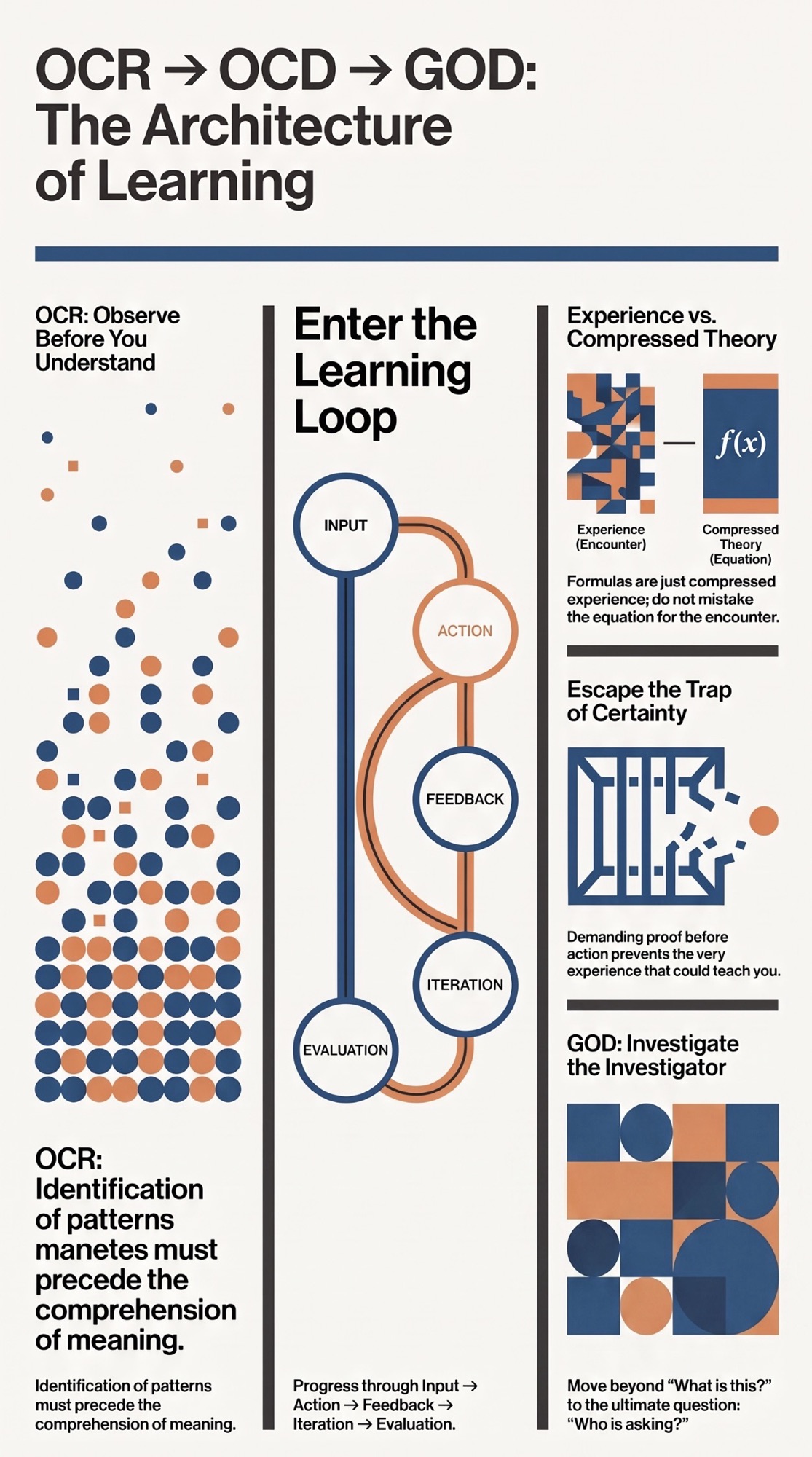
Input → Action → Feedback → Iteration → Evaluation
Something enters the system. The system acts. The world responds. The system adjusts. The result is evaluated. Then the loop begins again.
It is not that every AI system literally learns in exactly this sequence. It is a way of describing a broad pattern of learning through interaction and feedback.
The machines did not invent this loop. They inherited a crude version of something a nervous system already does.
A brain is a prediction engine. It carries a prior — a quiet model of what the world is likely to do — then acts, then receives a prediction error when reality disagrees. That error is the teacher. In the language of neuroscience, the signal is often dopaminergic: not merely a reward, but a message that says this was better than expected, or worse; now update the model. Bayesian reasoning is only a name for the same humility. You do not throw away what you believed. You weigh the old belief against the new evidence and move the belief a little.
That is why a child dropping a spoon is already doing science, and why an AI system adjusting its weights after a wrong token is, in a crude way, doing something the nervous system has been doing for a very long time.
The danger is the same in both places. If the loop is open, the model learns. If the loop is closed by the hunger for certainty — if every surprise must be explained away rather than admitted — the system stops updating. It keeps checking the door.
And suddenly I could see the difference between two kinds of education.
The first begins with experience.
The second begins with explanation.
Modern education often gives the student:
Theory → Formula → Proof → Examination → Application
We teach the accumulated knowledge first. Then, much later, we ask: “Now, where can you use it?”
There is good reason for this. Humanity has spent centuries compressing experience into mathematics, language, models and methods.
A formula is experience compressed into symbols.
But somewhere in that compression, we can forget the experience that created the formula.
My father was asking us to enter the loop before we understood the theory behind it.
Do the problem. Make the mistake. See the result. Try again. Eventually, understand why.
The child sees the falling object. The physicist writes the equation.
The equation is not the experience. It is what generations of experience eventually became.
And perhaps that is why my son’s question bothered me more than I expected.
Because I could hear my younger self inside it.
The search for certainty
There is another kind of loop.
A person locks the door. Walks away. Then wonders whether the door was actually locked. They return. They check. The door is locked. They leave again.
The important difference is not repetition itself.
Learning can require repetition.
The difference is whether the repetition produces new information.
One loop moves toward understanding.
The other can become trapped in the search for certainty.
And that made me think about how often we approach life in the same way.
We want proof before experience. Proof before trust. Proof before action. Proof before wonder.
We want reality to submit its credentials before we allow ourselves to encounter it.
We keep checking the door, not because the door has changed, but because uncertainty has become uncomfortable.
Perhaps that is the strange paradox of proof.
The more desperately we demand certainty, the less willing we may become to enter the experience that could teach us something.
But what exactly do we mean by proof?
The elephant
Imagine someone standing in front of an elephant and asking: “Prove that it is an elephant.”
You can photograph it. Measure it. Scan it. Describe its anatomy. Record its movements. You can produce data until the room is buried in paper.
But every instrument has a domain.
A thermometer can tell you temperature. A weighing scale can tell you its mass. A camera can record its shape.
None of them can tell you everything about the experience of standing beside it.
He who asks for proof of an elephant may be determined to reduce it to the size of a dog.
The problem is not proof.
The problem is using the wrong instrument and then declaring reality inadequate because it did not fit the measurement.
And that brought me to another category.
Unknown.
Unknown is neither true nor false.
It simply means: I do not know yet.
That is a much harder sentence to live with than either belief or disbelief.
The man I knew
I thought about my grandfather.
He had met Neem Karoli Baba many times.
He spoke about those encounters matter-of-factly. Not as mythology. Not as a performance. Simply as things he had experienced.
I trusted my grandfather because I knew the man.
Our family lost land because he would not lie before the village sarpanch about property taken from poor farmers. He could have protected our interests by changing a sentence.
He didn’t.
We paid for that honesty.
So when my grandfather told me about Neem Karoli Baba, I believed him.
Trust is not proof. But testimony is not automatically worthless simply because it isn’t a laboratory experiment.
That distinction matters.
My grandfather’s words were not scientific evidence in the laboratory sense. They were testimony from someone whose character I had experienced over decades.
I did not have to turn his story into proof.
I also did not have to dismiss it simply because I could not prove it.
There is measurement. There is observation. There is inference. There is testimony. There is experience. There is belief.
And there is the uncomfortable space where we simply say: Unknown.
Who is looking?
That question changed the direction of the investigation.
We spend enormous effort examining the world. We measure the object. We test the claim. We demand evidence.
But what happens when the object of investigation becomes the investigator?
The fool investigates the world.
The sage investigates the investigator.
Perhaps that is where the child becomes important again.
A child does not begin by demanding certainty.
The child looks. Touches. Falls. Gets up. Asks. Tries. Repeats.
The child lives inside the loop.
Input → Action → Feedback → Iteration → Evaluation.
Then, somewhere along the way, we grow older.
We accumulate knowledge. We learn the formulas. We learn the rules of evidence. We become better at asking for proof.
And perhaps we also become less willing to enter the unknown.
That is when my old scribble, this Tamil verse came back to handy to understand this situation.
நீயும் கடவுள் தான்
உன்னில் நீ உன்னை காணத் தவறியது
கடவுளின் தவறில்லை.
You too are God.
Your failure to see yourself within yourself
is not God’s failure.
I don’t read that as a scientific proposition.
I read it as a question.
What if the thing we keep trying to prove is not somewhere outside us?
What if the observer is also part of the experiment?
OCR asks: What is this?
OCD, in this essay’s metaphor, asks: Are you absolutely sure?
GOD asks: Who is asking?
And then I was back at home
Looking at my son.
I realised that I was standing on the other side of the conversation now.
I was becoming the father who says: “Just do it this way.”
And he was becoming the child asking: “But why?”
For a moment, I could hear my father’s voice inside mine.
That unsettled me.
Because I had spent years questioning the instructions I received from my father.
Now I was watching my son question mine.
Maybe that is not a failure of education.
Maybe it is education doing exactly what it is supposed to do.
A child receives a method. Then questions it. Then tests it. Then eventually understands what the method was trying to teach.
And perhaps the father has a lesson too.
Sometimes the person asking “Why?” is not resisting learning.
He may be beginning to learn how to learn.
The proof doesn’t always precede the journey. Sometimes the journey produces the proof.
My son is still asking why.
I smile.
And somewhere in that question, I hear my father’s voice again:
“By the time you understand why you did it this way, you will be my age, and I won’t be around.”
Perhaps that is what learning really is.
Not collecting answers.
Not eliminating uncertainty.
But becoming quiet enough to notice who is asking.
Leave a Reply