
The part of life nobody teaches us to prepare for
We spend the prime of our youth learning how to buy a life, but almost no time learning how to inhabit one.
From our first gold star in primary school, we are conditioned to compete, qualify, climb, and hoard. Progress is cataloged in ranks, titles, compensation tiers, and square footage. There is nothing inherently ignoble about this pursuit. Money matters. It quiets emergencies. It buys convenience and grants agency.
Yet money possesses a quiet, obstinate limitation: it can optimize the theater of our existence without teaching us how to perform the play.
We arrive without a ledger. We depart without an estate. Yet between those two clean silences, we become so fluent in the vernacular of commerce that we mistake solvency for vitality.
We mistake security for aliveness.
When the Instructions End
Retirement is traditionally framed as an actuarial hurdle:
Is the corpus self-sustaining?
Will inflation hollow out the portfolio?
Can the burn rate outlast the biological clock?
These are necessary questions, but they solve only one dilemma: Can I afford to stop working?
They offer no counsel for the terror that follows: Now that no one is demanding my time, who am I?
For six decades, existence is scaffolded by external mandates. School sets the bell; universities set the syllabus; corporate hierarchies set the quarterly metrics; domestic life sets the bills. Society supplies a continuous conveyor belt of expectations telling us where to stand, when to smile, and what to conquer next.
Then the engine cuts out.
In place of the machinery lies unscheduled air. Some step into it and breathe the clean air of autonomy. Far more feel the vertigo of the unmoored. The divide is rarely financial; it is existential. It is the sudden, stark realization that we never learned how to move without a leash.
The Ghost Audience
This is the quiet reckoning retirement forces into the light: whose life have we actually been living?
For decades, our ambitions are curated for a phantom gallery. We choose degrees to please anxious parents, buy cars to signal stature to indifferent neighbors, and chase promotions to confirm our relevance to peers who are too consumed by their own anxieties to notice. We call this maturity. Much of it is simply compliance.
Retirement strips away the performance. The boardroom no longer needs your tactical brilliance; the industry no longer registers your title; the market does not care that you hit target in 2014. The applause ceases, and with it, the exhaustion of pretending.
Only then do you encounter the question that terrifies the institutionalized mind: What do I desire when no one is grading me?
That is not senescence. That is the dawn of sovereign freedom.
The Mechanic at Eighty-Eight
My grandfather retired from civil service at sixty and lived until he was one hundred. Those four decades were not a coda.
He did not chase longevity trends or hoard distractions. He simply woke with an appetite for the world. He kept a deliberate routine, tended a chaotic plot of vegetables, mended broken hinges for neighbors, and argued politics over tea. The world still had purchase on him.
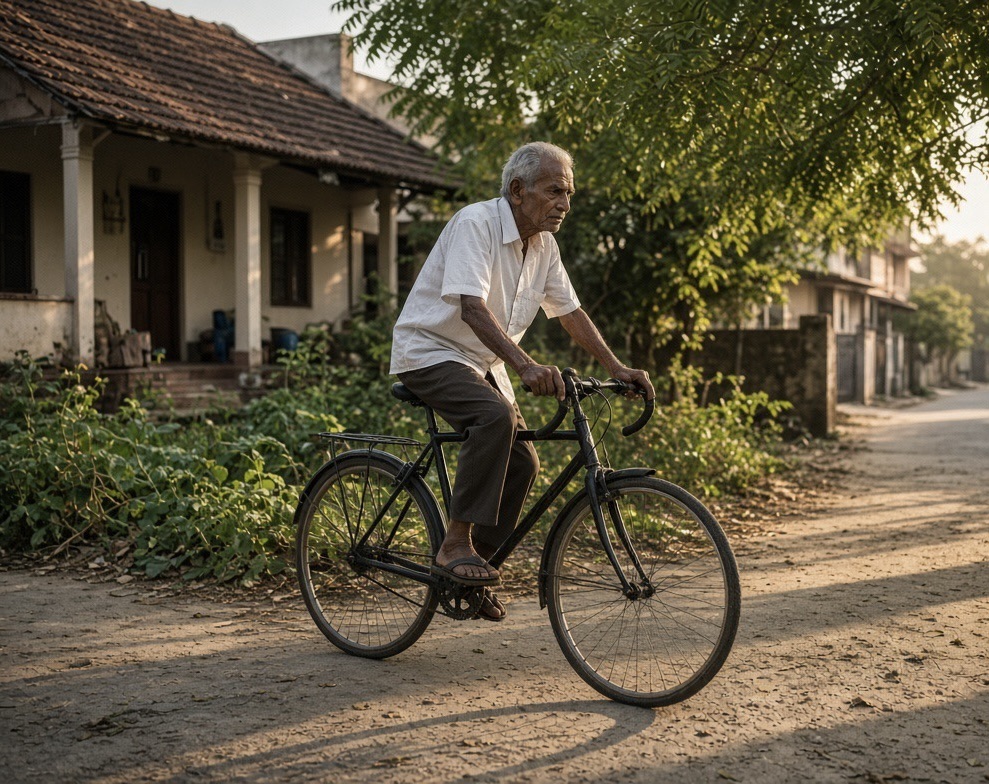
When he was eighty-eight, my younger brother was gifted a brand-new road bicycle. My grandfather did not admire it from the verandah with detached sentimentality. He took it into the driveway, threw his leg over the crossbar, and pedaled down the lane—spindly elbows flared, spine bent, slippers slapping the pedals.
He rode back, wiped grease from his thumbs onto a rag, retrieved an adjustable wrench, and set about truing the handlebars.
There was no grand philosophy in the act, no performance of youthful defiance. Just an eighty-eight-year-old man meeting reality with the basic, irrepressible instinct of an artisan: Let’s see how this works.
He did not obsess over staying young. He simply refused to stop participating.
The Omission in Our Education
Modern schooling is an industrial apparatus engineered for trade. It produces functional economic units capable of analytical rigor, compliance, and capital generation.
Historically, culture provided the counterweight: myth, philosophy, communal rituals, and craft. These were not ornamental distractions; they were survival technologies. They taught an individual how to absorb grief, how to inhabit solitude, how to marvel at beauty, how to age without bitterness, and how to surrender utility without surrendering dignity.
We have refined the machinery of economic training while dismantling the philosophy of living. We produce people who can manage a multi-million-dollar portfolio at forty-five, but who unravel into panic when confronted with an unscheduled Sunday at sixty-five.
We have mastered the mechanics of making a living. We remain illiterates in the art of being alive.
The Wealth That Doesn’t Compound
We have allowed balance sheets to colonize our vocabulary. A home is no longer a sanctuary; it is an asset class. Travel is no longer a pilgrimage; it is an experiential acquisition. Solitary curiosity is hijacked into a monetizable side-hustle.
Capital can bulldoze obstacles, but it cannot seed passion. You can purchase prime acreage, but you cannot purchase the stillness required to watch an orchard bloom. You can buy a bespoke bicycle, but you cannot write a check for the sheer, irrational impulse to ride it down the road at eighty-eight.
Money preserves life’s container. It cannot furnish the interior.
Practicing the Unproductive
To survive the stillness of our later years, we must begin apprenticing ourselves to the unprofitable long before the office door shuts for the final time.
A life needs anchor points that yield zero return on investment:
A craft practiced poorly for the private pleasure of it.
A dialect or instrument that will never be showcased on a stage.
A garden bed weeded by hand.
A stranger assisted without an audience.
A long, aimless walk down an unremarkable road.
The objective is not self-improvement. It is not self-optimization. The objective is simply shedding the compulsive need to justify one’s breath through productivity.
Retiring into Reality
To retire need not mean retreating from the arena into obsolescence.
We step away from employment; we lay down a corporate identity; we surrender the illusion that our worth corresponds to our productivity. But we do not retire from reality.
If the first half of life requires building an armor to survive the world’s demands, the second half grants permission to take the armor off. It is an invitation to unlearn: to wander without a schedule, to speak without calculating leverage, and to become a beginner again without shame.
My grandfather understood that retirement is not an exit corridor. It is the moment the stage lights are cut, letting you step out of the theater and into the open night air.
You arrive with empty hands; you leave with empty hands. The ledger burns at both ends. All that matters is whether you had the courage to live in the house before the lease ran out.
Don’t wait for permission from a pension plan. Practice living lively now.
Leave a Reply